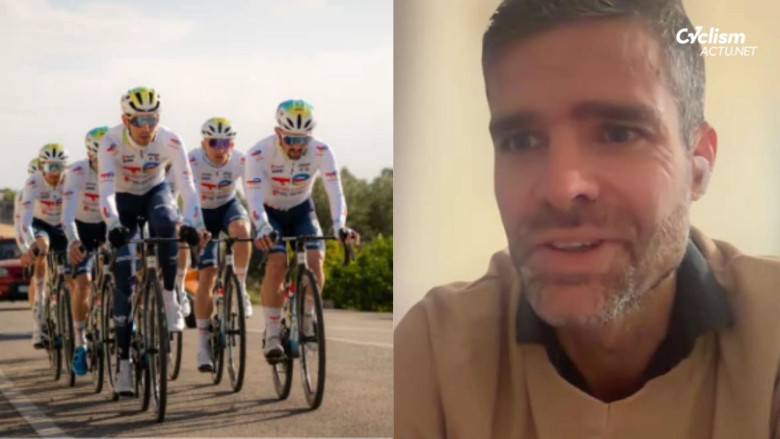
Endofibrosis of the external iliac artery in professional cyclists, Digi Mart USA News: Team TotalEnergies, led by president Jean-René Bernaudeau and general manager Stéphane Heulot, is preparing to unveil its future title sponsor on Tuesday, November 10, at 11:30 a.m., a moment that marks an important chapter for the French team. Meanwhile, the team doctor, Dr.
Samuel Maraffi, answered questions from Cyclism’Actu about external iliac artery endofibrosis, a condition that regularly affects elite cyclists.
Using the recent cases of Célia Géry and Sandy Dujardin, Dr. Maraffi discusses symptoms, diagnostic difficulties, the consequences of surgery and ways to better support athletes.
His clear message is that performance depends above all on health.
Long considered rare, external iliac artery endofibrosis is nonetheless regularly encountered in professional cycling. “When I studied medicine, we were told it was a rare condition.
Practicing in cycling, I would no longer classify it that way,” Dr. Maraffi explains.
Over roughly a decade in the professional peloton, he estimates seeing “at least one or two cases a year, if not more.”
The condition is characterized by the gradual formation of tissue inside the artery, which narrows its diameter and limits blood flow to the leg. Its particularity is that it causes no symptoms at rest.
Pain, burning, tingling or loss of power appear at high intensity and disappear once the effort stops, which is easily confused with ordinary cycling fatigue. “At first, we don’t make the connection: we think it is normal to have sore legs during intense effort,” the doctor notes.
Puncheurs, sprinters and climbers can all be affected, each feeling symptoms during the efforts that most stress their capacities.
The absence of symptoms at rest greatly complicates diagnosis. An ultrasound or conventional scan may reveal nothing.
Doctors sometimes need to reproduce the conditions in which pain appears: the athlete pedals until symptoms return, and physicians immediately measure blood flow. “At that precise moment, on the ultrasound, we observe a drop in blood flow,” Dr.
Maraffi says. These examinations require specialized centers, which remain relatively few.
According to the doctor, the average age at diagnosis is around 26 or 27, in riders who typically cover between 15,000 and 20,000 kilometers a year.
When the condition becomes disabling, treatment is mainly surgical. “It is a major vascular intervention,” he reminds.
For professionals, roughly three months are needed before training resumes, and generally four to six months before returning to competition. Sandy Dujardin, operated on during the summer, was able to organize his reconditioning during the off-season.
An operation in the spring, however, can compromise much of the season.
Can the condition be prevented by changing riding position? Prolonged hip flexion and very aerodynamic positions were long considered important factors.
But the mechanisms are more complex. “Today, we know it is more complicated,” Dr.
Maraffi explains, pointing also to the length and stiffness of the arteries, their attachment to the psoas muscle, and certain inflammatory and metabolic factors. The doctor especially urges caution regarding systematic screening.
“If we ran systematic tests on the entire asymptomatic professional peloton, we would find slightly narrowed arteries in many of them. But people without symptoms should not necessarily be operated on!” Diagnosis should rest on symptoms and their impact during exercise.
In cases of recurrent pain or loss of power at high intensity, he nonetheless recommends consulting a sports physician or a qualified professional, while avoiding excessive worry and listening to the signals the body sends.
Beyond this condition, the doctor details the monitoring of TotalEnergies’ 25 riders. It includes regulatory examinations as well as broader medical support, both physical and psychological, coordinated with the various professionals surrounding the athletes.
“We are not there to guarantee performance, which would open the door to all kinds of abuses, but to guarantee health. A high-performing athlete is above all a healthy athlete,” he insists.
He illustrates the point with a telling comparison: “Some cyclists are ready to spend 200 euros on ceramic derailleur pulleys to gain 1.2 watts at 46 km/h, but hesitate over a 10-euro fee for a vitamin D test or a 50-euro dietitian consultation!” For Dr. Maraffi, the priorities lie elsewhere: eating well, sleeping well and benefiting from appropriate medical follow-up.
“Performance comes through health,” he concludes.