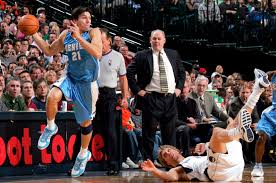
Eduardo Najera Mexico City NBA games Nuggets, Digi Mart USA News (Mexico City): Eduardo Najera wrangled all the talent he could convince to make the trip. It was the summer of 2005, and the Michael Jordan of Mexico was assembling a team of sorts.
The goal was not a gold medal or a championship ring, but something closer to his heart.
“There are a lot of kids that don’t have the means to travel to an NBA game,” he remembers thinking. “So I tried to put up as close as I could to an NBA type of game with a bunch of players.”
He gathered a handful of Nuggets teammates and Denver connections for the inaugural event, a charity all-star game in his hometown of Chihuahua. NBA slam dunk contest champion Jason Richardson was the headliner.
Over the next couple of years, Marcus Camby, Kenyon Martin and JR Smith joined. Najera later organized similar exhibitions elsewhere in Mexico, featuring stars such as Kevin Love, DeAndre Jordan and DeMar DeRozan.
Back in 2005, only one regular-season NBA game had been played in Mexico. Preseason games were a growing trend in the country, but there was no guarantee that teams would play their starters in that setting.
That is why it was important to Najera to bring the NBA home in his own way.
“When I was growing up, we had this huge satellite dish on the roof that you had to move around manually to watch the games,” he said. “Nowadays, all the fans in Mexico have access to it.
There’s more excitement from the younger generations.”
More than 20 years after that first charity game, the Nuggets were in Mexico City on official business this weekend, facing the Indiana Pacers. Neutral-site showdowns are now the norm in the North American city, which has hosted 15 regular-season games since 2015.
Najera, the first and only Mexican-born player drafted in the NBA until this year, has been beaming with pride to see one of his favorite teams in Mexico City for a second consecutive year. His Mavericks visited in 2025.
Najera now lives in Playa del Carmen on Mexico’s east coast and works for the Mavericks as an ambassador to Mexico. But in his 12-year playing career, he appeared in more games as a Nugget (243) than with any other team.
“I gave my whole body, my soul to those two franchises,” he said. “I do identify myself with the Nuggets.
I see a lot of Nuggets jerseys with my name and 21 around the country.”
In Denver, Najera was a hard-nosed role player during the Carmelo Anthony era, a contributor on four playoff teams from 2005 to 2008. In Mexico, he is still regarded as Jordan, even 15 years after his retirement.
Camby used to call him “the king of Mexico” when they were teammates in Denver, Najera remembers.
He is not entirely comfortable with the label, partly out of respect for past generations of Mexican players unknown to NBA audiences, and partly because he has been anxiously waiting to be dethroned. The next great hope is rookie Karim Lopez, who was drafted 16th overall by Memphis this year.
“I think he’s gonna be the best player our country has ever seen,” Najera said. “He’s got it.
Mentally, he’s got the tools. He’s got the size.
He’s got the length. He’s got the athleticism.
But mentally, that’s where I kind of question players. Based on what I’m hearing, he’s got that fire and that motor within that most players lack.”
Basketball was a secondary sport when Najera was growing up in Chihuahua. He played on a beat-up neighborhood court with no net on the rim.
At first, he planned to pursue baseball more seriously, following in his father’s footsteps. But when he tried out for the high school team as a freshman, his coach told him he was too tall and should try basketball instead.
Najera took the advice and proved to be a natural.
“I want to say at 17, I was already dominating. My talent, per se, not necessarily my skill level, was dominating the basketball competition in the country.
I was already so far ahead that I was competing with pro players.”
He had to leave Mexico to take the next step as a prospect. He moved to San Antonio as an exchange student and caught the attention of prominent NCAA coaches, which helped him develop into a more polished, pro-ready player.
His reluctance to anoint himself as Mexico’s greatest of all time stems from that experience. Najera has no way of knowing whether the great talents before him might have found long-term success in the NBA had they received the same opportunities.
“This is why I really understand Michael Jordan’s point of view,” he said. “There are some other players here in Mexico, old-school, like Arturo Guerrero, who I never got to watch play, but I think he’s better than me.
Manuel Raga, I think he was better than me. I think Horacio Llamas was better than me.
I just had a better career. That’s all there is to it.
They had more talent, and again, in Mexico you might not have the same tools as the U.S., or you might be stuck here. I made that sacrifice, went to the U.S., acclimated myself to U.S.
basketball, and then it was easier for me to get to the NBA. These guys would have done the same thing.”
Still, Najera seized the opportunity when it presented itself. He was drafted 38th overall in 2000.
After four years in Dallas and half a season with Golden State, the Nuggets traded Nikoloz Tskitishvili and Rodney White, among other pieces, for him in 2005.
His lasting relationship with Denver is tied to the reminders of home it offered. “Chihuahua is very similar to Denver,” he said.
“It’s surrounded by mountains. It’s about a mile high in altitude.
Kenyon Martin was telling me in Chihuahua, this actually feels like Denver.” Najera still visits Aspen on vacation from time to time, though he has reservations about how expensive the famous ski town has become.
Not long after arriving in Denver, he also realized how meaningful his status as a Nugget was for his exposure back in Mexico. Suddenly, he was surrounded by hugely popular names, from Anthony to Allen Iverson.
“It seemed like my level of recognition in Mexico went to another level,” Najera said.
His most resonant memory as a Nugget is almost 20 years old: the notorious brawl between his team and the Knicks at Madison Square Garden, where Anthony threw a punch and was suspended for 15 games by the league.
What happened next is what Najera remembers fondly. The Nuggets traded for Iverson a few days after the fight, and their season suddenly felt on the brink, even though it was only December.
“I don’t think Melo understood the severity of what he did. That was a year we were supposed to go all the way, and that event took a lot out of everybody,” Najera said.
“It could have deflated us and gone the other way, but at the end of the day, we came together as a strong unit. Melo came back and did what he does best.
We made the playoffs. Even though we did not make it very far, we saved the season.
It took a lot of energy, a lot of mental toughness and emotional intelligence. Otherwise, we would have been crucified by the media.”
He will never forget Iverson’s simple power during a game late that season. The Nuggets needed a win, and their playoff hopes hung in the balance.
They trailed by almost 20 in the first half. Najera, Iverson and Martin were on the floor together, and Iverson huddled them to plead for intensity: “Guys, we’re better than this.” The message was nothing out of the ordinary, but it stayed with Najera, perhaps simply because of whose voice it was.
The Nuggets rallied to win and snuck into the playoffs.
They could never win once they got there, not until after Najera had left. His four years in Denver were marked by first-round losses and a cumulative 3-16 playoff record.
Najera’s dream had been to win a championship, and it did not come true. He left Denver in free agency in 2008, signing a four-year deal with the Nets.
“I did try to give the Nuggets an opportunity,” he said, “but I couldn’t ignore that the offer was pretty good.” The Nuggets did not match it, and they made a run to the Western Conference Finals the following season.
Najera harbored no hard feelings as the rest of his career played out. He says he rooted for the 2009 team from afar.
He was still somewhat haunted by his lack of playoff success in Denver. He wondered how he might have contributed to that 2009 run, which ended two wins short of the NBA Finals.
Najera developed a serviceable 3-point shot late in his time in Denver after coach George Karl challenged his lack of spacing. With that new weapon, he wonders whether he could have helped against Kobe Bryant’s Lakers.
When he retired as a player, Najera reached out to Josh Kroenke “because I kind of wanted to be there for the rest of my life,” curious about job opportunities with the franchise. Nothing materialized, and he ended up with the Mavericks instead.
“Sometimes I regret it when I think about my career there, my four years. We were so good,” Najera said.
“And we had Carmelo really young. At the end of the day, on paper, the roster was supposed to win a championship.
We just couldn’t get through the first round, until I left.”
Denver’s trip south of the border coincides with an ongoing NBA expansion saga that has involved some flirting with Mexico City. The metropolis appears to be on the outside looking in, with Las Vegas and Seattle considered distant frontrunners for the 31st and 32nd teams.
But according to ESPN’s Brian Windhorst, commissioner Adam Silver reintroduced Mexico City at the board of governors meeting in September, perhaps as a leverage play to elicit higher bids for a Seattle franchise.
Najera is biased, but he does not see it that way with Seattle. He likes the dark horse more.
He has been trying to get a team in Mexico for more than a decade. He remembers attempting to convince a wealthy Mexican acquaintance to bid for the Sacramento Kings before they ultimately went to Vivek Ranadive’s ownership group in 2013.
“They thought that I was crazy because basketball was not as big as it is now in Mexico,” Najera said. “Obviously, they didn’t think it would be a good business deal.
Now they’re kicking themselves because they should have done it. Mexico City, or the country, is ready for an NBA team.
It has been ready for quite some time. We just need to get somebody to pull the trigger and really commit to it.”
Najera will likely have to settle for more regular-season games against visiting teams, like Denver and Indiana this weekend. Even that might have seemed unimaginable two decades ago, when he was gathering as many Nuggets as possible for a charity exhibition.
“When I migrated toward basketball, I saw the lack of platforms for the youth,” he said. “Ultimately, I think this is a great thing for boys and girls.”