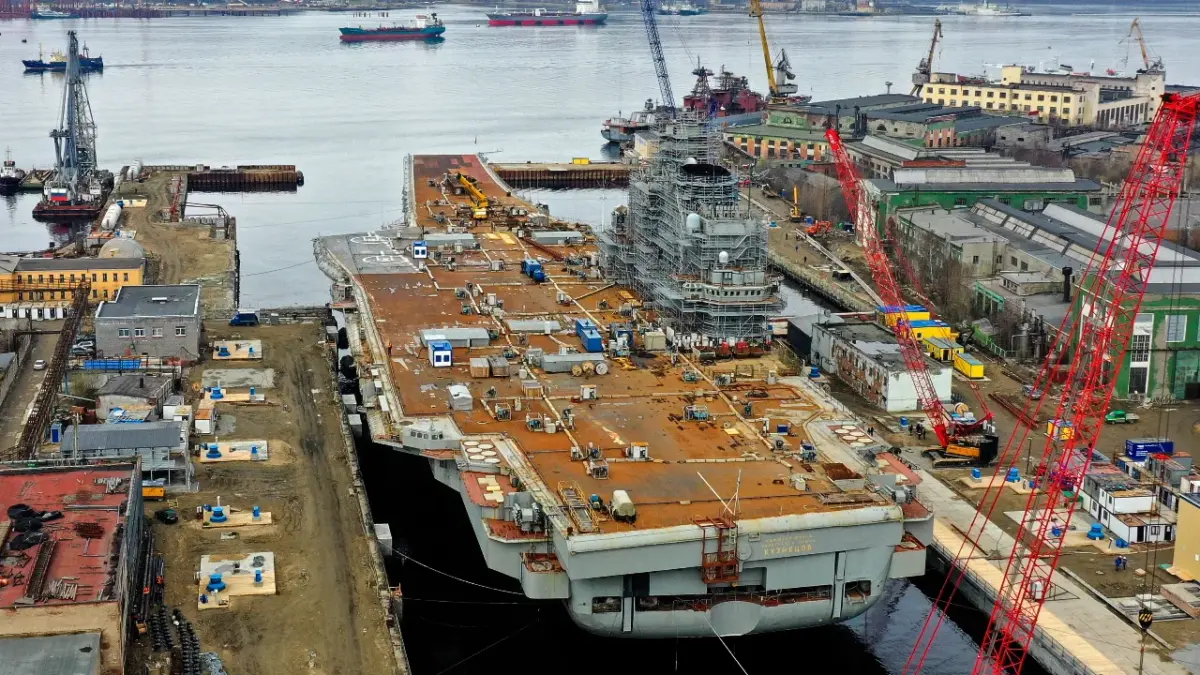
Russia aircraft carrier construction delayed to 2040s as Admiral Kuznetsov remains idle, Digi Mart USA News (Murmansk, Russia): Russia has postponed its ambitions to build new aircraft carriers until the 2040s, a significant delay for a goal the country has pursued for decades.
According to reports from the Polish defense site Obronny, Russia is now uncertain about the fate of its only existing aircraft carrier, the Admiral Kuznetsov. The ship has been standing still in Murmansk for years, and current modernization efforts have stalled.
In 2025, it emerged that Moscow was weighing whether to sell the ship or send it for scrapping. To keep all options open, the vessel has been placed in reserve, allowing usable parts to be recovered or basic hull maintenance to be carried out by a minimal crew.
The current timeline contradicts years of official promises. In 2016, naval officials suggested a nuclear-powered aircraft carrier would be operational by 2030, and President Vladimir Putin endorsed a carrier strike group strategy in 2017.
Although the 2022 naval doctrine emphasized the need for large-ship building capacity, construction never actually began.
In July 2026, Navy Commander Alexander Moiseyev shifted the target period to the 2040s in an interview with the Zvezda network. Although a broader maritime development plan through 2050 was approved in 2025, its details remain secret.
The Admiral Kuznetsov, originally built in the Ukrainian Soviet Socialist Republic, has experienced a series of disasters since arriving in Murmansk. Its maintenance history is marred by the sinking of the PD-50 floating dock in 2018 and fires that broke out in 2019 and 2022.
In addition, the ship’s eight steam boilers must be fully replaced. Although the Sevmash shipyard supplied a specialized floating lock in August 2024 to facilitate dry-docking, some officials argue the effort is pointless.
Andrei Kostin, head of USC, suggested that the exorbitant repair costs could jeopardize the financial stability of the shipbuilding group and divert essential funding from submarine production.
Within Russia, debate continues over the strategic value of aircraft carriers. Sergei Avakyants, former commander of the Pacific Fleet, argues that modern anti-ship missiles have made such ships obsolete.
Analyst Ilya Kramnik, by contrast, maintains that carrier-based aviation is vital, even while acknowledging that the Kuznetsov is unreliable and outdated. The lack of a functioning carrier forces greater reliance on aircraft operating from land.
The conflict in Ukraine has also hindered pilot training. According to USNI, key facilities at Novofedorovka and Yeysk are unusable, and some crew members were reportedly transferred to the front in 2024.
The carrier’s problems reflect a broader pattern of inefficiency in the modernization of the Russian Navy. Several other Soviet-era giants face similar fates: the destroyer Admiral Chabanenko has experienced repeated delays, and the nuclear-powered cruiser Admiral Nakhimov has been under repair since 1999.
In 2026, a commission ruled that renovating the cruiser Pyotr Velikiy was financially unfeasible. Due to these setbacks, the future of Russian naval aviation and the costs of any successor ships remain highly uncertain.