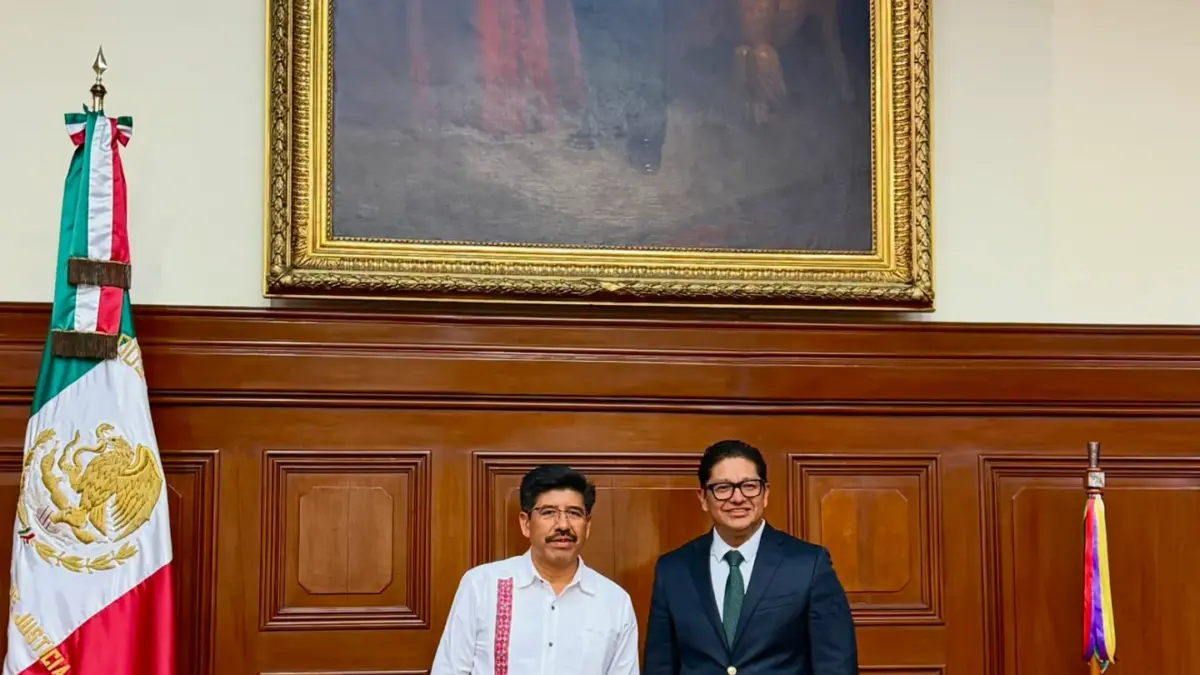
Mexico Supreme Court building history, art and symbolism, Digi Mart USA News (Mexico City): This week, a group of magistrates from the Superior Court of Justice of Oaxaca visited the Supreme Court of Justice of Mexico, accepting an invitation to dialogue between courts. The visit allowed them to learn firsthand about the history preserved in the building at Pino Suárez 2, in the Zócalo of Mexico City, which was constructed between 1936 and 1941.
According to the publisher’s account, the building’s art and symbolism extend throughout its interior and exterior. The account points to its symmetrical forms, the number of its windows, its Art Deco main door of 3.5 tons of polished bronze, roughly 1,500 square meters of murals divided among eight artists, the names of its patios, and the number of steps on each staircase.
The building is described as differing from the colonial-style buildings surrounding it. Its sober, monumental neoclassical exterior is complemented by the Art Deco main door and some interior details, as well as French Eclecticism and the functional rationalism typical of the period.
The murals are the most striking feature. Those by José Clemente Orozco around the Patio de los Pasos Perdidos are described as historic, while those by Raúl Cauduro are noted for their technique and subject matter.
According to the author, Cauduro was given the condition that no one could tell him what to paint or what to hold back, and his works openly reference faults in Mexico’s justice system, including files rotting in storerooms, injustice, corruption, torture, repression and prison overcrowding.
The main door is guarded by Mariano Otero and Ignacio L. Vallarta, the fathers of the Juicio de Amparo, while Manuel Crescencio Rejón is depicted as the building’s absolute guardian.
The author also notes masonic references throughout the tour, including 33 steps leading to the Salón de los Pasos Perdidos and oil paintings of Benito Juárez, including one presiding over the Salón de Plenos, depicting him wearing the white gloves traditionally given to initiates.
The author concludes that historic buildings preserve more than history, housing art and culture that reflect the ideology, tastes and preferences of the political class that placed them where they stand.