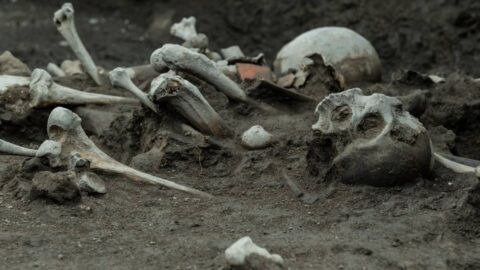
Mexico City-Querétaro passenger train excavation uncovers human remains and pre-Hispanic artifacts, Digi Mart USA News (Mexico City): Specialists from Mexico’s National Institute of Anthropology and History (INAH) have discovered a deposit of human remains that may correspond to an ossuary during archaeological rescue work along the route of the Mexico City-Querétaro Passenger Train, near the Buenavista terminal in the capital.
Based on its characteristics, the find may date to the Late Postclassic period (1200-1519 AD) or to the period of contact with the Spanish (1519-1535 AD).
The discovery occurred on September 17, 2026, during embankment work for the railway track, when the first bone remains were located. Excavations then continued under INAH supervision as part of an archaeological rescue project.
At a depth of 1.40 meters, skulls, jaws, hip fragments, femurs, ribs and teeth were found. At a lower level, the possible ossuary was identified, made up of human remains without anatomical relationship, which points to a funerary deposit.
So far, specialists have counted nine skeletons, two of which show cranial modifications, along with five jaws and large bones, including radii, tibias and iliac bones, which are in good condition.
The characteristics of the cranial modifications, as well as the age and sex of the individuals, will be determined through analysis at the Physical Anthropology Laboratory (LAF).
Ceramic pieces associated with the Aztec III period (1350-1520 AD) were recovered together with the human remains, mainly household objects such as plates, pots and salt containers, the latter used for salt extraction in the former Lake Texcoco.
The archaeological assemblage also includes seven miniature spindle whorls, two figurines and polished stone tools, among them four fragments of metate hands and mortars, as well as blades made mostly of green obsidian, possibly from the Sierra de las Navajas deposit in Hidalgo.
Another notable element of the find is its proximity to the Church of San Miguel Nonoalco, a 16th-century building that functioned as a visiting chapel of the Franciscan friars of the Convent of Santiago Tlatelolco.
According to specialists, the remains provide information about the funerary practices of the period. Although ossuaries identified in Mexico City are often associated with the viceregal period or the contact period, the presence of pre-Hispanic materials in this deposit opens new possibilities for establishing its dating and context.
After being recorded at the site, the materials were transferred to the project’s physical anthropology, lithic and ceramics laboratories, located in Tula de Allende and Tepeji del Río de Ocampo, Hidalgo, where they will undergo cleaning and restoration before analysis and storage.