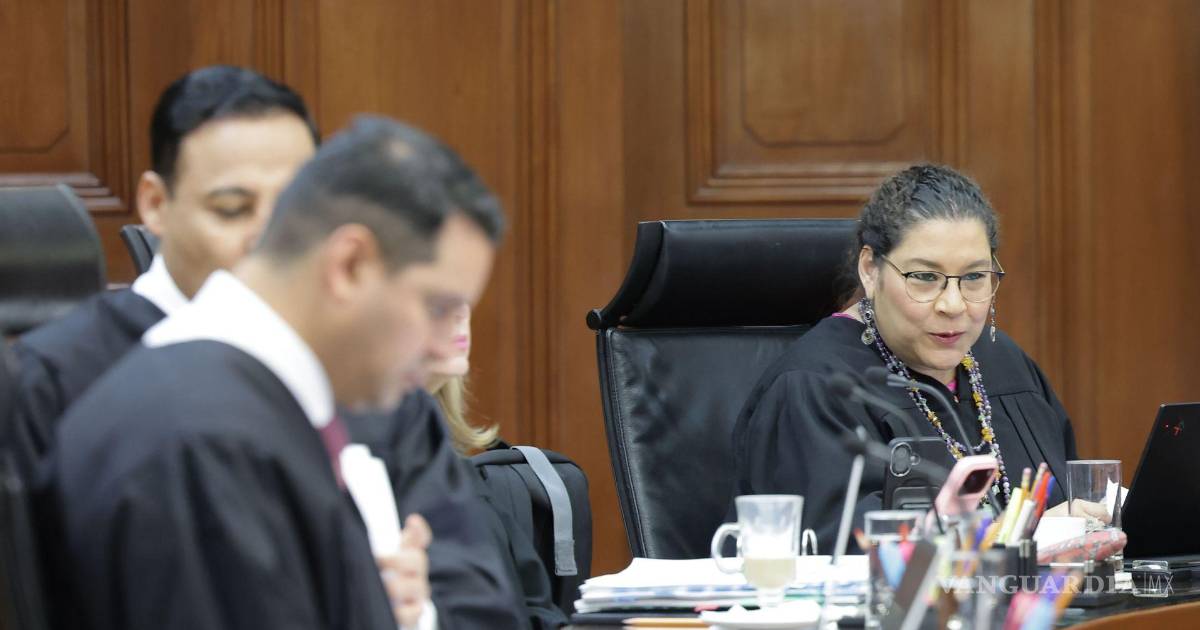
Lenia Batres and Hugo Aguilar tense exchange at Mexico’s Supreme Court, Digi Mart USA News (Mexico): Supreme Court Justice Lenia Batres Guadarrama and the president of Mexico’s Supreme Court of Justice of the Nation (SCJN), Hugo Aguilar Ortiz, clashed again during Monday’s plenary session over the order of interventions during discussion of a draft proposal by the justice, who warned of animosity between them.
The dispute began with a draft Batres presented concerning an intellectual property case, which some justices described as “contradictory.” Batres linked the discussion to the succession in the Court’s presidency, stating that “perhaps draft proposals will have to be presented only after the decision next year on the Court presidency, because otherwise it will be impossible for us to explain anything.” She said the proposed deadline is three months, under the Federal Law of Administrative Procedure.
Batres became upset twice. The first time was when Justice Arístides Guerrero insisted that certain considerations he had sent to the reporting justice be included in the final version of the case, which she accepted.
Justice Giovanni Figueroa then asked for clarification of the effects of the decision the reporting justice proposed. Amid a struggle over who had the floor, Aguilar Ortiz intervened, and Batres demanded that he give her the floor, but was unable to speak because of constant interruptions.
With her arms crossed, Batres complained in a reproachful tone: “You tell me, minister, if you want to give me the floor, the day you choose.” The president of the SCJN asked Batres to take the floor, saying his intention was not to give priority to the minister, but to ask her to explain her reasons herself.
The discussion flared again when Justice Yasmín Esquivel insisted that the draft was contradictory. “It seems our drafts are read in a somewhat strange way,” Batres told Esquivel.
A recent reform to the judiciary, sent on May 20 to the Permanent Commission of the Congress of the Union and published on June 2, left a constitutional contradiction that could call into question Batres’s accession to the Court presidency on September 1, 2027. The contradiction stems from two constitutional articles, 94 and 97, that set different periods and mechanisms for renewing the Court’s leadership.
Article 94 provides for the presidency to rotate every two years according to the votes each candidacy receives, while Article 97 requires the plenary to elect its head every four years and prohibits immediate re-election. The reform postponed the corresponding election until 2028 but did not harmonize the federal provisions governing the presidency, so the Pleno may have to decide which provision applies if Congress does not correct the contradiction.