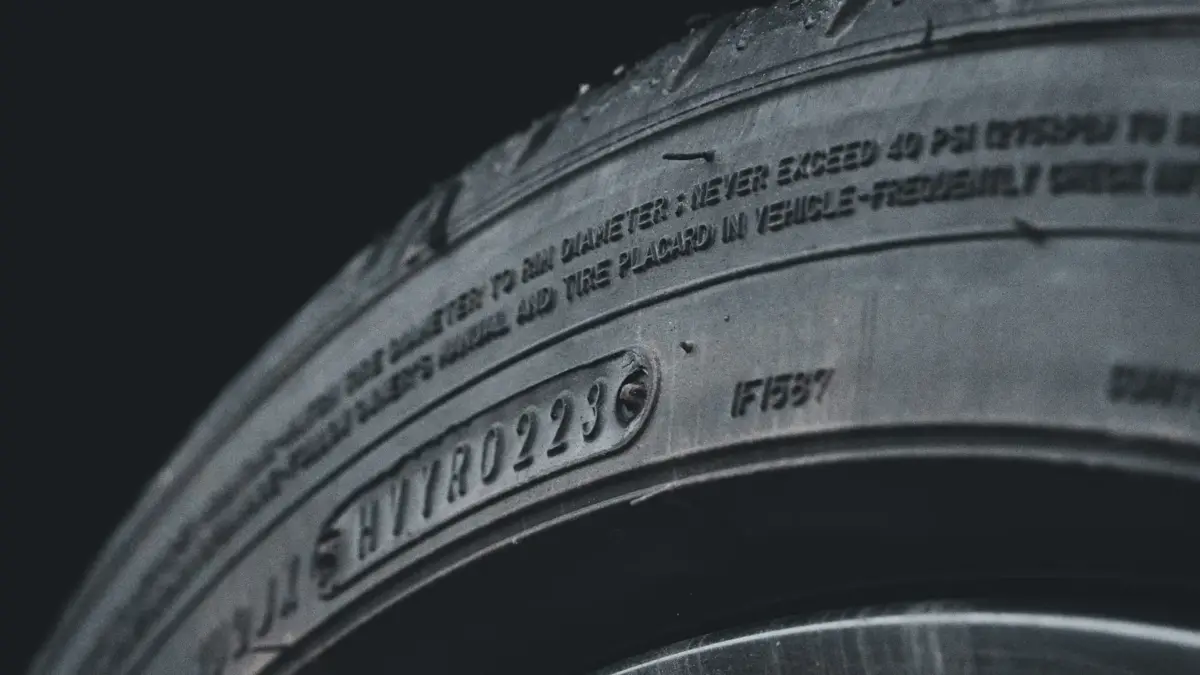
motorcycle tire aging in France, Digi Mart USA News (France): A motorcycle tire can be sold as new even after five years of storage, and no French regulation sets an age limit beyond which riding becomes prohibited. The technical inspection does not examine the manufacturing date either, so a tire can remain legal as long as its tread stays above one millimeter.
Most riders judge tire condition by tread depth, assuming that as long as rubber remains, all is well. That logic is incomplete, because wear and aging are two distinct phenomena that progress independently.
A tire can show intact tread while undergoing irreversible chemical changes, which is the hardest condition to detect.
A motorcycle tire is a compound of natural and synthetic rubbers, reinforcing materials, oils and chemical additives. Oxygen, ultraviolet light and heat attack these components over time, altering their molecular structure.
The rubber gradually loses elasticity, microcracks appear, and the tire’s ability to perform its role declines.
The rubber is not defenseless, however. The compound contains waxes and antiozonant agents, including 6PPD, which slowly migrate to the surface and form a film that captures ozone before it reaches the rubber.
The brown haze that sometimes stains a sidewall is this product oxidized at the surface, which means the protection is working rather than indicating a defect.
This protective reserve is locked in the rubber in finite quantity, and it is consumed by reacting with ozone and oxygen in the air, whether the motorcycle is ridden or not. A machine left in a garage for six months uses up part of it without moving.
Collectors, owners of several motorcycles and seasonal riders are therefore the most exposed: their tread remains new while the chemistry declines.
Two tires manufactured the same day do not age at the same rate. A tire stored in a cool, dark room lasts far better than one left in the sun on a parking lot, exposed to temperature swings and humidity.
Incorrect inflation pressures and excessive loads accelerate degradation further, and part of the change remains invisible, since the tread can look perfect while the internal compound deteriorates.
There is no universal expiration date for a motorcycle tire, and the ten-year figure often repeated is not based on any public measurement. Continental itself states that an exact prediction of a given tire’s service life in chronological terms is not possible.
The benchmark is a manufacturer precaution, not the result of a test showing that something changes at ten years.
Independent work does exist. In the early 2000s, the U.S.
National Highway Traffic Safety Administration launched a program on tire aging because the industry lacked a uniform approach. Three methods were compared before oven aging was selected: tires inflated with oxygen-enriched air and held at high temperature, followed by endurance testing.
In its 2014 report, the agency still had not set a pass or fail criterion for this test.
What manufacturers are willing to put in writing is another matter. Continental, in its section on two-wheelers, acknowledges that an unused, properly stored tire aged up to five years may be sold as a new tire and put into normal service, unless local regulations say otherwise.
It specifies that the warranty runs from the purchase date rather than the manufacturing date, and recommends replacing any tire older than ten years.
Michelin, for its part, gives two instructions that are sometimes seen as contradictory: a professional check every five or six years on one hand, and a thorough inspection at least once a year on the other. The two do not conflict, since the pages address different stages: the first covers a tire in ordinary service, the second the period beginning after five years.
Both documents, however, concern cars rather than motorcycles.
The French motorcycle technical inspection standard is public and can be read in a few minutes. Point 5.2.3 of Annex I to the order of October 23, 2023 covers tires in five lines: rubbing or risk of rubbing against a flexible element, non-compliant size or load and speed index, abnormal or uncontrollable pressure, worn, damaged or cut tires, and the same defect aggravated to the point of constituting an imminent safety risk.
What this list does not contain is worth noting. Neither age, manufacturing date nor the DOT code appears in it, and no other line of the annex mentions them in relation to tires.
An inspector therefore has no basis for refusal based on the calendar. A fifteen-year-old tire whose tread is intact and whose appearance reveals nothing passes the inspection without objection.
The nuance lies in one word: damaged. Clearly visible cracks on a sidewall can fall into that category and count as a major defect, or even a critical one if they become deep.
Aging remains detectable through its effects, never through its date. As long as it is not visible, it is not penalized, which is precisely why the owner’s visual check is irreplaceable.
The practical tool is engraved on the sidewall: the DOT code. This marking comes from U.S.
regulation, which requires a thirteen-character identification number whose last group of four digits gives the week and year of manufacture. Week 01 is the first complete calendar week of the year, Sunday to Saturday.
A code ending in 2221 therefore means the 22nd week of 2021, at the start of June.
The code must still be visible. The regulation requires the full number on only one sidewall, and nothing guarantees it will be the side facing outward once the wheel is mounted.
If the code cannot be found, the other side must be inspected, with the motorcycle on its stand and the wheel turned by hand, or the fitter consulted. On a machine built before 2000, the group has only three digits and the decade can no longer be read.
This check takes thirty seconds and can change a purchase decision. Before buying a set of tires, especially if the price looks unusually attractive, it is worth checking these four digits and asking about storage conditions.
The same check applies to tires already mounted on a used motorcycle: a good-faith seller will give the date without difficulty, while a refusal or hesitation deserves attention.
The arithmetic is unambiguous. Five years used up of the ten manufacturers recommend means half of the calendar service life is paid for at the price of new.
The law does not help the buyer much: the French Consumer Code requires the seller to disclose the essential characteristics of the goods before purchase, without defining that phrase or citing the manufacturing date. Nothing obliges the seller to announce it unprompted.
The conditions in which a motorcycle is kept influence tire aging as much as its raw age. A machine parked on its center stand, in a room sheltered from sun and temperature swings, keeps its tires in a noticeably better state than one left outside or in an uninsulated garage.
Ultraviolet exposure and cycles of heat and cold exert constant chemical pressure on the rubber compounds.
Prolonged parking on a hard surface also creates flat spots and localized deformation. For long winter storage, workshop stands that lift both wheels off the ground remain the most effective precaution, since the center stand only relieves the rear.
A tire that spent the winter flat on concrete may reveal itself through vibration on the first spring ride.
Without a workshop stand, the remedy comes down to three steps: inflate above the usual running pressure before storing the machine, workshops recommending two to five tenths of a bar more depending on whether it rests on its center or side stand; slide a board between the tires and the concrete; and move the motorcycle a few centimeters each month.
Since no manufacturer publishes a storage pressure, these values come from workshop practice.
Riding habits also play a role in the equation, but in a different way: sudden acceleration, aggressive braking and incorrect pressures accelerate mechanical wear, while prolonged immobility and poor storage accelerate chemical aging. The two processes can coexist, but they do not offset each other.
Visual checks should systematically cover several points: cracks on the sidewalls or in the grooves, cuts, bulges, embedded foreign objects, uneven wear and tread depth. If anything looks doubtful, a professional inspection is warranted rather than hoping another season will be fine.
Certain dynamic signals should also prompt immediate action: behavior that differs from the usual, unexplained vibration or repeated pressure loss justify an immediate check. These symptoms can reveal internal damage that cannot be seen on the surface.
One final benchmark, this one legal. In France, tread depth is measured at four points around the circumference and must not fall below one millimeter at more than one point in four, a rule set by Article R314-1 of the Highway Code and the order of July 18, 2019.
Below that, the offense is a fourth-class fine, with possible immobilization of the vehicle.
At five years of manufacture, an annual professional inspection becomes essential. At ten years, replacement is recommended regardless of how the tire looks.
And before any purchase, new or used, the four digits on the sidewall provide information that neither the seller nor the price can replace.