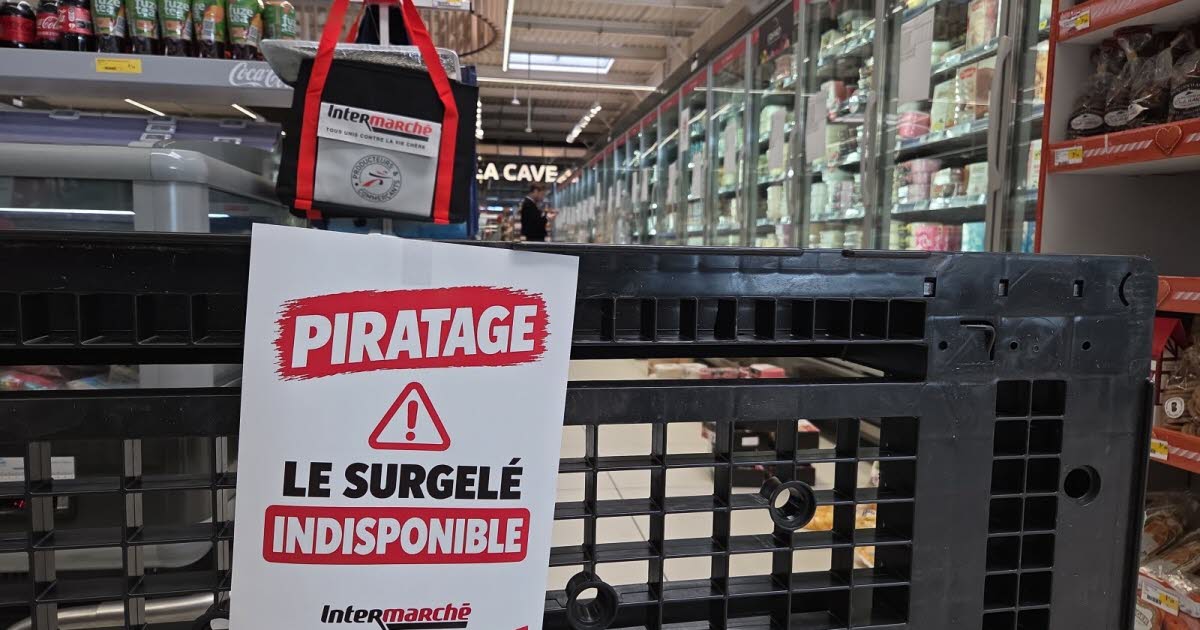
Iran cyberattack on French supermarket refrigeration systems, Digi Mart USA News: Tensions between France and Iran have escalated further following a cyberattack that disabled refrigeration systems at 700 supermarkets. Relations between the two countries have been very poor since the start of the war in the Middle East.
France has accused Iran of responsibility for the attack, which occurred in October and caused the refrigeration systems of 700 supermarkets to fail. Several butcher shops, a slaughterhouse, food cooperatives and small hydroelectric units were also affected, resulting in losses of several tens of millions of euros in merchandise.
The government has described the attacks as the “first cyber-offensive campaign carried out purely for sabotage purposes on national territory.”
The attacks follow renewed tensions between France and Iran. “There has been a deterioration in bilateral relations.
A French diplomat was assaulted and the French language center in Tehran was closed,” said Clément Therme, a researcher specializing in Iran. “Historically, France has been designated as an enemy by the Islamic Republic.
It was the ‘little Satan’ during the Iran-Iraq War,” recalled Therme, author of Demain l’Iran.
France is in the crosshairs because it defended its Gulf allies when they were attacked by Iran. “It is perceived as the junior partner of the United States,” Therme said.
“The regime is sending a fairly clear deterrence message by saying that Europe will become a battlefield in the event of new Israeli-American strikes on Iran.”
In 2024, Iran was already behind a cyberattack that attempted to display messages denouncing the participation of Israeli athletes on video terminals at the Paris Olympic Games, without success. “What is new is that Iran is targeting civilian infrastructure such as supermarkets rather than the Jewish community,” Therme noted.
“The aim is to cause economic losses and create a kind of latent psychosis. The Iranians are capitalizing on the disorder France is currently experiencing,” added Pierre Pahlavi, professor at the Royal Military College of Canada.
Another cyberattack targeted cold rooms of the French Blood Establishment three weeks later, without loss of blood products and with no proven link to date to the previous attack. The same night, supermarket refrigerators were targeted in about ten European countries, but it is not known whether these attacks are linked to those in France.
Iran has rejected what it called “unfounded accusations.” France’s reaction has been very firm. The Iranian ambassador has been summoned, and France says it “rules out nothing” in its response to Iran.
This marks a change in tone, as destabilization operations had previously been handled discreetly. Emmanuel Macron reportedly opposed the publication of a report on Iranian cyberactivism, according to La Lettre.
The C4, the national cyber crisis coordination center, published a detailed report pointing to Iran and the Shahid Kaveh unit, which depends on the Islamic Revolutionary Guard Corps. The Iranian hackers left traces, including IP addresses located in Iran and words in Farsi, the country’s language.
According to Nextgov, France collaborated with U.S. authorities investigating cyberattacks attributed to Iran that affected refrigeration systems at food stores located on several U.S.
military bases.
Pierre Pahlavi, deputy director of the Defense Studies Department at the Royal Military College of Canada, analyzes Iran’s motives in the cyberattack on French supermarket refrigerators. The professor, who teaches at the Canadian Forces College in Toronto, warns of the possibility of attacks with more serious consequences because Iran has invested heavily in building an offensive cyber apparatus.
Why is France targeted by Iran?
“Rightly or wrongly, Iranian leaders have long considered France to be one of Israel’s main supporters. This perception persists despite the more nuanced positions Paris has adopted on the Palestinian question and French diplomatic efforts to distance itself from the more radical approaches of Washington and Tel Aviv.
In the Iranian strategic view, France belongs to the Western camp hostile to the Islamic Republic. Bilateral tensions related to Iran’s nuclear program, the activities of the Islamic Revolutionary Guard Corps and French support for Iranian civil society reinforce this hostility.”
What is Tehran’s objective through the destruction of food products?
“In an asymmetric logic, the Iranians have understood that it is not necessary to defeat an adversary militarily in order to make it pay a political price. Disruptions in the Strait of Hormuz and their repercussions on oil prices have shown Tehran’s ability to make the consequences of a distant conflict felt in the wallets of Western consumers.
In the case of French refrigerators, we are facing a form of ‘cold war.’ The implicit message is fairly simple: even far from the Middle East, Western societies are not immune to Iranian retaliation.”
Is this a sign of a regime under pressure, severely weakened economically and militarily?
“Yes, but we must avoid confusing weakness with powerlessness. Iran is going through an extremely profound economic and social crisis.
The resort to cyber warfare is revealing. Unable to impose a favorable balance of power on a conventional battlefield, Tehran is seeking to shift the confrontation to areas where its adversaries are more ‘reachable.’ A relatively inexpensive cyberattack can cause millions of euros in damage and produce a disproportionate psychological effect.”
Does Iran have the means to do even more harm?
“For more than 15 years, the Islamic Republic has invested heavily in building an offensive cyber apparatus. Iran is now among the first circle of powers capable of carrying out sophisticated cyber operations.
The Revolutionary Guard Corps has become a master of ‘spectacular cyberattacks,’ operations also aimed at striking the public imagination. Even more worrying, the ability to identify vulnerable equipment on a large scale opens up prospects for sabotage far more serious than the simple destruction of food supplies.”
Is it possible that Iran is acting on behalf of Russia, as part of Russia’s strategy to destabilize French society?
“This is a hypothesis that must be taken seriously. Russia and Iran share a series of adversaries and strategic interests.
Both seek to weaken Western cohesion and make Western societies pay the price of their international commitments. France, notably because of its support for Ukraine, is a privileged target for Moscow and a relevant target for Tehran.
This convergence encourages intelligence exchanges, technical rapprochement and, potentially, certain forms of cyber cooperation.”