Armistice Day 2026 war memorials and Morts pour la France in the Pays d’Ouche region, Digi Mart USA News (Pays d’Ouche, Normandy, France): In November 2024 and 2025, L’Éveil Normand published several articles about soldiers from the Bernay area (Eure) who died in the Great War. This year, the publication visited the Pays d’Ouche, including Bois-Anzeray, La Barre-en-Ouche, La Haye-Saint-Sylvestre, La Roussière and Le Chamblac, recording the names of several poilus and other soldiers who died for France in 1940 or in Cochinchina.
November 11 is an important date in France. It marks November 11, 1918, the armistice that ended the First World War, and the 2026 anniversary falls on the same date.
The armistice anniversary was adopted as a public holiday in 1922, and ceremonies take place at war memorials in towns and villages across the country.
The first stop was Bois-Anzeray, a small village near the Orne border. Its stone obelisk-style memorial stands near the church and bears the inscription “À nos Morts pour la Patrie.” Ten soldiers from the First World War are named on it, including Captain Roy Poulet, born in Paris in 1880 and killed at Verdun on June 23, 1916, assigned to the 245th Infantry Regiment.
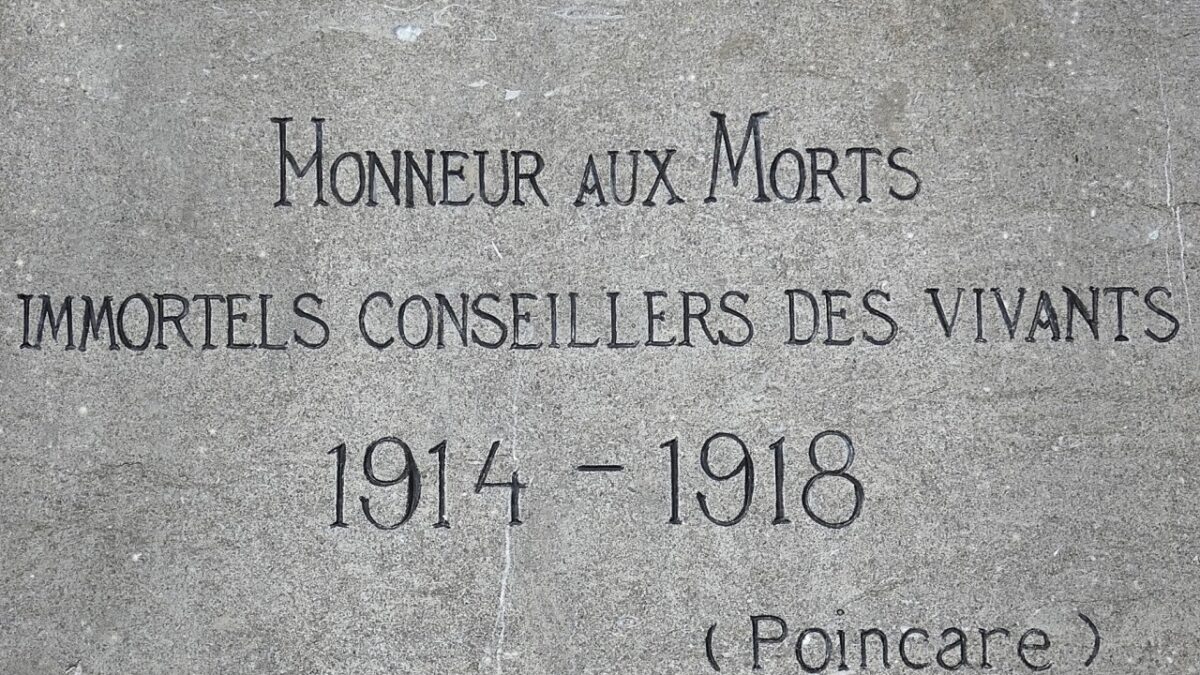
In La Barre-en-Ouche, in the commune nouvelle of Mesnil-en-Ouche in the Eure, the memorial stands on the square near the former gendarmerie. Its inscription reads “Aux soldats de La Barre Morts glorieusement pour la France,” with a quotation from Raymond Poincaré.
The monument, topped by a victorious rooster, was funded by the generosity of residents and bears the names of thirty poilus, four soldiers from the May–June 1940 fighting, and Jean Baziret, killed in an ambush in Cochinchina in 1947. His remains were repatriated to Fréjus in 1986 or 1987.
In La Haye-Saint-Sylvestre, a classic pyramid memorial stands at the village crossroads, inscribed “Gloire à nos morts 1914-1918.” It bears eleven First World War names and two soldiers from 1939–1940. A stele honors U.S.
pilot Lt. John Harber, and six graves of soldiers listed as Morts pour la France are in the churchyard cemetery.
The route continued to La Roussière, a village known for the autumn fog that inspired writer Jean de La Varende. Its memorial, to the right of the cemetery entrance, lists eighteen poilus and four soldiers from 1939–1940.
A damaged enamel plaque with photographs of the soldiers sits at its base. The source notes that the village lost a large number of soldiers in 1940, including Marc Maurice Henry, born in 1917, who was killed in the Luftwaffe bombing of Évreux on June 9, 1940.
The pilgrimage ended at Le Chamblac, home of Jean de La Varende, who served as a stretcher-bearer and orderly with the 18th Infantry Regiment from 1914 to 1919. His writing was deeply shaped by that experience.
The village memorial, opposite the cemetery, is inscribed “À nos morts pour la patrie” and lists thirteen poilus and one soldier from the Second World War. An additional plaque names Louis Chanu, died October 19, 1918, Robert Pellerin, died October 7, 1918, and Marcel Marchand, died August 22, 1914, at Anderlues, Belgium.
Louis Eugène Chanu, born in Broglie in 1886, is buried in the cemetery. He was killed in action twenty days before the armistice, at Oiry in the Marne, and was a first-class private with the 21st Colonial Infantry Regiment.
The article’s research was based on the Mémoires des Hommes and Geneanet databases.