Joburg mine tailings radiation risk, Digimart Global (Gauteng, South Africa): A million or more people living in Gauteng’s former goldfields face potentially serious health and environmental risks from radioactive mine tailings and poorly managed mining waste, according to environmental experts who are calling for urgent intervention. Eco-activists and mining experts say abandoned, ownerless and inadequately rehabilitated mines are exposing residents to potentially hazardous substances, including uranium and other heavy metals.
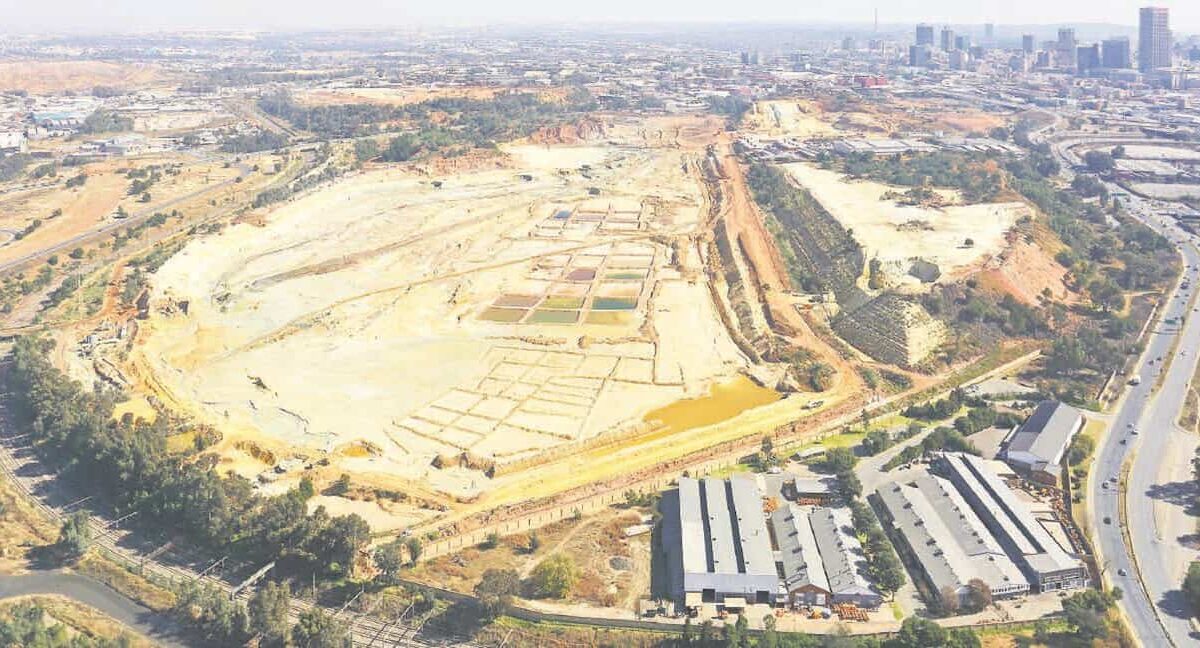
Mariette Liefferink, an expert at the Federation for a Sustainable Environment (FSE), told eNCA that most mine residue deposits in the region are radioactive because gold ore naturally occurs alongside uranium. She said Joburg’s mining belt has about 270 mine dumps covering an area of 400 square kilometres, along with tailings storage facilities, some of which are being reclaimed, which she estimated contain about 600 000 tons of uranium.
Liefferink said radioactive material has historically migrated from mine dumps into surrounding wetlands, and that some mine tailings have been used as construction material. Investigations by the Council for Geoscience had identified elevated radioactivity in large parts of Johannesburg’s CBD, with wetlands also affected.
She said many radioactive hotspots have no access control, fences or warning signs.
According to Liefferink, uranium poses radiological and chemical health risks, with exposure potentially contributing to kidney damage and other complications. Much of the radioactivity is linked to radon gas, which is released continuously as uranium-238 and radium-226 in exposed, unlined dumps decay.
Estimates cited in the report suggest about 1.6 million people in Joburg and the West Rand live directly next to, or on top of, these radioactive dumps, despite mining guidelines recommending a 500-metre buffer zone around tailings.
Radon can seep through foundation cracks and accumulate inside homes and schools, particularly during cold Highveld winters when windows remain closed. The Cancer Association of South Africa states that inhaling radon gas products damages lung tissue and dramatically increases cancer risks, especially for smokers.
Radon is also described as a group 1 carcinogen and the second-leading cause of lung cancer globally.
Liefferink criticised regulatory gaps, arguing that the National Nuclear Regulator (NNR), established under the National Nuclear Regulator Act of 1999, has interpreted its mandate narrowly and mainly deals with radioactive waste on licensed sites. She said contamination outside these sites is inadequately regulated, that the department of environmental affairs does not regulate radioactive waste, and that the NNR faces capacity constraints in enforcing rehabilitation requirements.
Mining expert David van Wyk said communities near abandoned and poorly managed mines along the Main Reef Road corridor, from Springs in the east to Westonaria in the west, face serious health and environmental risks. He said the waste contains substances including uranium, lead, arsenic, silica, cadmium, strontium, copper and iron, most of which he described as carcinogenic, and called for mining companies to be held accountable for failing to close and rehabilitate sites.
Van Wyk also said spatial apartheid placed most townships, including Soweto, on the wrong side of this mine waste.
Mazi Choshane, an attorney at the Centre for Environmental Rights, said the department of mineral and petroleum resources (DMPR) needs to strengthen oversight and enforcement of rehabilitation obligations. She warned that transfers of mining rights should not become a way for companies to escape accountability, noting that larger companies often sell rights to smaller operators that may lack the financial and technical capacity to rehabilitate decades of damage.
The DMPR did not respond to questions by the time of publication.