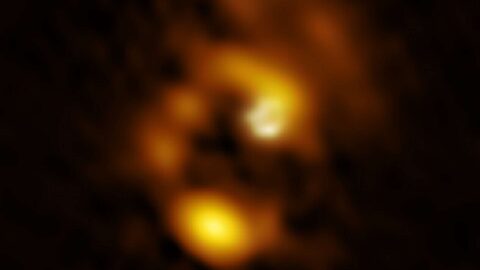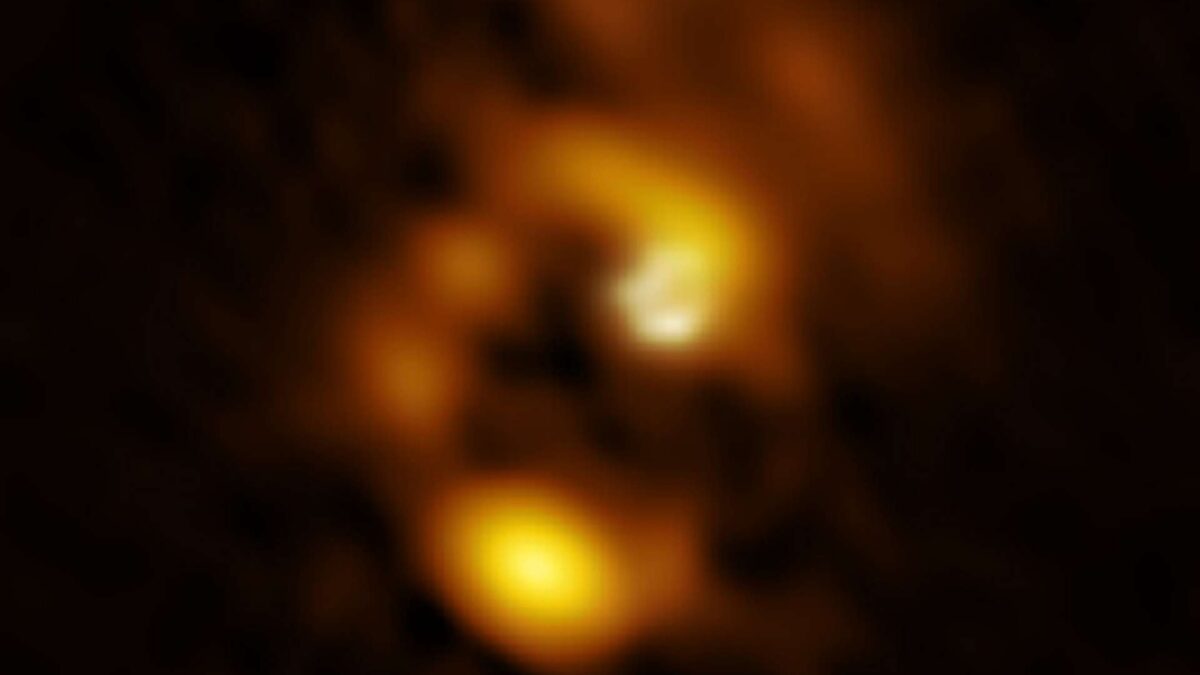
Mira Ceti red giant, Digimart Global: Mira Ceti, a red giant star about 330 light-years from Earth in the constellation Cetus, has shown behaviour that astronomers did not expect. Data from the Atacama Large Millimeter/submillimeter Array (ALMA), a radio telescope complex in Chile, show a huge loop of material thrown out from the star.
The loop extends up to 10 astronomical units from the star’s surface, a distance equal to the gap between the Sun and Saturn. The star was named “the marvellous” in 1662, when it was the first pulsating variable star recorded by astronomers, whose brightness cycled roughly every 333 days without a known explanation.
Repeated observations over the centuries have shown that red giants like Mira Ceti are near the end of their lives and shed their outer layers into space. Astronomers had long believed this stellar wind was continuous and moderate, with light pressure pushing dust grains away from the surface.
The scale of the new ejection, however, suggests a stronger mechanism is at work. Researchers from Chalmers University of Technology in Sweden, writing in the journal Astronomy & Astrophysics, argue that the process is probably linked to the star’s magnetic field.
In their account, magnetic flares may account for most of the mass the star loses, supported by the repeated appearance and disappearance of hot spots like the one seen by ALMA.