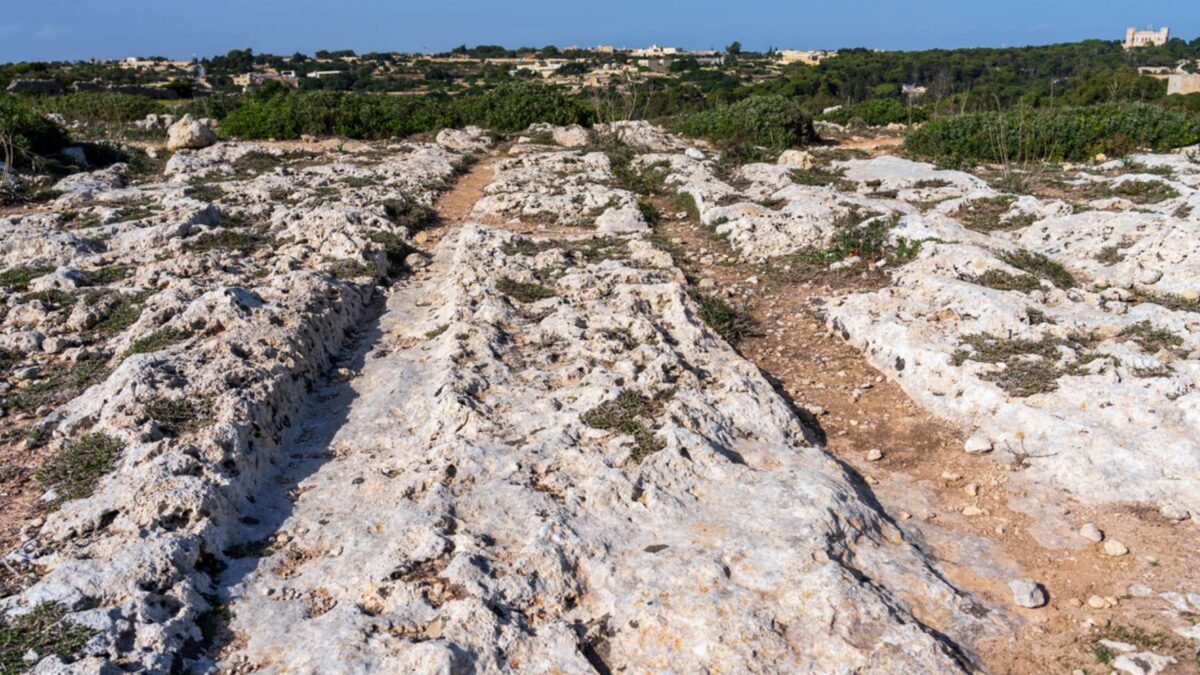
Malta ancient wheel ruts, Digimart Global (Malta): Deep grooves cut into the limestone of Malta have puzzled visitors and researchers for centuries, fuelling theories that ranged from an antediluvian civilisation to the Bronze Age. A new study now argues that most of these ruts are Roman rather than prehistoric.
The research was led by Joel Grima, a researcher at the University of Malta, and published in 2026 in the Journal of Archaeological Science: Reports. According to the source article, it is the most extensive survey of these ruts carried out so far.
Grima recorded 2,628 distinct traces on Malta and Gozo, totalling about 50 kilometres in combined length.
Because bare limestone does not preserve datable sediment inside a groove, researchers have to date the ruts from the layers above and below them. Grima used several types of cross-evidence.
At Mdina, a pair of ruts runs along a street lined with Roman houses, with seven layers of Roman road surface built up above the bare rock. At Marsa, an 1794 drawing shows grooves cut into the entrance slabs of a Roman warehouse that has since been demolished.
Quarries provide further evidence. According to the study as reported, quarries cut across ruts at 112 separate locations, and ruts wear down quarry floors at 17 other points.
Seven Punic or Roman tombs also cross ruts, which earlier authors had read as proof that the grooves were very old. Grima reverses that argument, noting that the Romans buried their dead along roads and that abandoned tracks existed alongside active routes.
The article also addresses the sea-level and erosion questions often raised about the ruts. It says sea level around Malta has risen by about 1.20 metres over 2,000 years, which it presents as enough to explain a rut that appears to run toward the sea at Birzebbuga, and that cliffs retreat by several millimetres a year, so no extraordinary timespan is needed to explain collapsed sections.
Grima does not claim to rule out every prehistoric trace, but the source states that no site yet provides solid proof of one. The next step, according to the article, would be laboratory dating of materials trapped in the fill, which has not yet been attempted on Malta.