Thales quantum technologies, Digimart Global (France): Quantum technology is moving beyond computing, according to a publisher report on work at French group Thales. The company is developing quantum-based innovations for aerospace, defence, medicine and telecommunications, drawing on about one hundred experts and collaborations with the CNRS and the Albert-Fert laboratory.
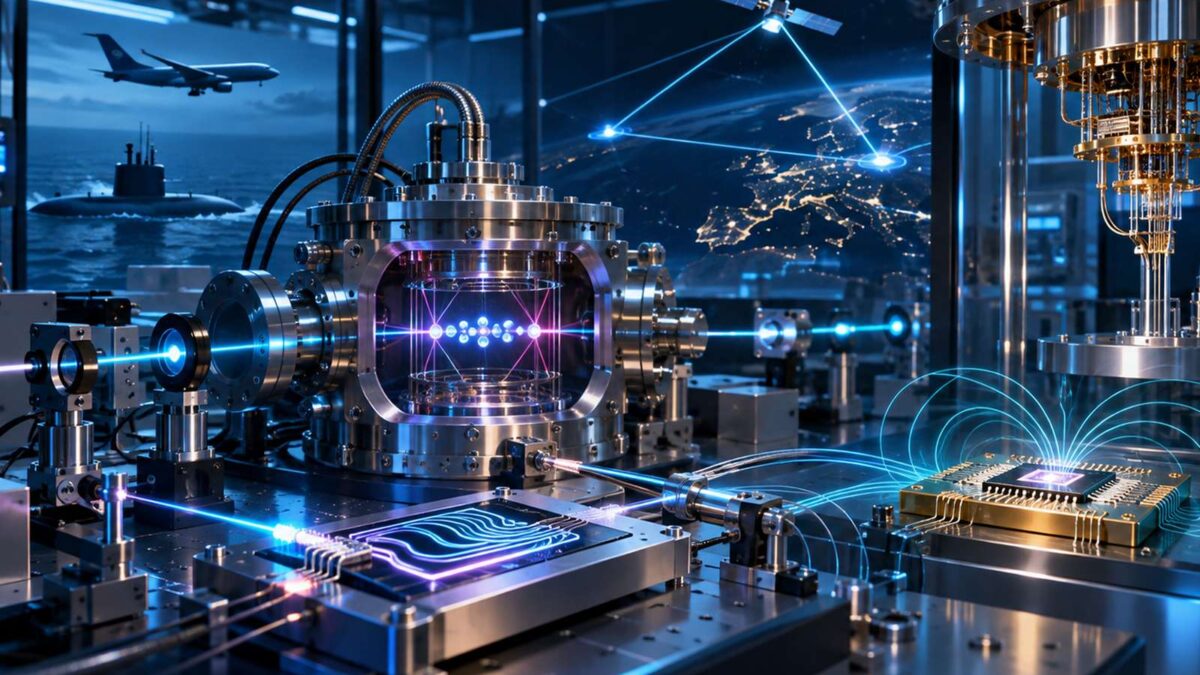
One focus is navigation. Thales researchers are improving quantum inertial navigation systems, which use the behaviour of atoms to continuously measure acceleration and rotation so that vehicles could in principle determine their position without external signals.
Current systems of this type can drift by several kilometres after several hours without correction, and the team aims to reduce positioning errors to roughly one hundred metres.
To achieve this, researchers place rubidium atoms in a vacuum chamber and use lasers to cool them to temperatures close to absolute zero, about -273 °C. Thales combines atomic chips, which manipulate atoms with magnetic fields, with photonic chips to miniaturise the optical functions.
The report says the benefits could be significant for submarines, which lack GPS at depth, as well as aircraft and military vehicles facing satellite signal jamming, but a complete, compact and robust quantum navigation unit may take ten to fifteen years of work.
A second line of research involves superconducting quantum interference filters, or SQIFs, which detect very weak variations in the magnetic field associated with electromagnetic waves. According to the report, Albert-Fert laboratory researchers are developing sensors fitting on a two-centimetre chip that cover a wide frequency range.
Thales is also studying high-critical-temperature superconductors to simplify cooling requirements. Potential uses mentioned include detecting faint military and maritime emissions, radio astronomy, subsurface exploration and medical imaging with weaker magnetic fields than current MRI systems.
Before serial production, the report says reliability must improve and manufacturing must be industrialised, a process that could take ten to twenty years for large-scale deployment.
The third area concerns communications security. Current digital encryption may become ineffective once future quantum computers arrive.
Thales is working on quantum key distribution, which lets two parties create a secret key by exchanging photon-encoded quantum states; any interception attempt causes detectable anomalies, allowing the parties to reject a compromised key. The group is also developing post-quantum cryptography, which uses new classical algorithms designed to resist quantum-computer attacks and can be applied more directly to existing systems.
The report concludes that quantum technology is not limited to ultrapowerful computers, but moving from laboratory experiments to reliable, compact and affordable devices could take decades.