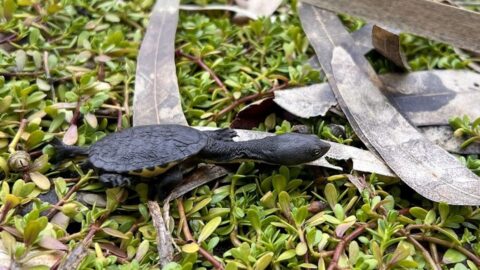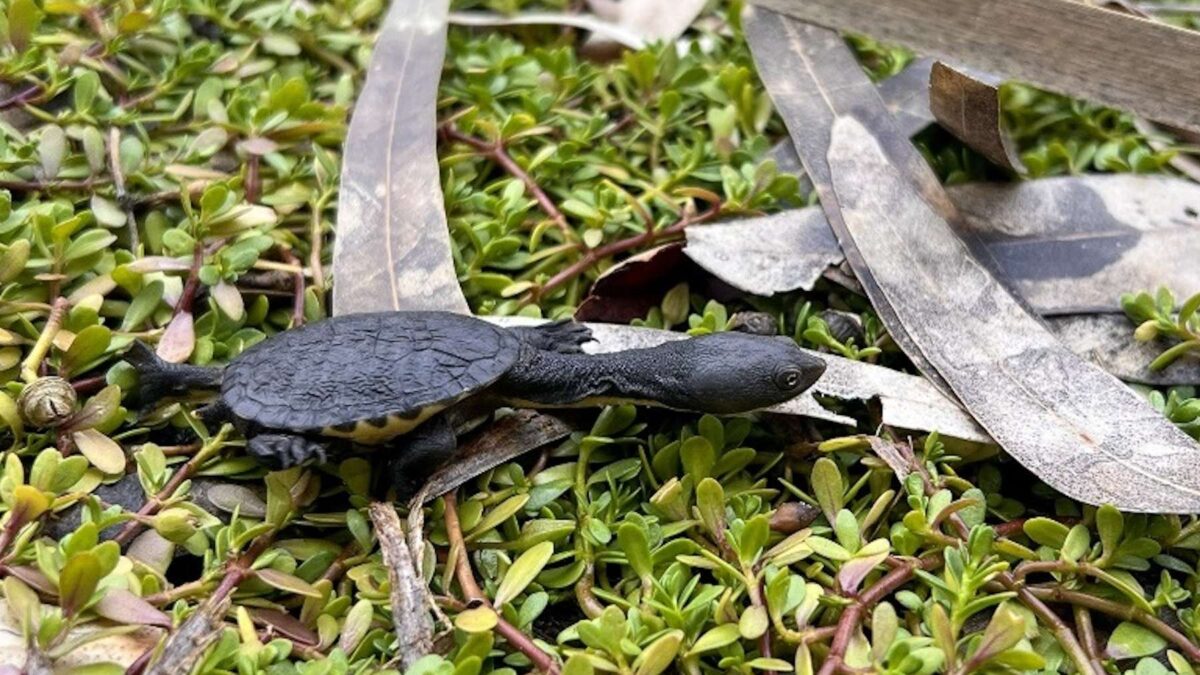
Artificially hatched turtle, Digimart Global (Lake Manning, Perth, Western Australia): In July 2025, researchers from Murdoch University released a tiny southwest long-necked turtle (Chelodina colliei) into Lake Manning in the wetlands of Perth, Western Australia. The animal weighed no more than 4.77 grams, roughly the weight of a sheet of paper, and the study aimed to test whether turtles raised through artificial incubation could survive in the wild.
The release was part of a conservation effort for a species that is under pressure. According to the publisher report, predators are increasing, road deaths and drying habitats are reducing its range, and climate change is adding further strain.
Researchers have observed that young turtles are becoming scarcer in local populations. Anthony Santoro, a researcher at the Centre for Sustainable Aquatic Ecosystems, warned in a statement that the species occurs only in the southwest of Western Australia and would disappear permanently if lost there.
Recapture Offers First Evidence of Survival
In October, during annual population surveys at Lake Manning, the team captured a turtle released more than a year earlier. Because it was too small for current long-term tracking technology, it had to be identified from photographs, which were compared with images of the hatchlings the researchers had released.
The animal had grown from 4.77 grams to about 100 grams.
According to the report, this capture confirms for the first time that a turtle raised in the laboratory can survive in good health in the wild. Researchers note that juvenile captures are rare in the Perth wetlands, which makes the recapture notable.
Caution Over Conclusions
April Sturm, a doctoral student involved in the work, said the result is encouraging and that artificial incubation could help increase the number of juveniles in populations where they are scarce. She added that researchers still need to confirm that the observed survival is not simply due to chance for a single individual.
The researchers stress that artificial incubation should remain a last-resort measure, used alongside other conservation methods. The report notes that the experiment shows existing conservation tools can be effective and that it is not too late to reverse the decline of this species.