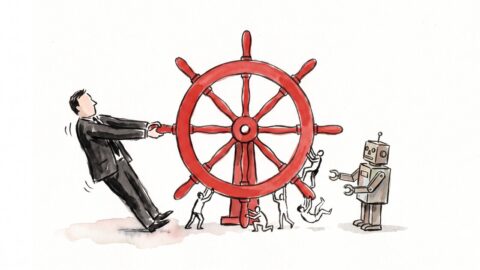
Anthropic CEO AI decisions, Digimart Global: Darío Amodei, CEO of Anthropic, the company that created Claude, responded angrily on X on Wednesday, November 25, to accusations that he wants humanity to cede decisions to artificial intelligence. “No, I don’t believe we should ‘hand over human free will’ to AI systems, and it is absurd to suggest that I believe it,” he wrote in a long post.
The report behind the reaction
The post followed an article published hours earlier by the U.S. news site Axios.
According to its sources, a notion is common inside Anthropic: that humanity should cede part of its decision-making to superintelligent AI. The report also said that more and more executives at rival companies are questioning that vision.
Amodei built his public profile by warning that AI could escape human control, and in September he asked the whole industry to slow down. Against that backdrop, the accusation strikes at the core of his brand.
Rivals weigh in
According to TechCrunch, Sam Altman, CEO of OpenAI, said this month that he wants people to keep control over their future. Alexandr Wang, Meta’s head of AI, wrote that society should not accept a “handover” to AI.
Amodei’s defense
Amodei argued that for millennia, defenders of autocracy promised better and faster decisions than democracy could offer. Even if that were true, he wrote, “we should never sacrifice legitimacy or self-determination on the altar of efficiency or safety.” He also said other AI companies do not think very differently from him about which tasks to automate, and that some CEOs repeat phrases such as “human control” as a commercial and political stance.
Amodei said that anyone who had read his writings or interviews carefully could not conclude otherwise, though he acknowledged that Axios drew part of its report from his own words. In a November 2024 podcast interview with Lex Fridman, he compared future science to a human professor supervising a thousand AI graduate students, and said that at some point AI systems could become the lead researchers and give orders to humans or other AI systems.
He was speaking about laboratories rather than governments.
Where Amodei draws the line
Amodei distinguished between handing governance to AI and letting AI complete tasks on its own, such as driving a car, designing a cancer treatment or writing a program from start to finish. On that question he said his view is “mixed.” He said such capabilities are in many cases clearly desirable and could save large numbers of lives, but he identified four limits: AI that improves itself, job displacement, safety research carried out by the same systems, and what people prefer to do themselves.
He also said there is not, and should not be, a single decision-maker.