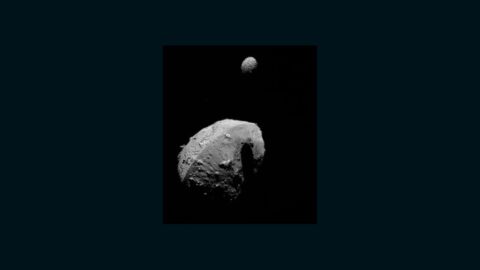
Dimorphos asteroid crater, Digimart Global: The first images of an asteroid that Nasa deliberately crashed into to test Earth’s defences have been released, showing a stadium-sized crater on the damaged body Dimorphos. The pictures were published on Wednesday, according to the report.
The collision took place in December 2022, when Nasa’s Dart spacecraft was crashed into Dimorphos to test whether a rock could be pushed off course if it were ever on a path towards Earth. The European Space Agency (ESA) has since sent a spacecraft called Hera to assess the damage caused by the impact.
What the Hera mission has found
ESA said Nasa’s spacecraft had successfully altered the asteroid’s orbit as it circled a larger asteroid called Didymos. Dimorphos now has one face flattened by a stadium-sized crater and is tumbling chaotically, while hundreds of previously unknown boulders surround the pair, according to the agency.
The Dart spacecraft struck Dimorphos at about 14,000 mph (22,000 km/h). The 150m (500ft) wide body was left with a debris trail reported to be 6,200 miles long.
Before the impact, Dimorphos took around 11 hours and 55 minutes to orbit Didymos, a period that has since shrunk by around 33 minutes.
Scientists reveal the impact’s effects
Hera’s principal investigator, Patrick Michel, said scientists had debated whether Dimorphos had gained an impact crater, changed shape or stayed the same. He said the answer was all three at once, with the face struck by Dart flattened into a crater the size of a sports stadium that extends across the asteroid’s entire width.
The images were unveiled at the Natural History Museum in Berlin. Hera mission manager Ian Carnelli said the mission showed that humanity was validating how to prevent an asteroid impact of the kind that changed the course of life on Earth 66 million years ago.
Next steps for the investigation
The investigation has not concluded. Hera is scheduled to approach about 13km from the asteroids in December and return progressively higher-resolution images.
In January 2027, the spacecraft is due to deploy two shoebox-sized CubeSats, miniature satellites that will venture even closer.
ESA also noted valuable contributions from international partners, including Japan’s JAXA, in the discovery.