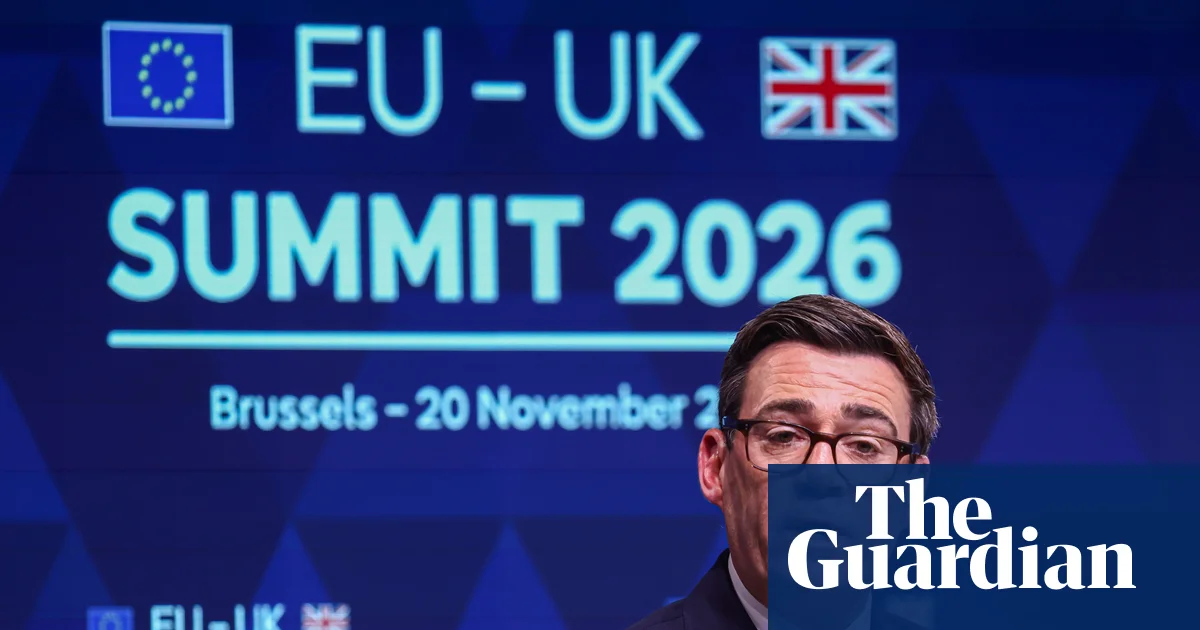
Burnham EU relationship, Digimart Global (United Kingdom): Prime Minister Andy Burnham is not backtracking or delaying his ambitions to build closer links with the European Union, government officials have told the Guardian, following a UK-EU summit in Brussels. The reassurance comes after signs of an apparent slowdown in the timetable for setting out the UK’s long-term relationship with the bloc.
At Friday’s summit, Burnham finalised a deal on reducing food and drink checks, emissions trading and a mutual youth mobility scheme. Rather than setting out firm options, he spoke about “brainstorming” ideas with the EU for what comes next, with a timetable of some months.
He had earlier promised to outline options for the UK’s long-term relationship with the EU, including the possibility of rejoining, later in the year.
The apparent shift prompted speculation that Downing Street wanted to reduce political pressure and stop its agenda being overshadowed by arguments about the EU. Officials rejected this.
One said there was “no backtracking or pumping the brakes”, adding that the government “just wants to let this deal breathe a bit, and point to the benefits”. Another said there had been no timetable change since the summit and that the question was being considered alongside the domestic agenda and the 10-year plan.
Foreign Secretary backs deeper integration
Foreign Secretary Ed Miliband spoke warmly on Sunday about the benefits of greater integration with the EU. In a BBC interview, he argued that closer links would give the UK a say on decisions made in Brussels, noting that British businesses currently act as “rule takers” when selling into the European market.
He said non-integration for food and agricultural products meant firms had to complete a large number of forms, which he described as “the worst of all worlds”.
Miliband also pointed to the changed geopolitical landscape since 2016, including Russia’s full-scale invasion of Ukraine and the United States’ distancing from Europe under Donald Trump, as a further reason for closer ties.
Political reaction
Burnham is due to brief the Commons on the summit and deal on Monday, where he is expected to face strong opposition criticism, particularly from Reform UK. Reform leader Nigel Farage is set to tell the CBI conference that rejoining the EU would be “a disaster” for the UK economy and that his party would reverse the Brussels deal.
Conservative leader Kemi Badenoch has criticised the negotiations but has been less critical of the wider aim of smoothing trade links with Europe, saying she is “all for working on a smarter deal”.
Former prime minister Theresa May warned that rejoining would tie up the government for years, telling the BBC that voters backed Brexit and that the country should “just accept Brexit and move on”.
Burnham will also visit a Morrisons branch on Monday to highlight the supermarket’s youth employment efforts and to argue that the food checks deal will lower retail prices.