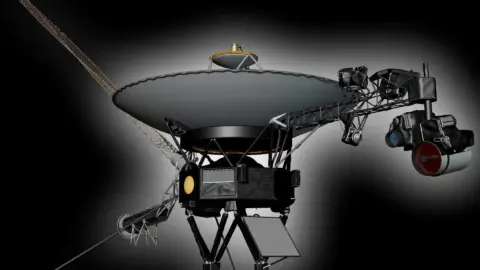

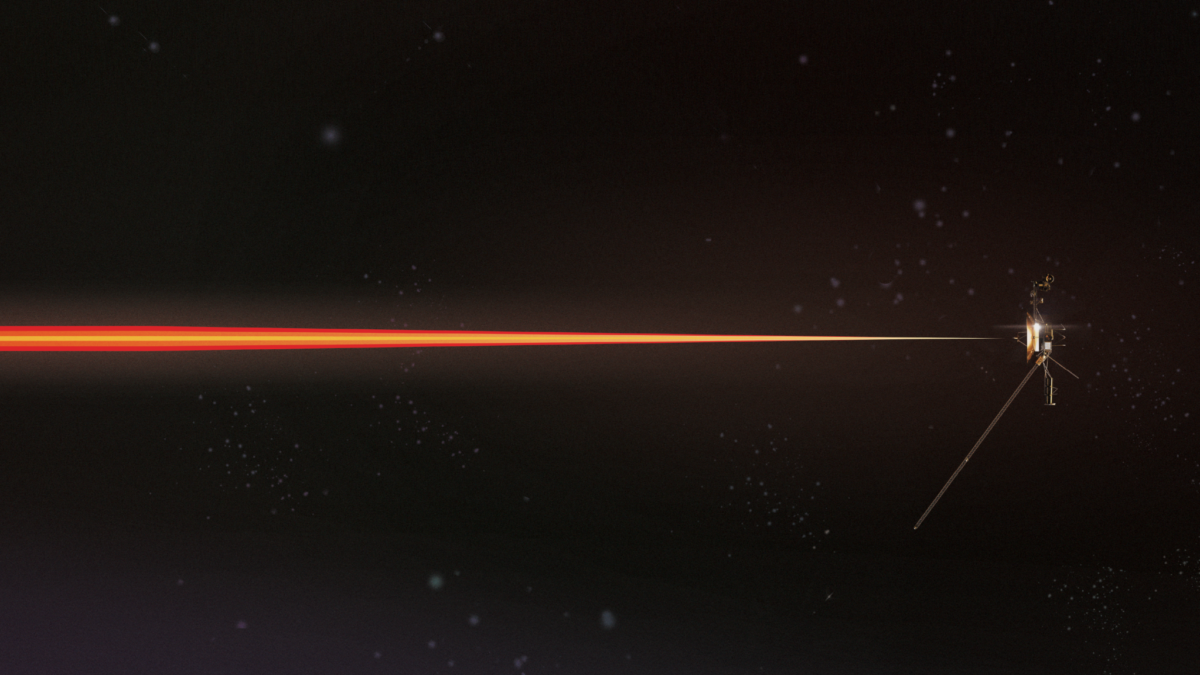
Voyager 1 Becomes First Spacecraft to Reach One Light-Day From Earth, Digimart Global: NASA’s Voyager 1 probe, humanity’s farthest-flying spacecraft, has reached one light-day from Earth after more than 49 years of constant travel. A light-day is the distance light travels in 24 hours, equal to about 16.1 billion miles (25.9 billion kilometres).
According to NASA, the spacecraft reached the milestone at 2:16 a.m. PST (5:16 a.m.
EST) on 18 November. Team members at NASA’s Jet Propulsion Laboratory in Southern California, managed by Caltech, received a response from the probe 24 hours later, the time it took the spacecraft’s radio signal, travelling at the speed of light, to reach Earth.
Scientists use light to measure the vast distances of space. Light travels at about 186,000 miles (299,000 kilometres) a second in a vacuum.
A ray of sunlight takes about 1.3 seconds to reach the Moon and about four hours to reach Neptune, while it takes roughly another 20 hours to reach Voyager 1. A light-year is 5.88 trillion miles (9.46 trillion kilometres) for comparison.
The team has not received science and engineering data from Voyager 1 since 14 November. The spacecraft is still transmitting a carrier signal, and mission engineers used that signal and trajectory calculations to confirm the milestone.
They are continuing to analyse the issue affecting the data.
Voyager 1 and its twin, Voyager 2, launched in 1977 to take advantage of a rare planetary alignment. They were the third and fourth spacecraft to visit Jupiter and Saturn and the first to return high-resolution imagery of these worlds and their moons.
Voyager 2 went on to study Neptune and Uranus. Both spacecraft continue to measure changes in the Sun’s magnetic field across vast distances.
In 2012, Voyager 1 became the first spacecraft to leave the heliosphere, the bubble of particles and magnetic fields created by the Sun, and enter interstellar space. It is travelling at about 38,000 mph (61,155 kph).
Voyager 2 crossed the same boundary in 2018 after taking a different trajectory.
Engineers have extended the probes’ operation by overcoming ageing hardware challenges, including clogged thrusters and a malfunctioning computer. Earlier this year they turned off three devices on Voyager 1 and replaced them with lower-power alternatives, a move NASA described as not without risk, to conserve energy from the spacecraft’s radioisotope thermal generator, which converts heat from decaying plutonium into electricity.
Both probes lose about 4 watts of power each year, and the latest energy-saving effort is expected to keep their current science instruments operating until at least their 50th launch anniversaries next summer.
NASA’s Deep Space Network manages communication with the Voyager probes through large antennas at three facilities around the world. Suzanne Dodd, Voyager project manager at JPL, said the team listens to Voyager 1 every day and sends weekly commands, though communication now takes longer.
One day, when it can no longer communicate with Earth, Voyager 1 will become humanity’s silent ambassador to the stars.