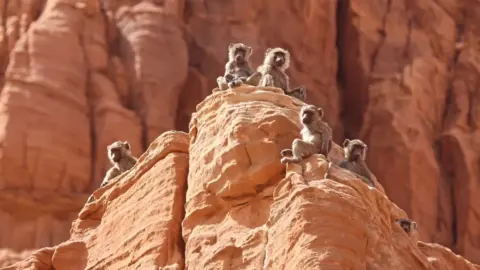

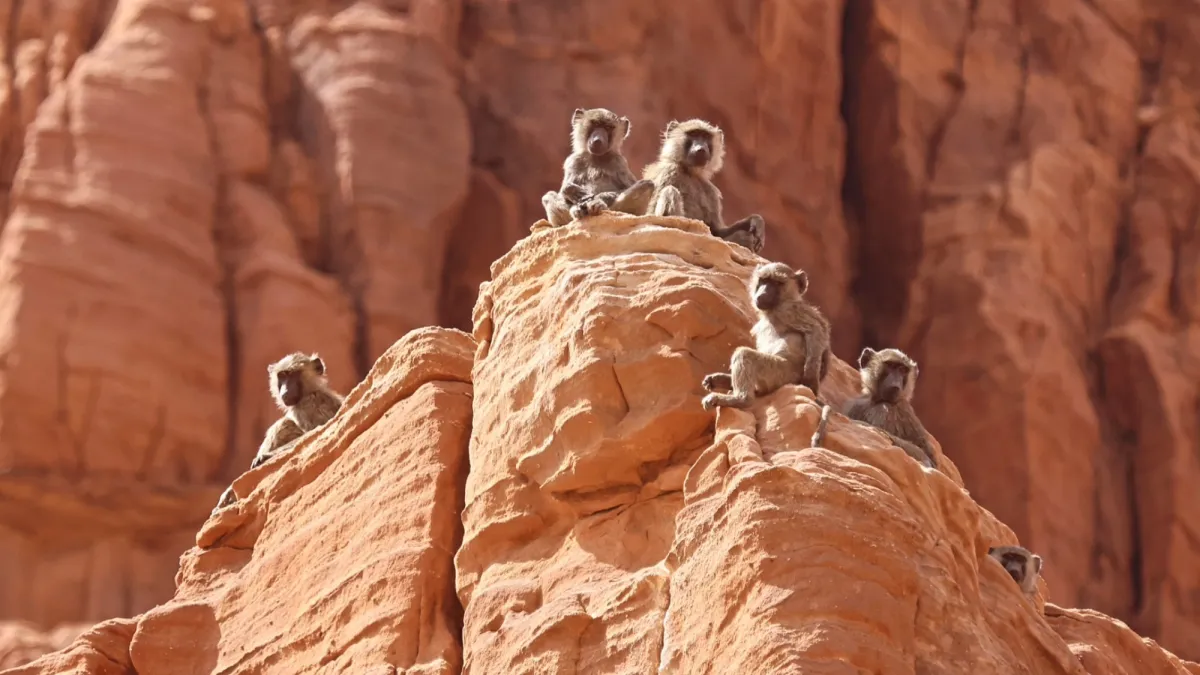
Verreaux’s eagles preying on olive baboons in the Sahara, Digimart Global (Ennedi plateau, northern Chad): An isolated group of olive baboons (Papio anubis) lives on the rugged sandstone Ennedi plateau in northern Chad, a region in the middle of the Sahara Desert about the size of Switzerland. Some of these baboons weigh 40 to 60 pounds, roughly the size of early hominin ancestors.
New research published in the American Journal of Biological Anthropology describes how Verreaux’s eagles (Aquila verreauxii) appear to be hunting these nearly human-sized primates. The study team examined skulls and bones of adult male olive baboons that show the signature marks of eagle predation, including talon punctures in the skulls and scrapes and rakes on the shoulder bones.
Scientists had previously believed that humans and their hominin ancestors largely escaped raptor predation for roughly the past 2.5 million years. No primate over 28.6 pounds (13 kilograms) had been confirmed as killed by raptors.
The team calculated that one baboon was over 57.3 pounds (26 kilograms), which falls within the range of some hominin species, challenging that assumption.
Catherine Hobaiter, a study co-author and primatologist at the University of St. Andrews in Scotland, said the team saw eagles while searching for baboons but never imagined they posed a threat.
“Then we found the first skull with a puncture mark, and then another, and another,” she said in a statement.
Dr. Jean Didier Akpona of the African Parks Network, who has worked in the region for about three years, said he had often seen Verreaux’s eagles near the gueltas, rock pockets of water, but had never imagined they would target primates of this size.
He said the discovery raises further questions about the gueltas of the Sahara Desert.
Modern primates facing eagle predators often move in large mixed-species groups and defend themselves by mobbing, or charging, attackers to drive them away. Researchers say this behaviour may mirror the cooperative social history of early ancestors.
The team hopes to learn more about the Ennedi baboons, whose diet and social lives the first observations have already challenged.