
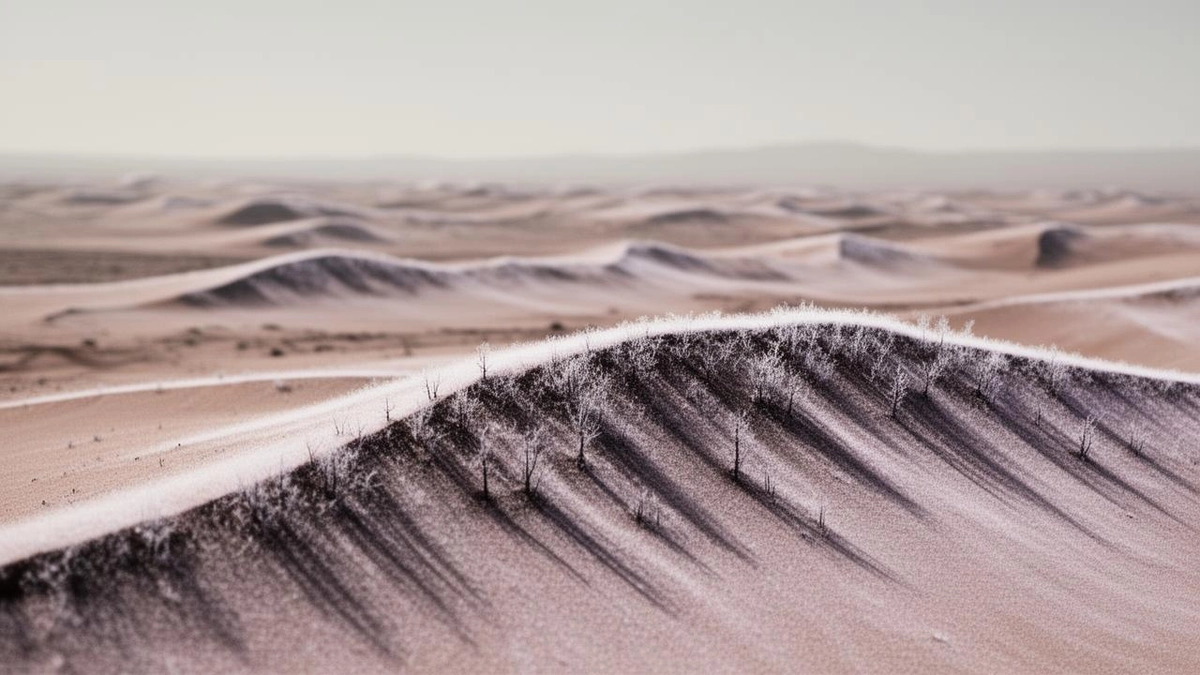
Martian ghost forest, Digimart Global (Mars north polar region): Long dark streaks on ice-covered dunes in the Martian north polar region have led many people to see rows of trees in a mysterious forest. According to the publisher’s report, the streaks are actually dark sand sliding down slopes, and NASA has shared the image taken by the HiRISE camera aboard the Mars Reconnaissance Orbiter.
The illusion comes from how the streaks are arranged. They begin near the crests of the dunes and run down to the slope bases, resembling tree trunks and branches.
Scientists note, however, that these “trees” cast no shadows, which indicates they are not objects standing above the surface. When the image is rotated, the features appear as dark bands of sand on a background of bright, icy sand.
The process is tied to the Martian seasons. During the polar winter, carbon dioxide in the atmosphere freezes and coats the dunes in a layer of dry ice.
In spring, sunlight, though weak, warms the ice enough for it to turn directly from solid to gas without becoming liquid. Light passing through the ice heats the sand beneath, and accumulated carbon dioxide gas occasionally bursts out, carrying dark sand up through the ice.
The sand then rolls downslope and leaves long dark streaks behind.
NASA’s Astronomy Picture of the Day account explained that when this occurs near a dune’s top, the dark sand can slide down and leave streaks that at first glance may look like trees in front of brighter areas, though they cast no shadows. The image was taken in April 2008, during Martian spring, and the HiRISE camera also captured a small dust plume rising as the sand slid.
According to a 2011 study published in the journal Science, a team led by planetary scientist Candice Hansen-Koharcheck of the Planetary Science Institute in the United States compared images of dunes at the Martian north pole over several years. The researchers found that the terrain changed markedly with the seasons, with new gullies appearing and sand accumulating at the base of slopes.
By summer the dry ice layer disappears, the dark streaks are gradually dispersed by wind, and the terrain becomes flatter. When winter returns, ice again covers the dunes, and the pattern can reappear the following spring.
The publisher report notes this cycle makes the region a natural laboratory for studying how sublimation shapes the planet’s surface.
The episode shows why researchers must check surface shapes against the physical processes at work. For the public, it is a reminder that familiar-looking features on Mars often form through mechanisms very different from those on Earth, and that changing the viewing angle can alter how an image is read.