
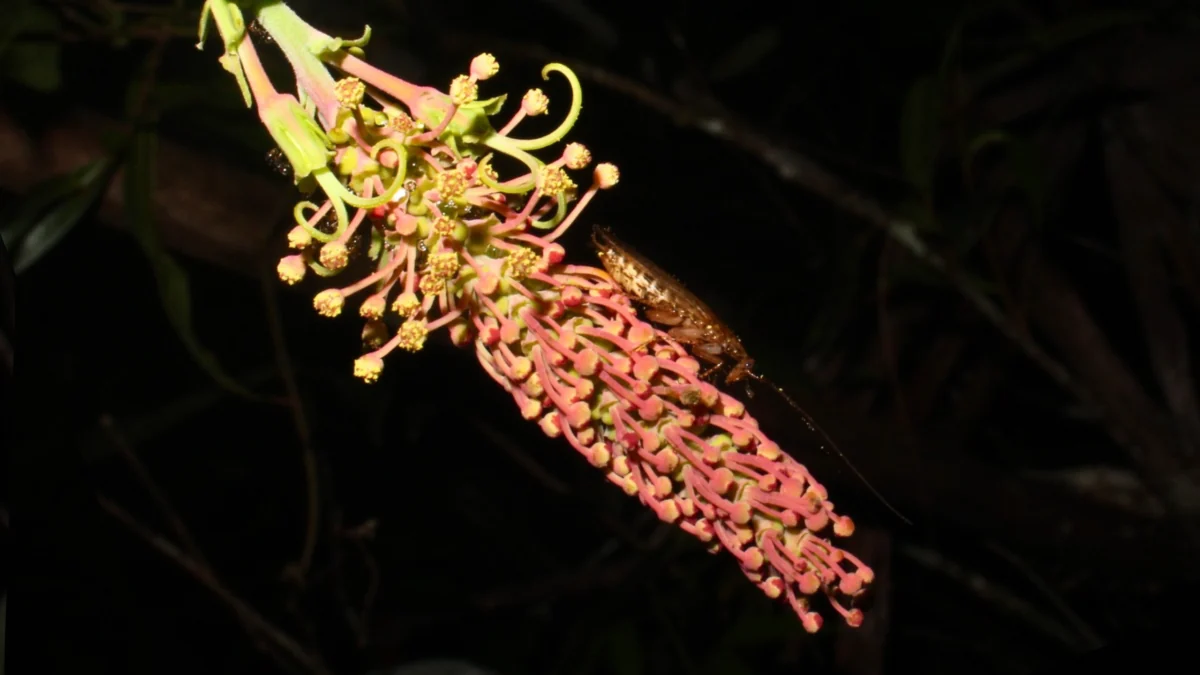
Cockroach pollinators Amazon, Digimart Global (Brazilian Amazon): As dusk falls in the Brazilian Amazon, the flowers of a small shrub begin to open and release nectar. According to a study published in the Brazilian Journal of Botany, the shrub, Mabea uleana, shares features with plants pollinated by bats, but researchers recorded no bat visits.
The team found no nectar in the flowers between 9 am and 5 pm. After dark, cockroaches appeared to be among the shrub’s most important pollinators, although wild cockroaches are rarely observed visiting flowers.
The shrub belongs to the spurge family and grows only in patches of vegetation on nutrient-poor white sand in Brazil’s Amazonas state. Each hanging flower cluster has one or two female flowers near the stalk and more than 200 male flowers below them that release pollen.
Cockroaches brush past the female flowers on their way to feed, picking up pollen from the male flowers on their legs and belly. When they climb back out, they touch the female flowers again.
The researchers noted that the pollen is very sticky, helping it cling to the insects.
Between June 2024 and January 2025, the team spent 252 hours watching flower clusters on six shrubs north of Manaus, split evenly between day and night. In a separate experiment, about 93 percent of flowers given pollen from another shrub formed fruit, compared with 15 percent of those given pollen from their own cluster.
About 73 percent of flowers left open to visitors produced fruit.
The team recorded 18 cockroach visits, though the botanist who led the work, Tulio Alex Martins-Silva, suspects some were missed because cockroaches are sensitive to light, noise and human presence. Small flies and moths also visited after dark, while stingless bees called Trigona almeidae were the most frequent daytime visitors.
The study took place at a single site, and the fruit experiment did not measure how much each group of visitors contributed to pollination.