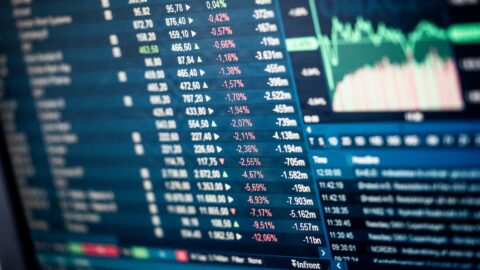
US stock market selloff after midterm elections, Digi Mart USA News: Stocks have fallen into a deep hole with sharp declines. On Thursday evening, investors in the United States were hit hard, with the benchmark S&P 500 and Nasdaq indexes dropping 4 to 5 percent.
The losses continued in overnight trading in Asia, and stocks in Europe and Denmark also opened lower, although the declines there were more restrained than elsewhere. The source notes that it is important to distinguish between what pushed stocks over the edge and what first brought them to that edge.
The midterm elections in the United States on Tuesday were the triggering factor. As a Democratic majority in Congress began to take shape earlier in the week, stocks initially fell sharply.
Investors wondered whether a close result could lead President Donald Trump to question the validity of the election and trigger a democratic crisis in the world’s largest economy.
Investors also questioned whether Democrats would turn their new power toward a less business-friendly policy than the Republicans have pursued in recent years, including tax cuts, easing of regulatory conditions and extensive economic stimulus.
Once the initial shock of the Democratic wave subsided, and as a clear Democratic election victory became apparent, investors reached the conclusion that a Democratic Congress and a Republican presidency would spend the coming years checking each other. Trump made his position clear by first acknowledging the election and later posting an image of a red cap with the word “veto” on his social media platform, Truth Social.
The prevailing market logic was that as long as politicians in Washington spend their time arguing without accomplishing anything, they also do no harm.
Historically, midterm elections in the United States have paved the way for stock gains regardless of the winner, because they reduce uncertainty about the political direction. In each of the last 20 midterm elections, Wall Street stocks rose the following year, with an average gain of 14 percent.
Financial markets, however, are a constant negotiation among millions of investors about the true state of the world and the direction of prices. What was good one day can be bad the next, and that is what happened with the midterm elections.
When US stocks opened on Thursday, prices fell, and the day ended as one of the most battered days in recent years.
Relief had given way to concern about what the shift in power could mean for the sector that has driven the economy and financial markets in recent years: technology companies and artificial intelligence. Billions of dollars have been spent building out artificial intelligence, and this has been central to growth and stock prices in the United States.
Democrats have been more skeptical than Republicans of the great power of technology companies, the societal risks of artificial intelligence and, not least, the expansion of large data centers, which have faced growing local protests across the United States. Investors now asked whether Democrats with a congressional majority could slow that development, even though their analysis from the day before had suggested that Washington’s real political capacity to act is weakened.
The concern grows as investors review the Democratic candidates who were elected, several of whom lean further to the left than business interests traditionally feel comfortable with.
The midterm elections were the trigger, but the underlying cause was already in place. Stocks were already out of balance before voters went to the polls on Tuesday.
For months, concern about technology stock prices had grown. In the spring and over the summer, the Nasdaq index, which includes many of the major technology companies, took sharp nervous dives before climbing back out, and into the autumn prices have been under pressure.
No one doubts that the spread of artificial intelligence is a decisive shift in technological development, as the internet was around the turn of the millennium. However, the question is whether the companies’ billion-dollar investments are truly sustainable and whether share prices have risen too far.
The change in power in Washington coincides with another negative development for technology companies. Interest rates have risen during the year, and as the US economy shows signs of strength and high growth, hopes for lower rates are fading.
This matters greatly for a sector in which large investments are largely financed by debt.
Global financial markets function as a single system, so shocks in the United States also cause tremors at home. Danish companies also point to the artificial intelligence boom when explaining their profits in these years, for example Grundfos, which supplies cooling systems to data centers, Vestas, which sells wind turbines to meet the centers’ large energy needs, and Maersk, which is busy shipping components for the construction of the centers.
However, the technology industry’s home is and remains the United States. Therefore, there is reason to believe that Denmark may be partly shielded from the worst declines, just as it has not experienced the very large gains of recent years.
It is highly doubtful that Democrats will seriously put an end to technology companies, because the United States has too much at stake in the area. Economically, technology companies keep growth going, and geopolitically it is a core task for the United States not to be overtaken by China in the technology race.
But the midterm elections were only the push. Investors were already standing on unstable ground.