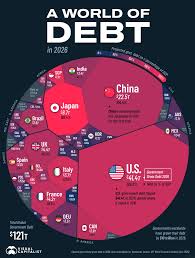
Government debt by country 2026, Digi Mart USA News: Government borrowing has climbed to historic levels, with rising interest costs and mounting spending pressures putting public finances under strain. While the world’s largest economies account for much of the total, debt burdens relative to economic output tell a different story.
This report breaks down projected government debt by country in 2026, based on the International Monetary Fund’s October 2026 World Economic Outlook. Figures represent general government gross debt, including liabilities across different levels of government.
The table ranks countries by projected government debt in U.S. dollars, with debt-to-GDP ratios providing a measure of each country’s debt burden relative to its economy.
The U.S. leads with $41.4 trillion in government debt, representing roughly one-third of the worldwide total.
Over the past decade, the U.S. debt burden has climbed from 107.5% of GDP in 2016 to 126.8% in 2026, as government borrowing has outpaced economic growth.
The cost of servicing that debt is also mounting. In fiscal 2026, federal net interest payments reached $1.1 trillion, exceeding military spending by $225 billion.
China ranks second at $22.5 trillion, with government debt projected to surpass 100% of GDP for the first time. Unlike the U.S., a central source of China’s fiscal pressure is its local government financing system.
For years, local authorities relied on borrowing and land-sale revenues to fund infrastructure and development. The property downturn has weakened this revenue model, increasing pressure on public finances.
Despite their different fiscal challenges, both countries illustrate how rising government borrowing is reshaping public finances in the world’s two largest economies.
The countries with the largest debt totals are not necessarily those carrying the heaviest debt burdens. Measured against economic output, government debt is projected to exceed 100% of GDP in 20 economies in 2026, ranging from major industrialized nations to smaller developing economies.
Sudan has the world’s highest debt-to-GDP ratio at 334.4%, followed by Japan at 199.4%. France (118.5%) and Canada (115.6%) also have debt exceeding their annual economic output, while Bolivia sits just above the threshold at 100.2%.
Even countries below this threshold can face considerable financial pressure. Interest costs exceed public spending on health care or education in 51 developing countries, which together are home to 3.7 billion people.
Looking ahead, the IMF projects that global government debt will surpass 100% of GDP by 2030, reaching a level last seen shortly after World War II.