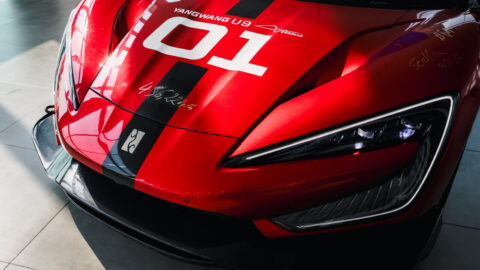
BYD Great Tang wheel rim installation error, Digi Mart USA News: BYD has officially apologised to customers after assembly teams installed front and rear wheel rims in reverse on its Great Tang electric SUV. The problem surfaced after Chinese owners complained on platforms such as 3YC User Report that wider 9J rear rims had been mounted on the front tyres and narrower 8J front rims on the rear axle.
Confirming the completion of its internal investigation on Wednesday, the company traced the mix-up to a data coding error at a Hubei-based parts supplier. “We deeply apologise for the trouble this has caused owners,” BYD said in an official statement on Weibo.
The automaker has updated its automated assembly software, introduced secondary visual inspection checkpoints, and invited affected owners to service centres for free professional rim adjustments, courtesy loaner cars and the restart of vehicle warranties.
According to local outlet CarNewsChina, the issue affects the 950km rear-wheel-drive Da Tang trim. BYD engineered this model to run 255-profile tyres on 8-inch front rims and 275-profile tyres on 9-inch rear rims.
Because both aluminium rims share identical styling, mismatched installation forces the wider rear tyres onto rims that are technically too narrow under European Tyre and Rim Technical Organisation standards.
Fitting wide tyres onto narrow front rims also alters the contact patch and degrades steering response, leaving owners with unnatural highway tracking and unstable cornering.
Priced domestically from 239,900 yuan (approximately AUD$52,500), the full-size Great Tang anchors BYD’s executive Dynasty range and achieved roughly 14,000 deliveries in October. The assembly slip-up comes as Chinese regulators enforce stricter quality and durability benchmarks covering door handles, battery containment and driver-assistance systems.
Intense price competition is also pushing manufacturers to increase overseas shipments, which now account for roughly 40 per cent of third-quarter deliveries for both BYD and Geely. However, a strengthening onshore yuan, up 4.6 per cent against the US dollar this year, is squeezing foreign earnings across the sector.
BYD recorded a 1.14 billion yuan cash hit from exchange rate movements, while Geely reported a net foreign exchange loss that limited its net profit growth to 6.7 per cent.
As export expansion accelerates amid local price wars, error-free factory production remains essential for Chinese brands seeking to meet the expectations of international buyers.