Extreme weather pressure on European infrastructure and economic losses, Digi Mart USA News: A low river or a severe storm can have far greater consequences than it first appears. Because of climate change, our infrastructure is increasingly under pressure.
Extreme weather affects much more than what we experience outdoors. A factory can shut down because raw materials fail to arrive, while a power plant can produce less electricity due to a shortage of cooling water.
A new analysis by the European Environment Agency (EEA) shows how vulnerable Europe is to these effects.
2026 has already produced several examples. Portugal was hit by a severe storm in January.
In spring, a large part of Europe faced drought, followed by early heat waves in May and June. Such extremes fit the pattern of climate change, in which the likelihood of prolonged heat and drought is increasing.
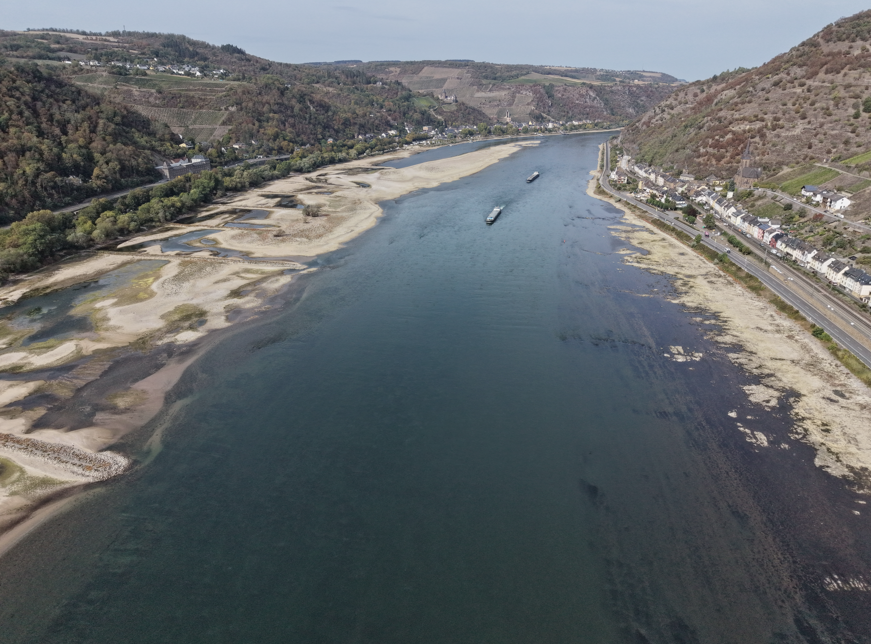
Take the Rhine. Due to persistent drought, the water level fell to exceptionally low values during the summer.
At Kaub in Germany, less than 10 centimeters was measured on August 14. Inland cargo vessels could therefore carry only a small fraction of their usual loads.
For an important European transport route, this was a significant restriction.
This did not go without consequences. Raw materials arrived at their destinations with greater difficulty, and companies had to limit production.
Replacing a single inland barge with trucks is not simple: up to 150 trucks may be needed. Transport costs also rose sharply.
The drought also affected energy supply. Hydropower plants could produce less electricity, and nuclear power plants ran into problems due to a shortage of cooling water.
At the same time, electricity demand in some countries rose by as much as 25 percent during the heat waves, partly due to the use of air conditioning. Just when less power was available, demand increased significantly.
Drought is not the only weather type that can cause problems. In late January, Storm Kristin moved across Portugal.
In some places, wind speeds reached about 200 kilometers per hour. More than one million households and businesses were left without power.
Roads and railway lines were also damaged.
The consequences did not end there. Without electricity, parts of the telephone and internet network also failed.
About 200,000 fixed internet connections and 300,000 mobile users were affected. The total economic damage was estimated at 5.3 billion euros.
According to the EEA, the economic impact of extreme weather in 2026 for the European Union is estimated at a minimum of 1 percent of gross domestic product: roughly 190 billion euros. Climate change therefore calls for adjustments to our infrastructure.
Railway tracks must be better able to withstand extreme heat, electricity grids must maintain sufficient capacity during prolonged heat, and power plants must be able to keep operating with less cooling water during droughts. Many facilities were designed for the climate of the past.
Repairing what breaks is no longer enough.