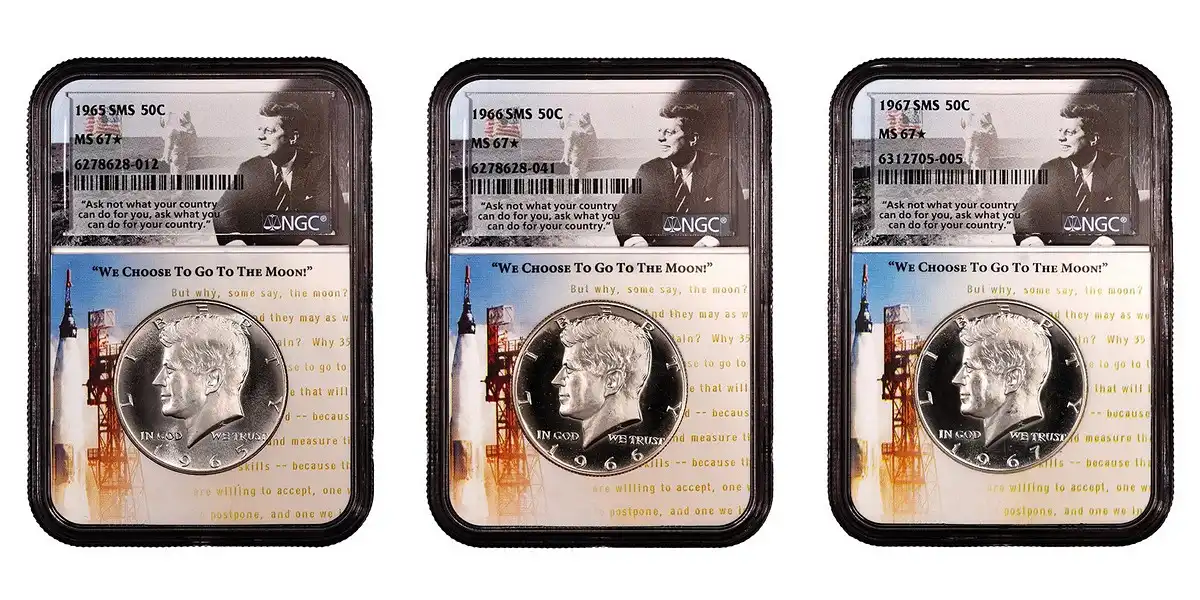
1965-1967 Special Mint Set Kennedy half dollars, Digi Mart USA News: Three years without Proof sets produced some of the most intriguing Kennedy half dollars ever struck. Recent auction results show why collectors still pursue them.
In 1965, the United States Mint stopped making Proof sets. Mintmarks disappeared from American coins, and the nation’s silver coinage underwent its biggest transformation in generations.
Yet collectors could still buy specially prepared Kennedy half dollars. These unusual coins looked better than ordinary circulation strikes but lacked the finish of traditional Proofs.
The 1965–1967 SMS Kennedy half dollars emerged from an extraordinary period in American numismatics. Today, they offer collectors a fascinating combination of history, silver content, die varieties, and occasionally spectacular Cameo contrast.
Their story also contains a surprising historical detail. Although the first coins carry the date 1965, the San Francisco Assay Office did not actually strike those Special Mint Set coins until 1966.
The Kennedy half dollar had barely entered circulation when the Mint faced a new crisis. Congress authorized the coin on December 30, 1963, just weeks after President John F.
Kennedy’s assassination. Chief Engraver Gilroy Roberts designed the obverse portrait, while Frank Gasparro created the reverse.
The first Kennedy half dollars reached the public on March 24, 1964. Demand for the new coin was extraordinary.
Many Americans saved the half dollars as memorials rather than spending them.
Meanwhile, rising silver prices and the withdrawal of older silver coins from circulation added pressure to an already strained monetary system.
On July 23, 1965, President Lyndon B. Johnson signed the Coinage Act of 1965.
The legislation eliminated silver from circulating dimes and quarters. It also reduced the silver content of Kennedy half dollars from 90% to 40%.
The Mint introduced a layered silver-copper composition for the half dollar. Its outer layers contained 80% silver, while the core contained approximately 21%.
Overall, each coin retained 40% silver.
The government also temporarily eliminated mintmarks to discourage collectors from setting aside coins according to their place of manufacture. Finally, Mint officials suspended the annual Proof and Uncirculated sets.
They redirected resources toward producing coins for everyday commerce.
For collectors, the changes threatened an annual tradition. The Mint responded with a product that occupied the middle ground between ordinary Uncirculated coins and traditional Proofs.
Each Special Mint Set, or SMS, contained five coins: a Lincoln cent, Jefferson nickel, Roosevelt dime, Washington quarter, and Kennedy half dollar. The combined face value was just 91 cents.
However, collectors paid $4 for each set. By comparison, the 1964 Proof set had cost $2.10, while the 1964 Uncirculated set sold for $2.40.
The San Francisco Assay Office produced the SMS coins using specially prepared dies and high-tonnage presses. Unlike traditional Proof production, the process generally involved a single strike.
These coins offered better relief and more attractive surfaces than ordinary circulation strikes. However, the results varied considerably.
The Mint’s 1968 announcement restoring Proof coinage confirmed the purpose of the program. Special Mint Sets had provided collectors with a higher-quality alternative while the Mint concentrated on solving the coin shortage.
The 1965 SMS Kennedy half dollar represents the first year of the experiment. Most examples display satinlike surfaces rather than deeply mirrored fields.
Some possess attractive reflectivity, but strong Cameo contrast remains much more elusive than on ordinary Proof issues.
However, the coin’s production history deserves attention. Numismatic researcher David W.
Lange, writing for NGC, documented that the San Francisco Assay Office struck the entire 1965-dated SMS production in 1966. Therefore, the date on the coin does not identify its actual calendar year of manufacture.
The Mint packaged the first Special Mint Sets in flexible Pliofilm holders. Each package included the five coins and a blue-and-silver plastic token identifying the Special Mint Set.
A certificate and cream-colored outer envelope completed the presentation.
The 1965 SMS Kennedy half dollar offers another attraction. Specialists recognize a Doubled Die Reverse, cataloged as FS-801.
That variety remains an additional collecting challenge beyond the ordinary issue.
For 1966, the Mint improved both the presentation and the coins. Collectors received the five pieces in rigid plastic holders inside dark-blue boxes.
The improved packaging continued in 1967. More importantly, many 1966 SMS coins exhibit greater reflectivity and more attractive surfaces than their 1965 counterparts.
The Kennedy half dollar also offers two important varieties. The 1966 SMS Doubled Die Obverse displays doubling in portions of Kennedy’s portrait and the motto IN GOD WE TRUST.
Specialists recognize several doubled-die attributions, making accurate identification important.
Meanwhile, the 1966 SMS No FG Kennedy half dollar lacks Frank Gasparro’s initials on the reverse. Normally, the letters FG appear near the eagle’s right-side tailfeathers, as viewed from the front of the coin.
Excessive die polishing removed those initials from certain dies. The No FG variety has attracted sustained collector interest, especially in higher certified grades.
In addition, collectors must distinguish a genuine No FG variety from a weakly struck or damaged example. A faint trace of the initials does not automatically qualify a coin for the recognized attribution.
By 1967, the Mint had considerably improved the appearance of many Special Mint Set coins. The Kennedy half dollars from this final year frequently display stronger reflectivity and more pronounced contrast between their devices and fields.
Some examples resemble traditional Cameo Proofs.
Nevertheless, SMS coins remain a separate category. Their surfaces often show characteristics that distinguish them from true Proof coinage.
For advanced collectors, the strongest Cameo and Deep Cameo examples represent some of the most desirable coins from the three-year program.
The 1967 SMS Kennedy half dollar also offers a recognized Quadrupled Die Obverse variety, FS-101.
Then, in 1968, the Mint resumed traditional Proof coinage at San Francisco. Mintmarks also returned to American coins.
The Special Mint Set experiment had reached its conclusion.
Production remained substantial throughout the program. The Mint reported 2,360,000 Special Mint Sets for 1965, followed by 2,261,583 for 1966.
Production declined to 1,863,344 sets in 1967. Altogether, the three years account for 6,484,927 sets.
These figures explain why ordinary SMS Kennedy half dollars remain accessible. However, they do not establish how many examples survive in exceptionally high grades or with strong Cameo contrast.
That distinction drives much of the certified market.
The Kennedy SMS half dollars contain 40% silver, weigh 11.50 grams, and measure approximately 30.6 millimeters in diameter. Each contains approximately 0.1479 troy ounce of pure silver.
Their metal content provides an underlying bullion component, but grade, finish, eye appeal, and variety attribution can have a much greater effect on collector value.
Auction appearances during 2026 demonstrate how widely prices can vary within the short series. On March 31, Heritage Auctions sold a 1965 SMS Kennedy half dollar graded NGC MS-67 Cameo for $84.
However, variety collectors paid more for a different 1965 issue. On August 25, Heritage sold a 1965 SMS Doubled Die Reverse FS-801, graded NGC MS-67, for $341.60.
The 1966 coins produced several noteworthy results. On June 23, a 1966 SMS No FG Kennedy half dollar, graded NGC MS-66, realized $268.40 at Heritage.
Then, on September 22, a particularly attractive 1966 SMS Kennedy half dollar, graded PCGS SP-68 Cameo, brought $1,159.
The 1967 issues also demonstrated the importance of surface quality. A PCGS SP-68 Cameo example sold for $268.40 at Heritage on July 14, 2026.
Earlier in the year, Heritage sold a 1967 SMS Kennedy half dollar graded NGC MS-68 Ultra Cameo for $2,562 in its January 17 FUN auction.
These results represent individual transactions rather than universal market values. Moreover, the coins differ in date, grade, contrast, and variety.
Collectors should compare similar certified examples before drawing conclusions about price trends.
For perspective, PCGS CoinFacts records an exceptional 1967 SMS Deep Cameo half dollar that realized $31,200 in January 2019. That historical result illustrates the upper end of the specialty market, not the value of an ordinary SMS coin.
The 1965–1967 SMS Kennedy half dollars provide several distinct collecting opportunities. A three-coin date set offers an affordable starting point.
From there, collectors can pursue higher grades, Cameo and Deep Cameo designations, or recognized die varieties.
PCGS typically classifies these coins as Specimen strikes using the SP prefix. However, NGC and some older holders use MS terminology for SMS coins.
Therefore, buyers should examine the full certification description rather than relying on the numerical grade alone.
Original government packaging also remains relevant. Many surviving sets still contain all five coins, giving collectors an opportunity to study the original Mint product.
Before removing coins from those holders, collectors should examine them carefully. Original packaging has historical appeal, and handling can introduce damage.
The absence of a mintmark provides no rarity by itself. All three SMS dates lack mintmarks, even though the San Francisco Assay Office produced the sets.
Instead, the real challenges involve surface preservation, exceptional contrast, and documented varieties.
The Kennedy half dollars of 1965, 1966, and 1967 occupy a distinctive place in the history of American coinage. They commemorate a president whose image had joined the nation’s circulating coinage only a year earlier.
They also reflect a government struggling with silver supplies, public demand, and the practical requirements of producing enough coins for commerce.
The Special Mint Set program supplied a temporary solution for collectors while those problems played out. Today, the same coins reward a very different kind of attention.
Their value rests not simply on their dates or silver content, but on the fine distinctions of their manufacture. And those distinctions can transform an otherwise common Kennedy half dollar into a highly desirable numismatic specimen.
CoinWeek Giveaway #666, beginning November 7, 2026, celebrates this three-year chapter with one MS-67 SMS Kennedy half dollar from each year, plus the fourth edition of Rick Tomaska’s A Guide Book of Franklin & Kennedy Half Dollars. For collectors who want to explore the entire 15-coin series, Joshua McMorrow-Hernandez’s original CoinWeek guide to the 1965–1967 Special Mint Sets provides additional background.