Renault Niagara pickup launch in Argentina, Digi Mart USA News (Argentina): Renault’s European and South American customers are clearly not offered the same range. While the French automaker multiplies small electric cars in Europe, it has just launched in Argentina a vehicle of a very different kind, called the Niagara.
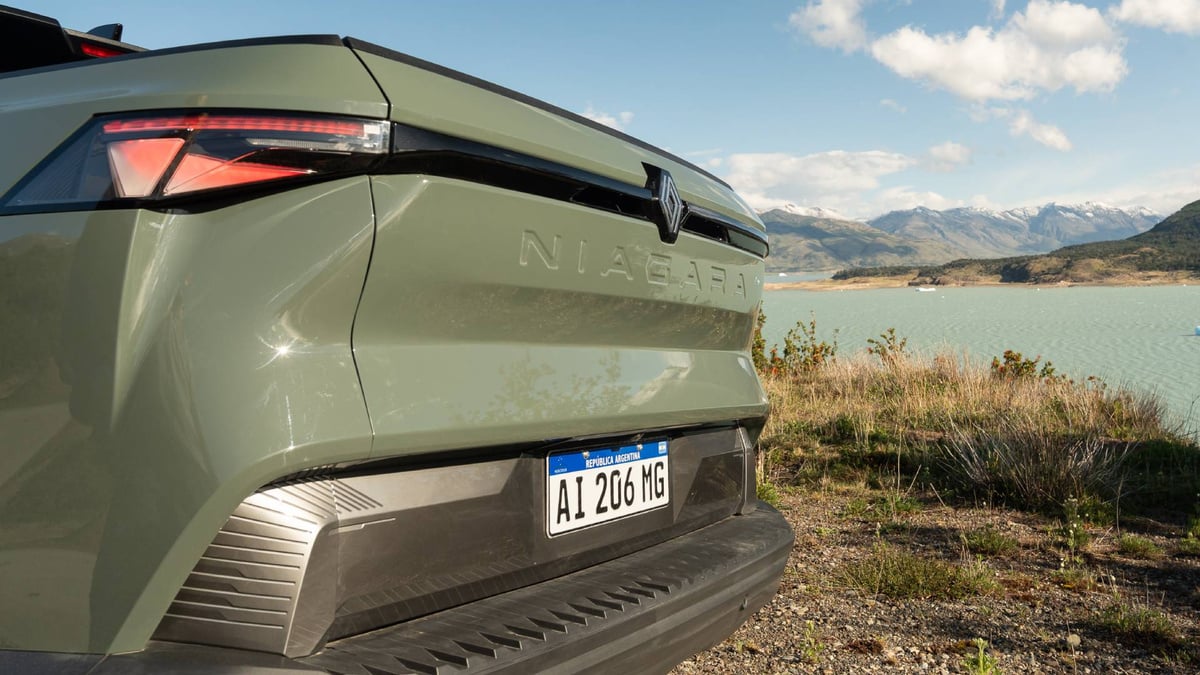
The Niagara is a large double-cab pickup designed to carry both a family and equipment. It was unveiled last September to replace the aging Oroch, which was based on the Renault Duster, and has now begun sales in Argentina, where it is also manufactured.
The source notes that it is not currently expected to reach French dealerships.
At nearly 5 meters long, with five seats and a gasoline engine, the Niagara is far removed from the electric Renault 5 sold in France. Yet the two share an unexpected point in common: their price.
The Niagara starts at 45.7 million Argentine pesos, about 26,300 euros after conversion, compared with 28,490 euros for the electric city car in France, a gap of only about 2,200 euros.
The comparison is indicative only, given differences in taxation and purchasing power between the two countries. The Niagara has little in common with Renault models known in Europe.
It is produced at the Santa Isabel plant in Argentina and rests on a platform also used by the Renault Boreal, an SUV aimed at international markets.
The pickup measures 4.91 meters in two-wheel drive and 4.94 meters in four-wheel-drive versions. It seats five occupants and offers a 938-liter cargo bed capable of carrying up to 654 kg depending on the version.
Under the hood is no electric motor but a 1.3-liter turbo four-cylinder gasoline engine producing 156 hp, paired with a six-speed manual gearbox or a dual-clutch automatic transmission. Four versions are offered in Argentina, from the Evolution+ to the Outsider, which has four-wheel drive and all-terrain tires.
The Outsider costs 59.99 million Argentine pesos, about 34,500 euros after conversion.
Despite its relatively accessible positioning, the Niagara includes modern equipment. Even the entry version has six airbags, automatic emergency braking, lane-keeping assistance, LED headlights and a 10.1-inch touchscreen.
Higher versions add, among other features, dual-zone climate control, 360-degree cameras and a multimedia system with Google Maps and the Gemini assistant.
In Europe, Renault is multiplying electric launches, from the R5 and R4 to the upcoming Twingo. In Latin America, the company continues to rely on combustion-engine vehicles such as the Niagara.
The source attributes this difference partly to driver habits, purchasing power and the still uneven development of charging infrastructure, and notes that pickups remain important there for both professionals and private buyers.
This strategy does not mean Renault is abandoning electrification outside Europe. The group aims to generate half of its sales in international markets by 2030, while raising the share of electric and hybrid models to 50% of volumes in those regions.
A hybrid version of the Niagara is planned later, although the automaker currently favors its gasoline engine.
The Niagara thus illustrates a multi-speed strategy: rather than imposing the same models and powertrains everywhere, Renault adapts its offer to each market. Its price, equivalent to that of a Renault 5, underscores how commercial realities differ from one continent to another.
The source concludes that the large pickup is not expected to arrive in France at around 26,000 euros.