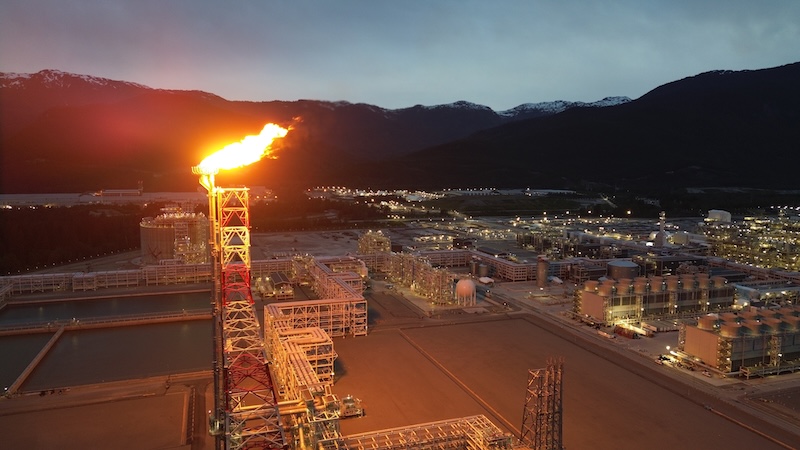
Canadian pension investors Blackstone LNG Canada stake, Digi Mart USA News (Kitimat, British Columbia): Four Canadian pension investors have signed a US$3.1-billion deal with U.S. asset manager Blackstone that will tie them financially to a major liquefied natural gas (LNG) export facility in British Columbia.
Blackstone and the Canadian group, which includes the Canada Pension Plan Investment Board, the Ontario Municipal Employees Retirement System (OMERS), the Investment Management Corp. of Ontario, and the Public Sector Pension Investment Board, are acquiring a 49.9% non-controlling interest in a Mitsubishi Corporation subsidiary that holds a 15% stake in LNG Canada, The Canadian Press reported on Nov. 2.
LNG Canada in Kitimat, British Columbia, is Canada’s first large-scale liquefied natural gas export terminal. It is a joint venture between Shell, PetroChina, Malaysia’s Petronas, Mitsubishi Corporation, and South Korea’s Korea Gas Corporation (KOGAS).
Mitsubishi values the 49.9% stake at approximately $1.6 billion, and the balance of the investment is intended to fund LNG Canada’s Phase 2 expansion, which is expected to come online in the early 2030s.
Pension advocates warn that the Canadian institutions are gambling their members’ financial futures with the deal. “By investing billions in LNG Canada through American private equity funds, four of Canada’s largest pension funds have ignored their core obligations to their contributors and beneficiaries,” sustainable pension advocacy group Shift Action for Pension Wealth and Planet Health (Shift) said in a media release.
“These pension funds are gambling their own members’ retirement savings on a high-risk, highly-polluting LNG facility that’s harming local residents and contributing to catastrophic climate change.”
Shift added, citing a 2024 Clean Energy Canada report, that “if fully built, the LNG Canada facility would release more than 2.9 million tonnes of carbon dioxide equivalent per year, the single largest point-source of greenhouse gas emissions in B.C., and enable another 6.5 Mt of upstream emissions.”
According to Blackstone, the investment in Phase 2 will help double the facility’s production to 28 million tonnes annually, making it one of the largest LNG facilities in the world, and will help meet rising global energy demand. However, the investment comes amid forecasts of a major wave of new global LNG supply.
Analysts told The Energy Mix that a global oil and gas glut is approaching and is expected to be in full swing by the time the expanded facility is built and operational.
Richard Brooks, climate finance director at environmental group Stand.earth, said Canadians should be “extremely alarmed” to see pension funds investing in LNG on behalf of millions of workers and retirees, according to The Canadian Press. “Canadians should have a say where and with whom their retirement funds are invested,” Brooks said in a news release.
“While geopolitical instability has driven up interest in Canadian LNG, this is still not a risk-free investment, particularly in the long term.”
Brooks said the world is scaling up clean energy infrastructure in order to reduce dependence on energy imports. The price of energy has skyrocketed in Europe and Asia since the United States and Israel launched their war on Iran in February, disrupting supplies from the Persian Gulf.
“The bottom line is that every dollar of workers’ pensions put into LNG Canada is a dollar not building the clean energy future,” Brooks said. “That capital should instead be accelerating clean energy projects with better long-term returns.”
Geoff Souter, managing director at CPP Investments, said in a news release Monday that LNG Canada “is a high-quality, globally strategic asset with strong long-term fundamentals and attractive return potential for the CPP fund.”
Pension plan contributors and beneficiaries cited by Shift are looking beyond the returns. Lee Ramsay, a retired librarian and OMERS member in Toronto, said in the media release: “It’s unacceptable that OMERS is using my pension to invest in fossil fuel infrastructure that undermines my own retirement security while causing harm to the municipal employees working through extreme heat, deadly wildfires, and toxic smoke.”