
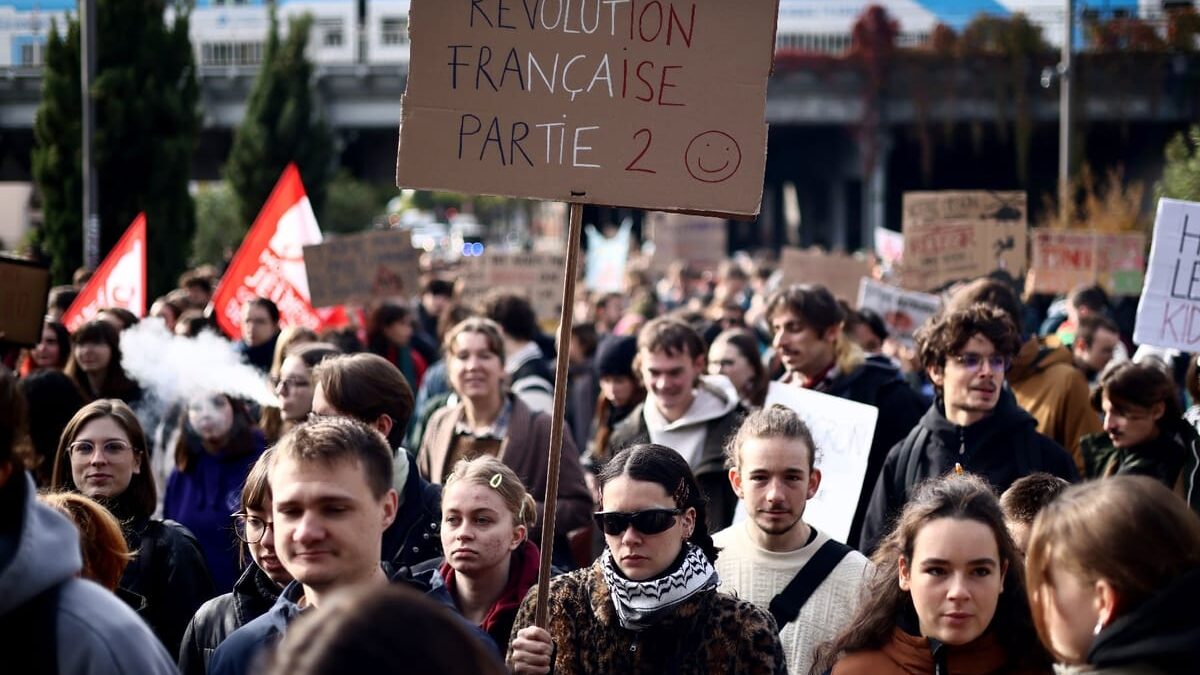
France nationwide strike and protests over cost of living and wages, Digi Mart USA News (France): The first nationwide call since the start of the autumn session to involve both the public and private sectors has drawn high school and university students, who continue a movement that began in mid-September, as well as the yellow vest movement, which has renewed protests against the high cost of living over the past three Saturdays. Farmers from the Confédération paysanne are also among those joining, according to the source.
Marylise Léon, general secretary of the CFDT, said “this will be a fine mobilization,” citing turnout indications similar to those seen during the pension protests. In 2023, the pension issue drew nearly 1.3 million people on certain days over several months, according to authorities.
For Thursday, authorities expect 500,000 to 700,000 people outside Paris and 40,000 to 80,000 in the capital.
On Wednesday evening, Interior Minister Laurent Nuñez announced the mobilization of 70,000 police officers and gendarmes, promising “an extremely firm response” to any possible “excesses.” The extent of strike participation in companies remains uncertain amid weak purchasing power.
Unions are demanding an increase in the minimum wage (Smic), which has not received an across-the-board boost since 2012, a raise in all salaries, greater tax fairness, preservation of public services, and better study conditions for young people. Regarding the minimum wage, the only one in France with automatic adjustments, the Labor Minister said on Tuesday he hoped to make announcements “around November 5,” without specifying whether this would be a direct increase.
Frédéric Souillot of FO, speaking to Le Parisien, called for acceleration on the Smic and an immediate “flash” negotiation on wages, while envisaging “other demonstrations” and a renewable strike. Rising fuel prices and a proposed austerity budget have placed purchasing power at the center of the growing discontent, which has intensified since late summer.
A barometer published Wednesday by organizations in the Pacte du pouvoir de vivre, including the CFDT, found that one person in two says they are struggling to get by on their household resources. Following demonstrations marked by violence and clashes with police, particularly on October 17, this day of mobilization is accompanied by protests over alleged infringements on the right to demonstrate, as several cities have banned marches in parts of their city centers.
In Toulouse, the intersyndicale decided to keep its original route. In Bordeaux, an agreement was reached after lengthy negotiations on a city-center route with a restricted zone along the busiest shopping streets, according to the prefecture.
In Lyon, the prefecture, which had banned the demonstration in the city center and proposed an alternative route, won its case in court. In Paris, the administrative court validated on Wednesday evening the alternative route proposed by the police prefecture between the Place de la République and the Place de la Nation, which organizers had contested.
Vincent Gautheron, general secretary of the CGT Île-de-France, told AFP that organizers would “in full responsibility” call on people to join that route. Sophie Binet said “we are in an extremely serious moment with a very dangerous authoritarian drift by the government.” Organizations including the Syndicat de la magistrature, the Syndicat des avocats de France and the Ligue des droits de l’homme also denounced an “authoritarian shift” and referred the matter to the Conseil d’État.
Fabrice Fort, central CGT union delegate at Renault Trucks, said a cumulative effect is emerging: sympathy for the high school and university students’ movement is not waning, and people are questioning restrictions on freedoms linked to protest bans, creating a surge of mobilization among people who do not usually speak out. He predicted strong participation.
The anger is expected to continue beyond Thursday. The yellow vest coordination has called for a rally on Saturday at Place de la Concorde in Paris, even though it is banned.
Together with housing rights unions and associations from six other European countries (Italy, Portugal, Spain, Belgium, Greece and the United Kingdom), it has also called for “coordinated demonstrations” against the cost of living at the end of November.











