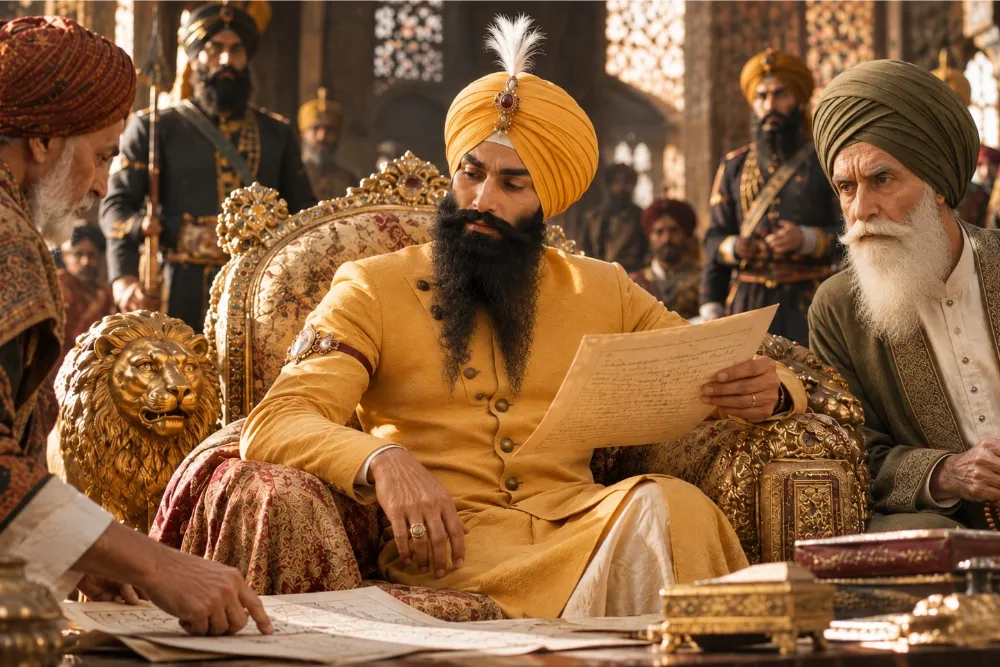
AI film Maharaja in Denims, Digimart Global: The feature-length generative AI film adapted from author Khushwant Singh’s novel Maharaja in Denims is nearing completion, according to a Variety report. The novel follows a young man who relives the life of 19th-century Sikh ruler Maharaja Ranjit Singh.
The makers hope to release the film by April 2027, in time for Baisakhi, the Punjabi harvest festival. Ahmedabad-based Twenty-Twenty One Studios has joined as co-producer and is weighing a theatrical run followed by non-theatrical distribution.
Punjab-based independent filmmaker Balpreet Kaur is directing and holds final creative control.
A project that took years to reach the screen
The book was optioned in July 2020 by producer Guneet Monga Kapoor, but that version was never made. Singh, who is also CEO of Intelliflicks Studios, the company producing the AI film, said the timing worked against it, as the option came during the COVID-19 pandemic and cinemas were slow to recover.
The AI route came from Gurdeep Pall, then corporate vice president of incubations at Microsoft, who proposed the approach during a 2023 visit to Chandigarh. Singh and Pall co-founded Intelliflicks that year and unveiled the project with a short clip in 2024.
Consistency was the central challenge
According to the report, production began in 2024 using Midjourney and Runway, then moved to Google Veo, with Nano Banana handling stills, before using Kling AI, Seedance 2.0 and tools available on Higgsfield. Keeping faces, costumes and sets consistent required heavy manual fixes using face-swapping software, Photoshop and Adobe Firefly.
Singh said Nano Banana became a turning point by generating new camera angles from reference images with fewer manual corrections, but near-perfect shot-to-shot consistency was only achievable in the past four or five months. The team rebuilt the stills for the entire film three times before settling on a look.
Singh said the budget rose as a result, and he put the cost at more than $500,000, excluding marketing.
Human-led creative process
Singh told Variety that screenwriting, direction, storyboarding, shot composition, performance evaluation and final creative decisions remain with the human filmmaking team. He said the AI tools help translate that vision to the screen and argued that human involvement will still be needed in AI-assisted cinema.
The report also says every song was written, composed and performed by people, with dubbing and narration recorded with actors in the studio.
The film is set in 2008 and follows Hari Sandhu, who has flashbacks to three earlier lives: as Ranjit Singh, as a victim of Partition violence in 1947, and as a victim of the 1984 anti-Sikh violence. Singh said the team stayed close to historical sources but took liberties where the tools could not render period costumes accurately.
Variety also noted that the project joins a long line of Ranjit Singh productions, including a big-screen biopic announced last week by Katha Studios and B4 Makers Studios, which is set to shoot in 2027. Singh described the film as an experiment, saying it will be the first full-length generative AI film rooted in realism.