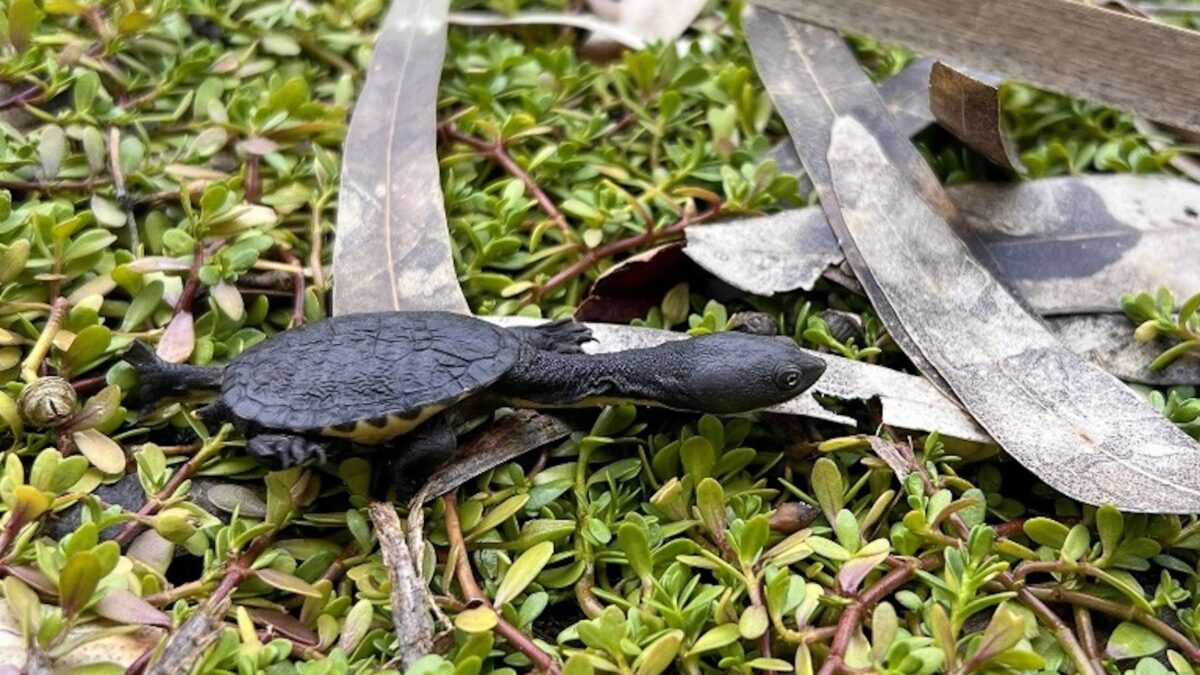
Australian turtle hatchlings, Digimart Global (Western Australia): A tiny southwestern long-necked turtle (Chelodina colliei), released in the wetlands of Perth in Western Australia, has been found alive more than a year later and is now about 21 times heavier than when it was freed. Researchers from Murdoch University say the recapture is the first confirmation that a turtle hatched in a laboratory can survive in good health in the wild.
In July 2025, the turtle weighed no more than 4.77 grams when the team released it at Lake Manning. The aim of the release was to test whether turtles from artificial incubation could survive in nature.
Because hatchlings are too small for long-term tracking technology, the researchers could not follow the animals closely after release.
The threats facing these turtles are well documented in the source. Predators are increasing, road deaths and drying habitat are reducing their range, and climate change is adding pressure.
Researchers have also noted that young turtles are becoming scarcer in local populations, and the species is found only in the southwest of Western Australia.
In October, during the annual population survey at Lake Manning, the team captured a turtle released more than a year earlier. Because it was too small for current tracking devices, it was identified by comparing photographs with the hatchlings released.
The animal had grown from 4.77 grams to about 100 grams. Researcher April Sturm, a doctoral student, described the result as an encouraging sign that artificial incubation could help increase juvenile numbers where they are scarce.
Scientists stress that the result still needs confirmation. A single surviving individual does not prove that the survival was not due to chance, and the researchers say incubation should remain a last-resort measure used alongside other conservation methods.
Anthony Santoro, a researcher at the Centre for Sustainable Aquatic Ecosystems, warned in a statement that if the species were lost from this region, it would disappear forever.