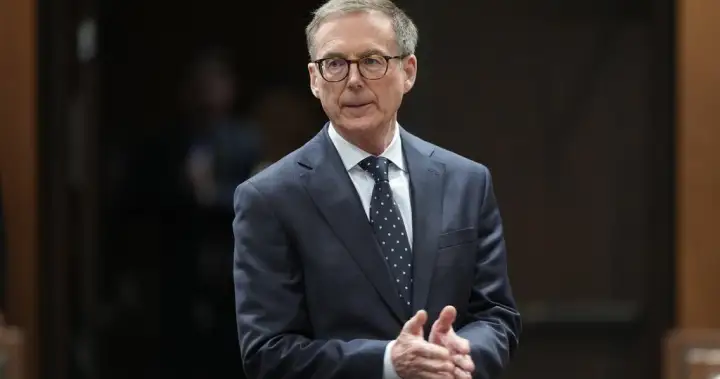
Bank of Canada economic shocks, Digimart Global (Canada): Bank of Canada Governor Tiff Macklem said Tuesday that global economic shocks are “likely to be larger” and more frequent amid trade conflicts and war. Speaking at the Economic Club of Canada, he said the central bank remains committed to its two per cent inflation target to keep consumer prices from rising to levels seen in the years following the pandemic.
Macklem said the central bank cannot prevent those shocks or their ripple effects, but monetary policy can keep them from undermining price stability. “In uncertain waters, it’s more important than ever to have a trusted anchor,” he said.
He also said the two per cent framework, which the central bank renewed earlier this month for five more years, has served Canadians well.
Inflation and the policy response
Macklem pointed to the inflation spike that followed the COVID-19 pandemic and the start of the Ukraine war, when the inflation rate reached about eight per cent in 2022, its highest in nearly 40 years. He contrasted this with the high inflation of the 1970s and 1980s, when rates reached 10 to 13 per cent before a formal target was in place, and said severe recessions in the early 1980s and 1990s were needed to bring them down.
Multiple rate hikes from 2022 to 2024 helped lower inflation below the two per cent goal, according to Macklem, but Canadians are now facing a rate of about three per cent. He said the Iran war and U.S.
trade conflict make it difficult to respond in a way that will lower rates, and that extreme weather and artificial intelligence are adding “new layers of disruption.”
Supply shocks and the outlook
Macklem said supply shocks, such as disruptions to oil, can push prices up while slowing economic growth at the same time, leaving households with higher prices and worse job prospects. In such cases, the central bank must weigh the risk of persistent inflation against the risk of weakening the economy through interest rate changes.
Late last month the Bank of Canada raised its key rate by a quarter point to 2.5 per cent, a move that was widely expected, and the bank said inflation for 2027 could reach about 3.1 per cent, up from the two per cent forecast in July. Macklem said oil prices and refinery margins have come down since October, suggesting inflation may not be as high, but he also said the oil shock’s second-round effects will add to inflation persistence.
He noted the economy has shown more resilience than expected.
The bank’s next and final decision of 2026 is expected in December, and Macklem did not indicate whether it would hike again or hold steady. He said his assessment of inflationary pressures will change with developments in the Middle East and Canada’s relationship with the U.S., while the ongoing adoption of AI could be “bumpy.” The bank also released an inflation dashboard this week bringing together the major price indicators it monitors.