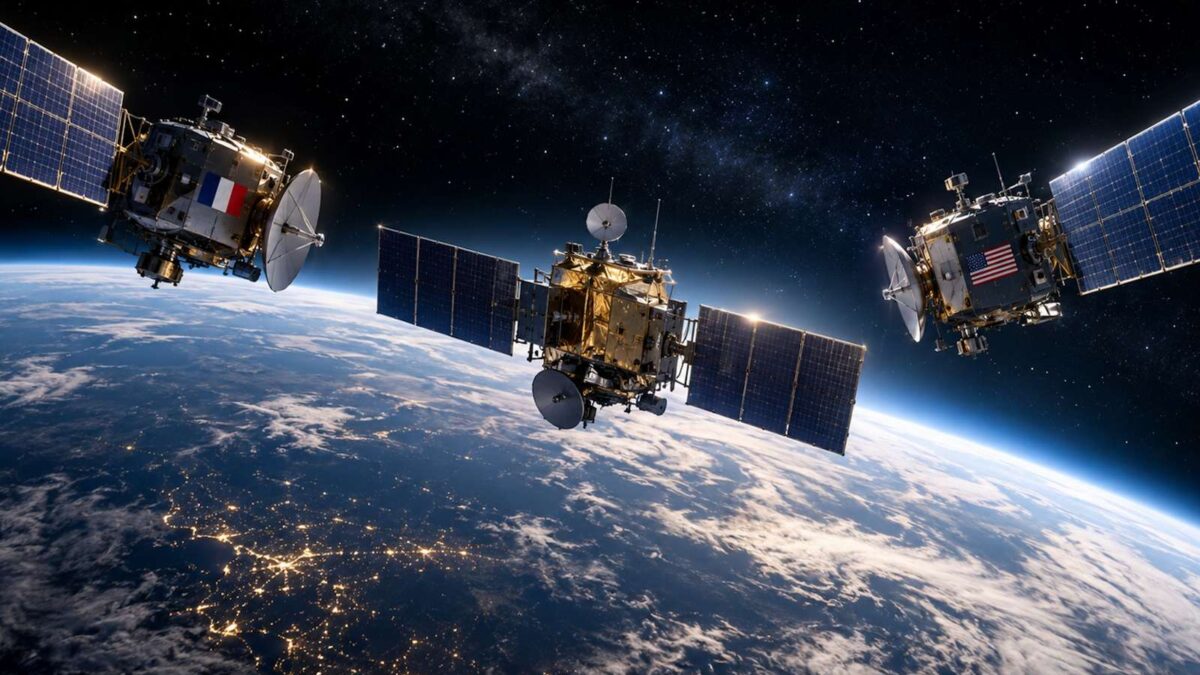
French US military satellites, Digimart Global: France has said for the first time that it carried out, together with the United States, a manoeuvre bringing two of their military satellites close to a satellite belonging to a rival country. The operation was described by General Bellanger, chief of staff of the French Air and Space Force, in an interview with the newspaper L’Opinion.
According to the publisher’s report, the general did not name the country concerned and gave no details of the operation. The report notes that few actors are active in space, and that Russia has previously carried out aggressive close-approach manoeuvres, so attention has focused on Moscow.
The report does not confirm that Russia was the country involved.
What is known and what remains unclear
The report says it is not known when the manoeuvre took place, which rival satellite was involved, the altitude or the closest distance reached. It is also unclear whether the operation included jamming, electronic espionage or dazzling of optical sensors.
The report states that both satellites returned to their respective orbits after the manoeuvre.
The publisher also recalls earlier examples. In 2018, Russia approached the Luch-Olymp satellite close to the Franco-Italian military satellite Athena-Fidus in geostationary orbit, about 36,000 kilometres up, an event that prompted France to accelerate its military space doctrine and create a Space Command.
In October, a Russian satellite, Cosmos 26-12, reportedly manoeuvred within a few tens of metres of a satellite operated by Finland’s Iceye for the United States and used to support Ukraine. The report asks whether the Franco-American operation is a response to that threat, but notes the general gave no answer.
A signal in a more contested orbit
The report says France and the United States had previously conducted coordinated manoeuvres in orbit, about a year earlier, when the satellites came within 25 kilometres of each other. This time, however, the report describes the manoeuvre as deliberately directed against an adversary.
The publisher presents the announcement as a sign that space competition is intensifying and that France wants to show it can exert military weight in orbit.