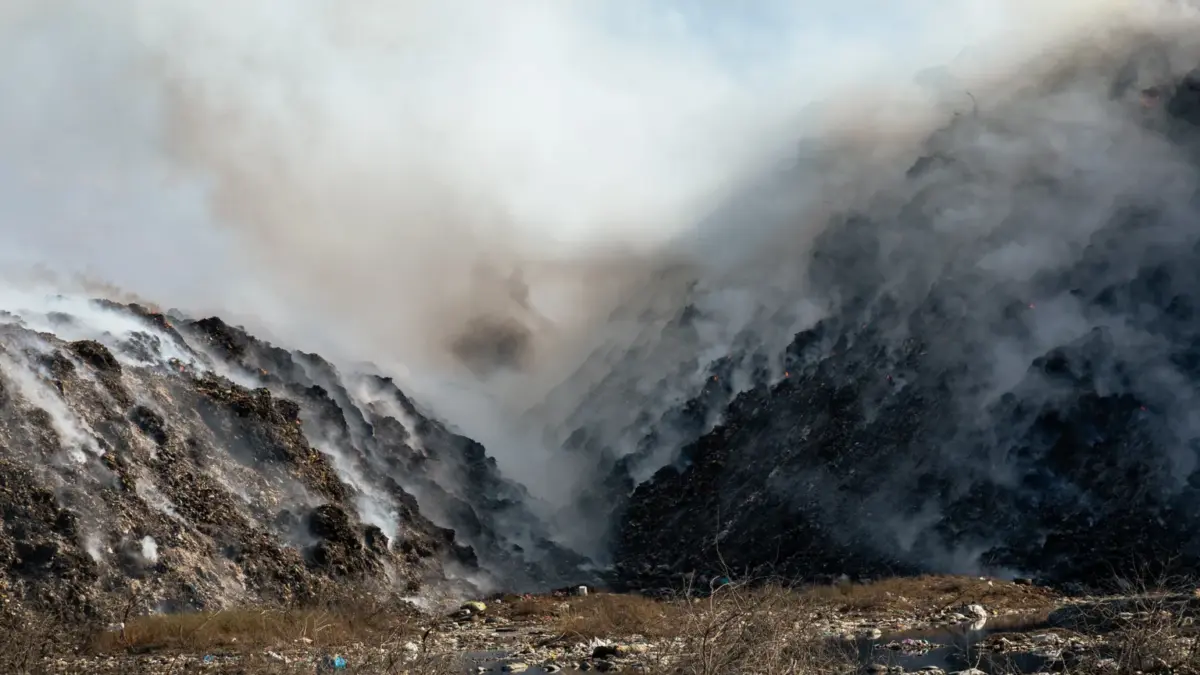
Mexico rural trash burning Inegi 2025 survey, Digi Mart USA News (Mexico): More than 3.4 million homes in Mexico habitually burn their garbage, according to the Inegi 2025 Intercensal Survey. The practice occurs in 8.65 percent of private homes in the country, highlighting the shortcomings of public waste collection and treatment systems, with direct consequences for the health of millions of people and for ecosystems.
Of the 39.6 million homes considered in this indicator, 83.17 percent hand their waste to a collection truck or cart, while 6.38 percent deposit it in containers. Another 1.06 percent take their waste directly to public dumps, 0.2 percent bury it, and 0.5 percent throw it into streets, vacant lots, ravines or rivers.
That last figure represents 199 thousand homes that directly contribute to environmental contamination.
Territorial inequality is especially alarming in localities with fewer than 2,500 inhabitants, where only 55.69 percent of homes give their garbage to a collector, while 35.41 percent choose to burn it. This implies that roughly 2.8 million rural homes are exposed to a practice that pollutes the air and can release toxic substances.
By contrast, in cities of 100,000 inhabitants or more, garbage collection reaches 91.1 percent of homes, and burning falls to 0.5 percent. The situation reflects a deep inequality in access to basic public services, affecting rural communities and municipalities with lower institutional capacity in particular.
Differences among states are also worrying. In Chiapas, 30.1 percent of homes burn their waste; in Oaxaca, 28 percent; in Guerrero, 26.5 percent; in Tabasco, 25.7 percent; and in Veracruz, 21.5 percent.
By contrast, Nuevo León has a rate of only 1.5 percent, while Mexico City registers just 0.1 percent.
The problem worsens when waste separation is considered. Nationally, only 47.43 percent of homes separate their organic and inorganic waste, while 52.52 percent do not.
Disparities are significant: in Mexico City, 82.6 percent carry out this separation, while in Baja California only 19.3 percent do, in Sinaloa 21.8 percent and in Sonora 22.2 percent.