

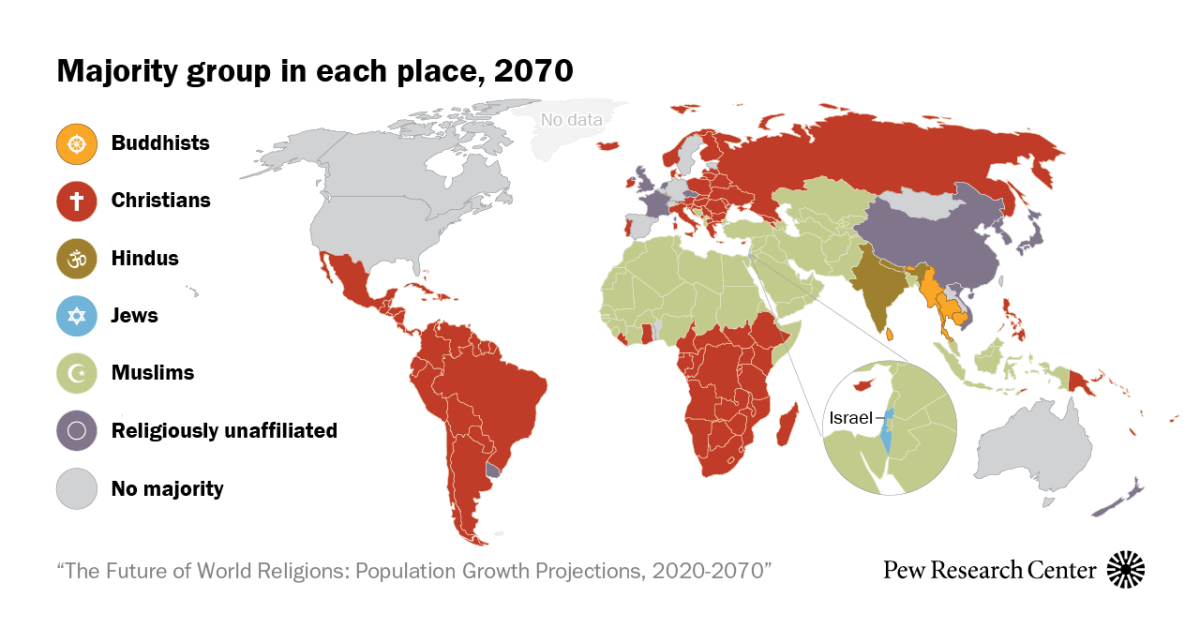
Muslim population projected to overtake Christians by 2035 Pew Research, Digimart Global: Muslims are expected to outnumber Christians by 2035, according to new projections from the Pew Research Center. Both groups are growing, but Muslims are growing faster, and if recent trends continue, there will be more than 3.6 billion Muslims and just under 3 billion Christians worldwide by 2070.
The projections, published by the Pew Research Center, cover seven religious groups across 201 countries and territories, which together account for 99.98% of the world’s population. The study models change between 2020 and 2070 and is part of the Pew-Templeton Global Religious Futures project.
The researchers note that the results are not intended to predict every way the world could change, since events such as wars, natural disasters, epidemics and economic shifts are not analysed.
The world’s total population is projected to increase by 29% between 2020 and 2070. Christians are projected to grow by 30% and Muslims by 80%. As a result, Muslims would make up 36% of the global population in 2070, up from 26% in 2020, while Christians would remain at about 29%.
Other shifts are also expected. Hindus are growing in number but are projected to decline as a share of the global population, and Jews are expected to follow a similar pattern.
Buddhists are expected to shrink both in number and as a proportion of the world’s population. People with no religious affiliation are projected to fall from 24% of the world population in 2020 to 17% in 2070.
Fertility and age profiles are major drivers of these projections. During the 2020-2025 period, the total fertility rate for Muslims was 3.1 children per woman, compared with 2.0 for non-Muslims.
As of 2020, the median age of Muslims was 24, nearly a decade lower than the median age of non-Muslims at 33. Sub-Saharan Africa, where most people are Christian or Muslim, is expected to account for more than a quarter of the world’s population by 2070.
The projections also assume that recent patterns of religious switching and migration continue. The study notes that its previous projections, made in 2015, correctly anticipated the direction and scale of change for most groups, but the unaffiliated population grew faster than predicted between 2010 and 2020. The authors acknowledge that the projections may not capture new trends, such as a rise in disaffiliation or a religious revival.