Tiangong space station ultracold rubidium atom record, Digi Mart USA News (Tiangong space station, China): Researchers have brought a cloud of atoms within a whisker of absolute zero in a recent space experiment, according to a publisher report from New Atlas. The team aboard China’s Tiangong space station coaxed around 20,000 rubidium atoms into expanding, a process linked to an energy equivalent of 9.7 trillionths of a degree above absolute zero.
That figure is four times lower than the record of 38 picokelvin set by researchers in 2021. The report notes, however, that the extremely low number is an estimate based on the energy associated with the cloud’s expansion, rather than a conventional thermometer reading. Measurements of how quickly the cloud spread along three axes suggested a temperature somewhere between 7.0 and 12.9 picokelvin.
The experiment also tracked the cloud’s expansion far longer than in previous experiments, for a total of seven seconds. A slower expansion gives physicists more time to study the cloud’s quantum behaviour before it becomes too diffuse to use, and the source suggests the longer observation window could help future work.
The research builds on decades of ultracold physics. In June 1995, researchers at the US National Institute of Standards and Technology and the University of Colorado at Boulder cooled rubidium to 20 billionths of a degree above absolute zero, creating a Bose-Einstein condensate, a state in which multiple atoms occupy the same quantum state.
The earlier 2021 record used freefall in a drop tower at the University of Bremen in Germany.
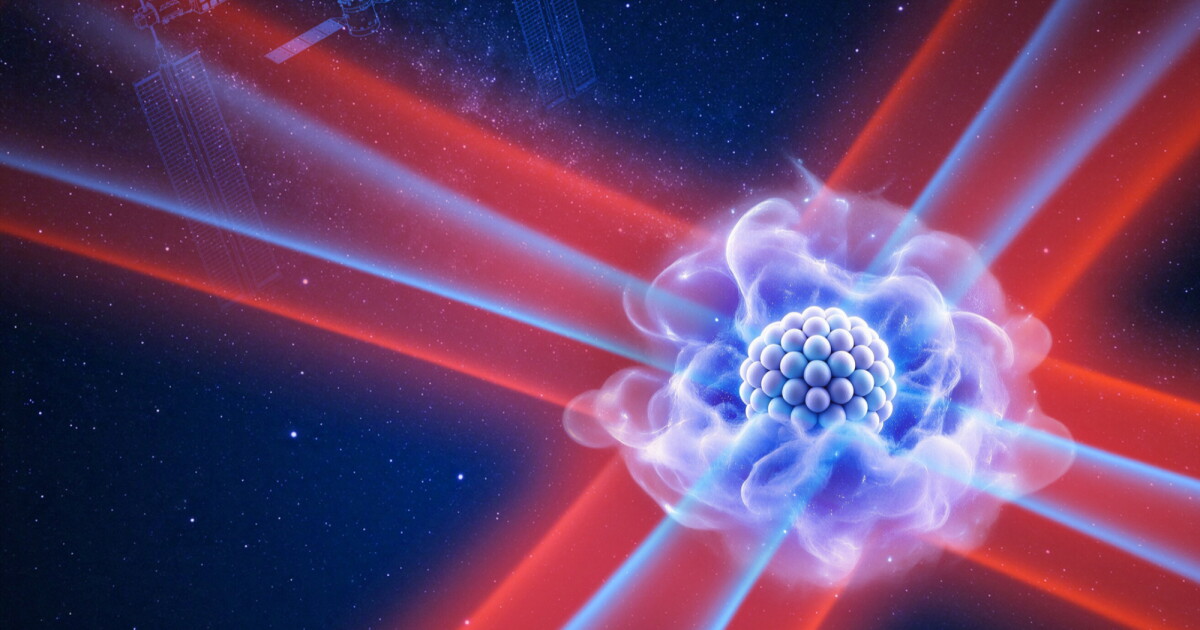
The orbital team used intersecting laser beams to hold atoms in an optical dipole trap, which confines atoms in a magnetically insensitive state. Lasers and evaporative cooling produced the condensate, and a magnetic field gradient expelled faster-moving atoms before the remaining slow atoms were moved into a wider trap and released.
According to the report, the approach could support interferometer experiments that test whether different atoms fall identically, which may offer new ways to test general relativity.