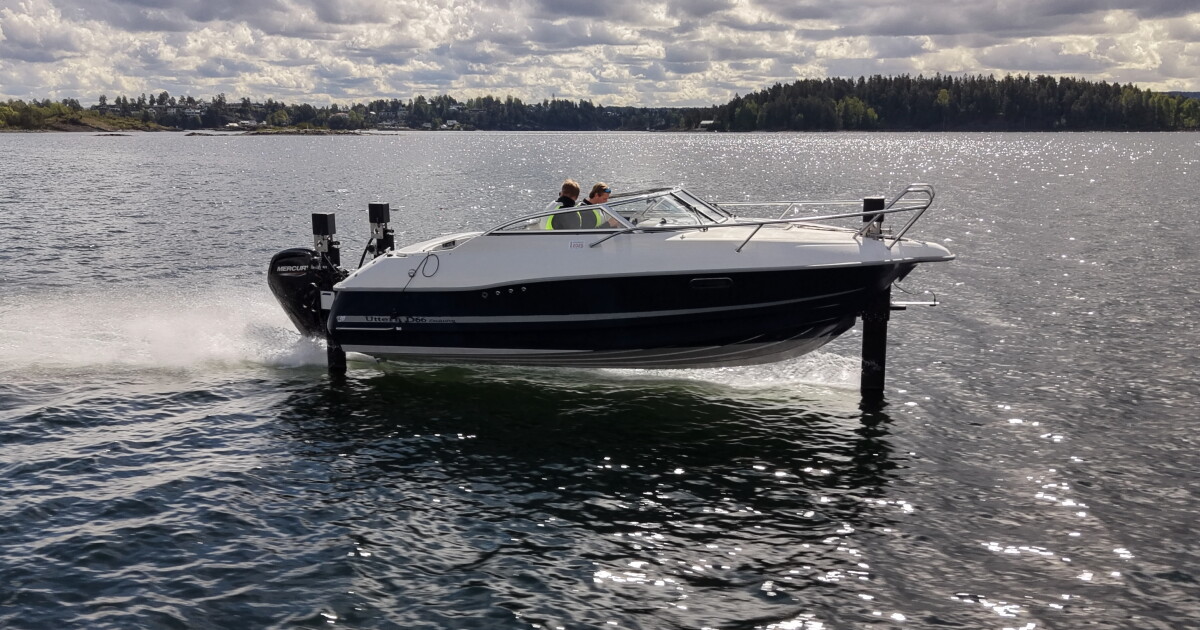
Lift Ocean ONE hydrofoil kit, Digi Mart USA News: Hydrofoils generally tend to be faster, more fuel-efficient and smoother-running than conventional boats. Norwegian company Lift Ocean has now developed a kit called ONE that aims to convert existing boats into hydrofoils, according to a report on New Atlas.
The ONE system is available to order now through the company’s website, but it will not begin shipping until sometime next year. For the moment, it is being offered only to watercraft manufacturers and fleet operators, who could offer speedboats with a foiling option if their clients want one.
It is not sold to individual owners of motorboats.
The kit has three main parts. The first is a set of three motorized foil assemblies, each consisting of a vertical mast with a movable wing at the bottom: two wings are mounted on either side of the single outboard engine at the stern, and the third is at the bow.
The second is an engine lift bracket that moves the third-party engine, either internal combustion or electric, up and down to keep the propeller in the water. The third is a flight control system of hardware and software that ties the components together.
When not in use, the foils retract fully out of the water, which the company says reduces marine growth on them and allows normal operation in shallow water. The foils are deployed at zero or low speed from a helm-mounted control panel.
According to Lift Ocean, takeoff on a lighter craft occurs at about 16 to 18 knots (around 20 mph or 31 km/h), and cruising speed is reached at 20 to 25 knots (around 26 mph or 42 km/h).
Users can select Low, Medium or High flight heights depending on wave height. Onboard sensors, including radar modules and dual GPS antennas, continuously send data to the flight controller, which operates the wings.
Different wings can also be swapped in, depending on whether users prioritize performance, efficiency or easier cruising.
The current version of ONE is designed for speedboats 6 to 9 m (20 to 30 ft) long, at least 2.4 m (7.9 ft) wide and weighing no more than 2.5 tonnes (2.75 tons). Lift Ocean’s Lars Bay told New Atlas that performance will vary because boats differ in weight and width.
He said the company’s measurements on its own test boats and client samples show roughly a 50% reduction in fuel consumption, a figure based on the company’s own testing rather than independent verification.