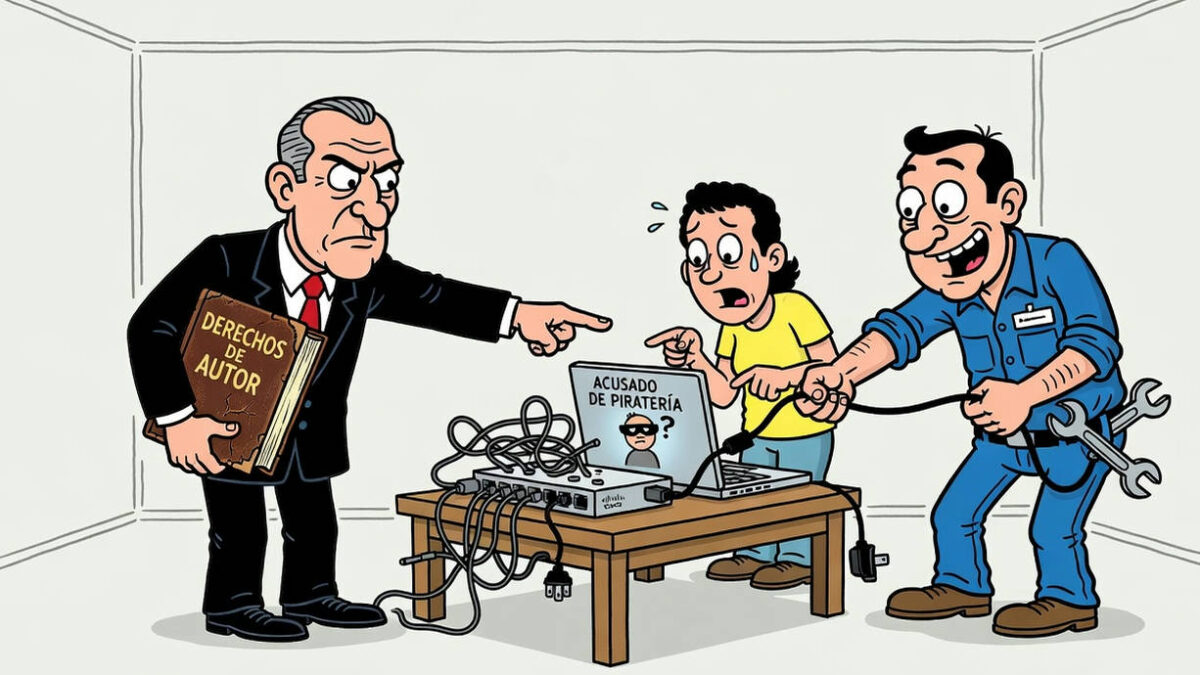
Mexico Senate approves copyright reform on repeat internet piracy offenders, Digi Mart USA News (Mexico): The Mexican Senate approved a reform to the Federal Copyright Law by a vote of 72 to 37 that brings internet service providers under the conditions for protection from certain liability for infringements carried out through their services. Among the requirements is having a policy to terminate the service of repeat infringers.
The Chamber of Deputies had already approved the text. Following the Senate vote, the decree must complete the corresponding procedure before it is published and takes effect.
The government proposed the changes in May, arguing that they would align Mexican legislation with the trade agreement between Mexico, the United States and Canada, known as the USMCA.
The discussion also comes under pressure from U.S. rights holders, who have demanded clearer rules on intermediary liability when their services are used to infringe copyright.
In January, the copyright industry coalition IIPA argued that Mexico’s 2020 reform did not establish a clear principle of secondary liability for those who induce or promote infringement. In April, the USTR moved Mexico to a lower tier of its piracy watch list and cited the draft amendments, according to a report by TorrentFreak.
Mexico incorporated safe harbors inspired by the U.S. DMCA in 2020, a framework that limits the liability of certain intermediaries when they meet legal conditions.
Under that scheme, hosting platforms and search engines can only access that protection if they have a policy to remove accounts of repeat infringers; the obligation did not extend in the same way to regular internet access providers. The new reform adds those providers to the requirement: to qualify for protection, they must have a policy to terminate the service of users considered repeat infringers.
That policy must be permanently published on the ISP’s website and in its terms of service, and must include a basic mechanism for notifying users. The potential consequence goes beyond closing an account on a platform: what could be interrupted is the internet connection itself.
The Mexican business outlet EL CEO noted that access providers such as Telmex and Izzi would need such a policy to meet the new conditions.
The reform provides that an ISP that fails to meet the conditions of its safe harbor may be exposed to liability if, knowingly, it contributes to, induces or causes the infringement. It also contemplates cases where the provider can control the infringing user and obtains a direct financial benefit from the infringement; in such cases, the Mexican Institute of Industrial Property may impose fines of up to MXN $4,700,000, roughly USD $250,000, depending on the infringement.
The law leaves open who counts as a repeat infringer. The approved text does not explicitly define what constitutes a repeat infringer and does not set how many infringements would be enough for a provider to apply its termination policy.
That lack of a uniform threshold leaves each provider to set its own criteria, which could produce differences between companies. Aurora López-Portillo, director of legal services at ClarkeModet, told EL CEO that each provider would have to determine its own threshold.
She also recommended that ISPs verify whether accusations are well founded and allow users to respond, although she acknowledged that the law does not make those steps an express obligation.
The concern is not limited to how infringements are counted. A home connection is often shared, and conduct attributed to one person can affect everyone who lives with them.
During the debate, opposition senator Gabriel Elizondo warned that an entire family could lose internet access because of one member’s activity. Opposition legislators had proposed requiring a court order before service could be suspended, but that alternative was not included in the approved text.
As a result, the reform does not expressly establish a prior judicial procedure or a specific number of infringements to trigger a provider’s policy.
The Mexican approach differs from a recent debate in the United States, where the DMCA also requires providers seeking safe-harbor protection to adopt a repeat-infringer policy in appropriate circumstances. However, in March, in the Cox case, the U.S.
Supreme Court concluded that knowing about piracy and not acting alone is not enough to hold an ISP liable for contributing to it. In that case, the court overturned a USD $1 billion verdict against Cox.
Justice Thomas wrote that under the Court’s precedents, a company does not become a copyright infringer by offering a service to the general public even if it knows some users will use it to violate those rights.
According to TorrentFreak’s description, the difference lies in how Mexico’s safe harbor operates: failing to meet its conditions, including the repeat-infringer policy, is a factor that can cause a provider to lose that protection. Even so, losing safe-harbor protection does not automatically equal liability; the ISP must also have knowingly contributed to, induced or caused the infringement, or be able to control the user and directly benefit from it.
The new rules will take effect 180 days after publication in the Official Gazette of the Federation. The report noted that, at the time of its publication, that publication had not yet occurred, so the effective date depended on that step.
It remains to be seen how Telmex, Izzi and other providers will draft their policies and what criteria they will use to distinguish an isolated infringement from repeat infringement. The absence of a legal definition, together with the lack of an express court-order requirement, keeps open the debate over how to balance copyright protection with continued internet access and the ability to respond to an accusation.