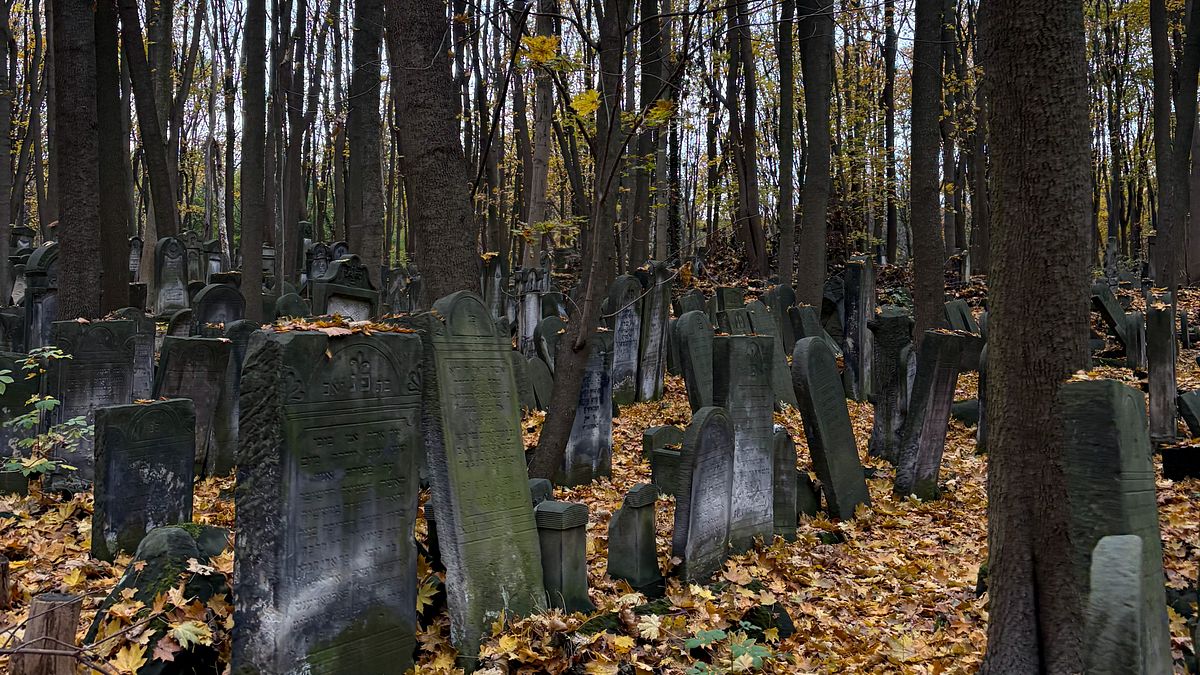
Warsaw Jewish cemetery and Polin museum visit reflecting on Kristallnight and the Holocaust, Digi Mart USA News (Warsaw, Poland): On a windless October day, visitors pass through a gate in the wall of Warsaw’s Jewish cemetery, where men are handed black kippahs before entering. The yellow leaves of the tall maples cover the grounds, and the darkened gravestones stand close together, many of them tilted, overgrown with algae and moss, or broken.
The Jewish cemetery, located beside the busy Okopowa Street, is one of the largest of its kind in the world, with up to a quarter of a million marked graves. Many belong to victims of the Holocaust.
The Nazis blew up buildings on the cemetery to make room and dug mass graves for Jews who fell during the ghetto uprisings of 1943 and 1944.
The Jewish ghetto was established in 1940, and in the summer of 1942 deportations of Jews to various extermination camps began. The process moved quickly: within a month, 300,000 of the total 350,000 had been deported, and the ghetto was reduced to a quarter of its area.
On April 19, 1943, the SS moved in to finish the job.
The Jewish resistance that remained had armed itself with revolvers, carbines and petrol bombs. It took the Germans, with artillery and armored vehicles, a month to suppress the resistance.
About 7,000 Jews fell in the uprising, and the rest were deported to the Poniatowa, Trawniki, Majdanek and Treblinka camps.
At the cemetery, time seems to have stopped. The cemetery was opened in 1806, and many graves were added more than a century before the horrors of the 20th century.
After World War II, too few Jews remained to maintain the site. When Germany invaded Poland in 1939, about 3.3 million Jews lived there; around 90 percent of them were murdered during the Holocaust.
Before World War II, 375,000 Jews lived in Warsaw, which had Europe’s largest Jewish population and the world’s second largest after New York. By 1945, only a few thousand Jews remained, and many felt compelled to conceal their identity.
In politics, the idea grew that the country’s Jewish population should shrink through emigration.
In 1990, the Jewish congregation began renovating the cemetery, where 20 to 30 burials take place each year in a newer section, with bright gravestones decorated with flowers, candles and wreaths. Small stones left by relatives also mark the graves.
After the cemetery visit, the author goes to Polin, the Museum of the History of Polish Jews, which is located in the Muranów district, the site of the Jewish ghetto. The exhibition shows the life of Jewish homes, towns and synagogues.
After World War I, when Poland regained independence and Jews became citizens, the country became one of the world’s leading centers of Jewish culture and community life. But the minority also faced growing antisemitism and discrimination.
A pogrom occurred as early as November 1918 in Lwów (today’s Lviv in Ukraine).
During the 1930s the situation became dramatically worse. Nationalist groups urged Poles not to shop in Jewish stores.
The number of Jewish students at universities was limited through quotas and other obstacles, and at several universities separate seating for Jews, so-called ghetto benches, was introduced. Jewish shops and homes were attacked.
In politics, the idea grew that the country’s Jewish population should shrink through emigration. Although Poland did not introduce a system equivalent to the Nuremberg Laws, the situation became so threatening in practice that many who could emigrated.
Others had no such options and stayed.
Meanwhile, Nazi Germany escalated its persecution of Jews. The night of November 9–10, 1938 marked a decisive escalation into organized mass violence.
The Nazis carried out a nationwide campaign of violence against Jews in Germany and annexed Austria. Synagogues were set on fire, and Jewish shops and homes were vandalized and destroyed.
People were beaten and murdered.
The victims could also be perpetrators.
The memory of the November Pogrom, or Kristallnacht as it became known for the broken glass from smashed shop windows, must be kept alive. It is a reminder that persecution of Jews in Europe could be escalated openly, before the step to full-scale genocide.
Although some international protests were heard, the event did not, for example, lead the world to offer Jews refuge to the extent that was needed.
Three years after Kristallnacht, the exhibition timeline at Polin shows place names such as Jedwabne, Radziłów and Wąsosz. These are Polish towns where massacres of Jews were carried out in 1941, though not by the German occupying forces.
It has been documented that in Jedwabne local residents rounded up their Jewish neighbors, herded them into a barn and burned them alive. When historian Jan T.
Gross presented this part of Polish history in 2001, it provoked a major debate. Although Nazi Germany undoubtedly created the conditions and drove the persecution, Polish actors took an active part in the killings.
The victims could also be perpetrators.
Europe is now seeing antisemitism grow again, leading to the curtailment of Jewish life through open hatred and direct threats. Jewish families in Europe in the 2020s, as in the interwar period, are talking with one another about where they could move.
At the Jewish cemetery in Warsaw, one does not need particularly good hearing to perceive the silent appeal from those who no longer have a voice: that this time we must act differently.