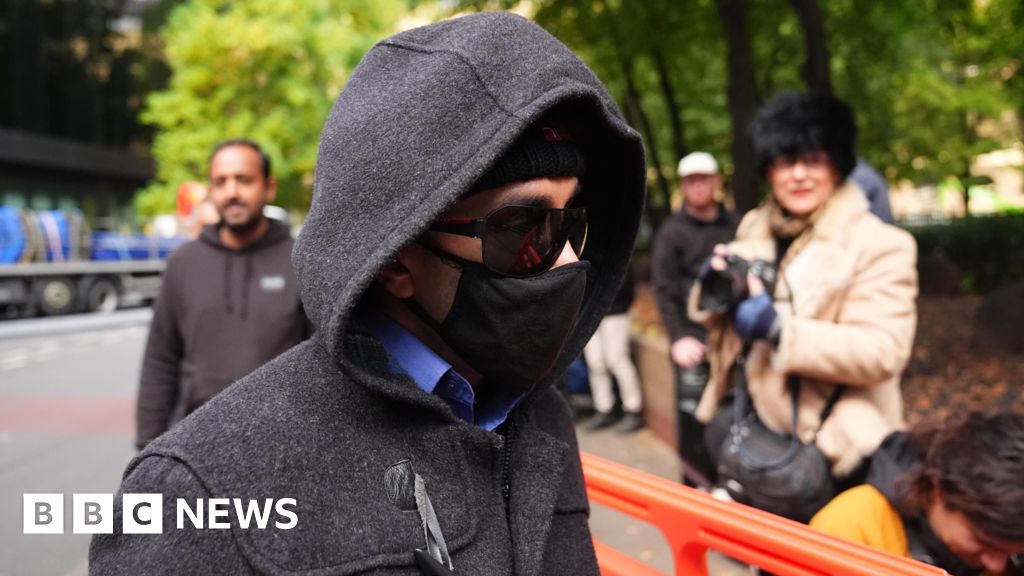
UK civil servant Kashim Chowdhury, Digi Mart USA News (London, England): Aleesha Adams joined a video call with Kashim Chowdhury in May 2023. He had been on sick leave from his job at the UK Health Security Agency (UKHSA) for nearly three months, and Adams, his line manager, wanted to put a plan in place to ease him back into work.
At the start of the call, Chowdhury was coughing and holding tissues up to the camera to show how ill he was. What caught Adams’ attention, however, was how pale he looked.
She noticed white powder had begun separating from his forehead.
“He was sweating, it was like rubbing off, so it was darker underneath and darker on the neck,” she told his trial. She claimed he was wearing white make-up to look sick, something he denied in court.
Adams did not know that the UKHSA was not Chowdhury’s only employer. That month, he was also being paid to work full-time for the Department for Environment, Food and Rural Affairs (Defra), the Department for Business and Trade, the Food Standards Agency and the Home Office.
He was contracted to work 183 hours a week, more than the number of hours in seven days, and fraudulently earned more than £284,000 of taxpayers’ money.
In total, he held eight overlapping full-time public-sector jobs between 2020 and 2023. During that time, this relatively junior civil servant was paid £350,000.
Soon after her call with Chowdhury, Adams discovered that he had logged into the call using a Defra email address. When she challenged him, he blamed a technical error.
She told the jury at his trial at Southwark Crown Court: “I believed he was lying.” She escalated her concerns up the chain, but his fraudulent behaviour remained undetected. Chowdhury kept working multiple government jobs until September 2023, when he left the Civil Service.
He was finally caught in 2024 by the government’s National Fraud Initiative, which searches Civil Service databases, such as payroll, every two years to look for anomalies.
On Monday he was found guilty of nine counts of fraud and told by the judge that he would face a “very substantial custodial sentence.” Chowdhury, 56, arrived at court each day alone. He is married, yet there never appeared to be any friends or family there to support him.
He often made his way down the court corridors carrying two plastic carrier bags, with a bobble hat on his head, and sometimes looked bewildered in the witness box.
Chowdhury, who had been diagnosed with PTSD in 2015, said he had taken on so many roles because he feared losing his livelihood after experiencing insecure employment. He said he had been forced out of a job at the Department for Education in 2013.
He said he had not been thinking clearly when applying for jobs “because of my stress, distress and trauma and due to my panic at the time.” The prosecution, however, argued his behaviour was “deliberate” and “intentional dishonesty” and that he had exploited the system.
The case raises important questions for the Civil Service about how he was able to get away with it for so long. Part of the explanation is that the Civil Service’s human resources system is not centralised.
Chowdhury did not declare on government application forms that he was already a civil servant, so the system did not spot the duplication. Hannah Keenan of the Institute for Government said the system clearly failed.
“Government departments are taking hiring decisions independently of each other and without systems that join up,” she said.
“That the model and the culture surrounding it aren’t working shouldn’t be a surprise though – we’ve known for a long time about poor performers flying under the radar by shuffling between jobs.”
There are more than 550,000 people employed across the Civil Service, many in offices in Whitehall, in central London. They are responsible for carrying out government policy and the daily administration of the country.
Another reason the fraud went undetected is that Chowdhury worked entirely from the east London house he shared with his mother. In 2023 she had dementia and terminal cancer, and he told his employers he needed to be at home to look after her.
Rather than reducing his workload to concentrate on her care, he took on more jobs and covered his impossible daily schedule with sick notes from his GP.
In April 2023 he was off with what he called “mixed anxiety and depressive disorder” from Defra, the UKHSA, the Department for Business and Trade and the Food Standards Agency. While the sick notes were shown to the jury, no evidence was given about what caused the depressive disorder or whether a psychiatric assessment had been carried out during this period.
His sickness did not stop him from starting yet another job, this time at the Home Office, and he mentioned neither his illness nor his other employment to them.
A succession of his line managers told the jury he had not been very good at his jobs. Dan McCartney, who managed Chowdhury at Defra, said he had to “effectively tell him what to do the whole time” and that Chowdhury kept his camera off during video calls for four months, claiming technical problems.
Because Chowdhury was not subject to any formal performance measures at Defra, he was given a permanent job and remained there for two years.
In September 2023, Chowdhury was found to have more than £40,000 in his bank accounts, as well as significant investments including £45,000 in premium bonds.
A recent survey of 1,700 civil servants by the independent think tank Re:State found 76% of respondents believed the Civil Service did not do a good job of tackling poor performers. An ex-senior civil servant told the BBC that much of the Civil Service is culturally averse to performance management.
“Whitehall’s known for ages it has to be less risk averse. Shrinking the Civil Service and the adoption of artificial intelligence technology make that more vital,” they said.
“But don’t underestimate the fear factor: fear of drawn-out grievances and fear of being accused of wasting taxpayers’ money if the Civil Service was to do what big private sector firms do, which is cut to get rid of poor performers by offering some money and a settlement agreement.”
A Defra spokesperson said: “Kashim Chowdhury abused the trust placed in him as a public servant and defrauded taxpayers out of almost £285,000. He will now rightly face the consequences for his actions.
This conviction is the result of a thorough and painstaking investigation led by the Defra Counter Fraud and Investigations team. It sends a clear message that fraud against the public purse will not be tolerated and those responsible will be held to account.” The spokesperson said Defra would use “all available avenues to recover the proceeds of Chowdhury’s offending on behalf of taxpayers.”
Chowdhury’s case also illustrates a wider issue known as “polygamous working,” in which people secretly hold several jobs. Websites have even been set up offering advice on how to keep employers in the dark, and the practice’s rise has been blamed on larger numbers of people working from home.
The government’s National Fraud Initiative identified 23 cases of polygamous working across London in its most recent report, uncovering £500,000 of overpaid salaries over a period of a few months.
Chowdhury is also involved in a legal dispute with his three siblings, who accuse him of “bullying” their mother into signing over half of her £2.1m home to him in the final days of her life. He denies it.
During his criminal trial he at times appeared confused by what he was hearing and blamed trauma for the web of lies he had spun. The jury took seven hours to reach its verdict and decided he was motivated by personal gain, stealing tens of thousands of pounds from the taxpayer.
Chowdhury now faces a significant custodial sentence.