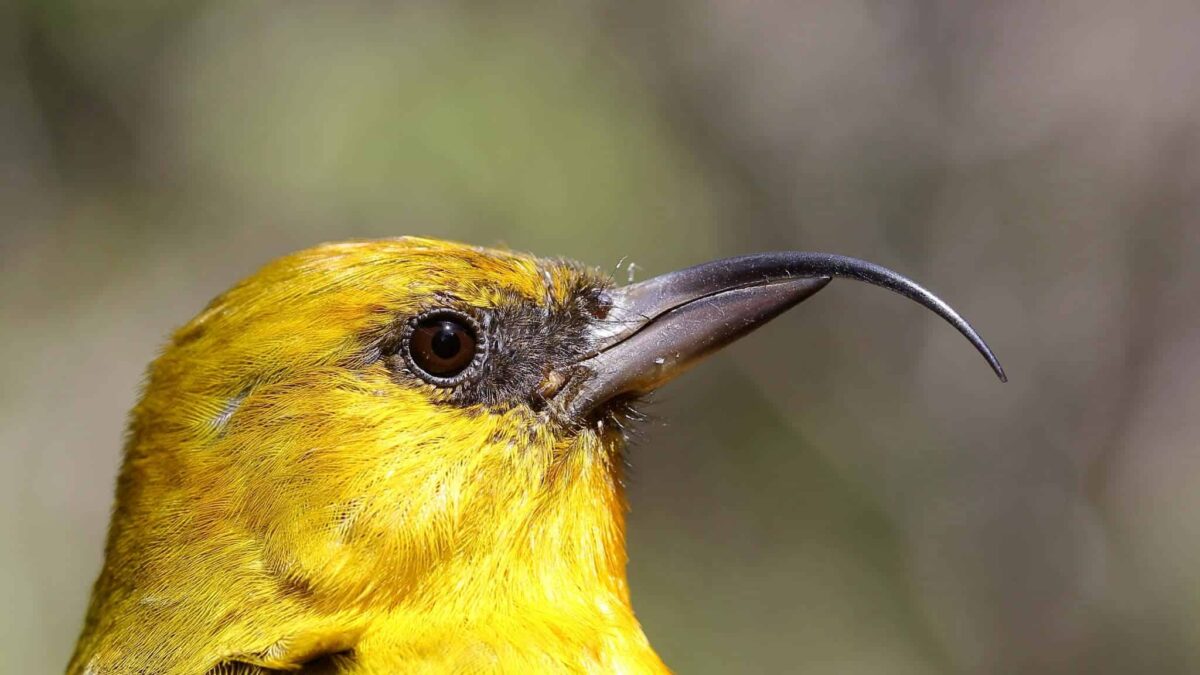
Akiapolaau, Digi Mart USA News: On Hawaii lives a small yellow bird that somewhat resembles a woodpecker when it searches for food: the akiapolaau. The bird chisels holes into branches and pries insects out of them.
It does this with a beak that appears to belong to two different birds. New research shows, however, that its unusual beak is only part of the story: the rest of its body plays an important role as well.
The study was published in the journal Ornithology.
The akiapolaau has a beak that can fairly be called a Swiss Army knife. Its two halves look very different and each has its own job.
The lower bill is short, thick and sturdy, and the bird uses it to chisel small holes in wood. The upper bill is long, thin and flexible, ideal for prying larvae and caterpillars out of narrow openings.
Scientists had long known how the akiapolaau obtains its food, but how the bird uses its body in the process was not clear. To find out, Alexander Clark and his colleagues examined the structure of its skeleton.
They studied old museum specimens from the collections of three American museums, including the Field Museum. They looked at the beak, the leg bones and the places where muscles attach.
They also compared the bird with related species on the mainland and with woodpeckers.
The ankles produced a surprising discovery. The researchers found that the akiapolaau has an unusually large tendon that helps flex its ankle.
This allows the bird to move its body quickly and forcefully downward. That movement helps it strike the wood with its lower bill.
This differs from woodpeckers, which rely mainly on their neck muscles when hammering. The akiapolaau instead draws considerable force from its legs and uses the weight and motion of its whole body.
“It’s like swinging an axe to split a block of wood: you put your whole body into it,” Clark explains. The bird first rises slightly and then moves forcefully downward.
The motion begins in its legs.
The bird’s upper thighs are also notable. They are relatively short and sturdy compared with those of related mainland birds.
Because of these thighs, the bird can keep its center of gravity close to the branch on which it perches, helping it stay steady while chiselling. The bird appears to pay a price for this: the akiapolaau also has proportionally shorter wings than its relatives.
The researchers also noticed something striking about the upper bill. The bone within the bill is much shorter than the outer shell of the bill.
This may explain why the long upper bill can bend in certain places, which is useful when the bird tries to pull insects from small holes.
Together, these findings show that not only the beak but the entire body of the akiapolaau is adapted to its distinctive way of foraging. “We knew what they were doing, but not exactly how their bodies made those movements possible,” Clark says.
“Now we have a fairly good picture of that.”
The discovery highlights how unusual evolution has been in Hawaii. The islands are highly isolated, allowing many animals to develop in their own way.
As a result, some species have traits found nowhere else. The akiapolaau is a good example.
According to co-researcher Paul Banko, competition for food likely played an important role in the development of these specialized adaptations. Banko said: “On the Hawaiian islands, different bird species had to compete for the same food, such as caterpillars.
That competition may have pushed birds to keep developing new ways of getting food.”
The researchers stress that their discovery also has a sad side. The akiapolaau is seriously endangered.
It is estimated that fewer than 2,000 individuals remain in the wild. All of them live on the same northeastern mountain slope on the island of Hawaii.
The akiapolaau is unfortunately not the only species this vulnerable; Hawaii is home to many animals found nowhere else on Earth. At the same time, more and more native species are disappearing.
For local biodiversity the outlook is poor: for decades, a growing number of Hawaiian animal species have gone extinct each year.
For Clark, this makes the research especially important. For extinct birds, scientists can often only try to understand how they lived based on fossils.
With the akiapolaau, they can still observe the behavior firsthand. Clark says: “What makes losing species so sad in Hawaii is that they disappear completely, because they don’t occur anywhere else.
You are then also talking about the complete loss of the song and behavior of birds, for example.” Clark therefore believes it is important to protect the species while there is still time.