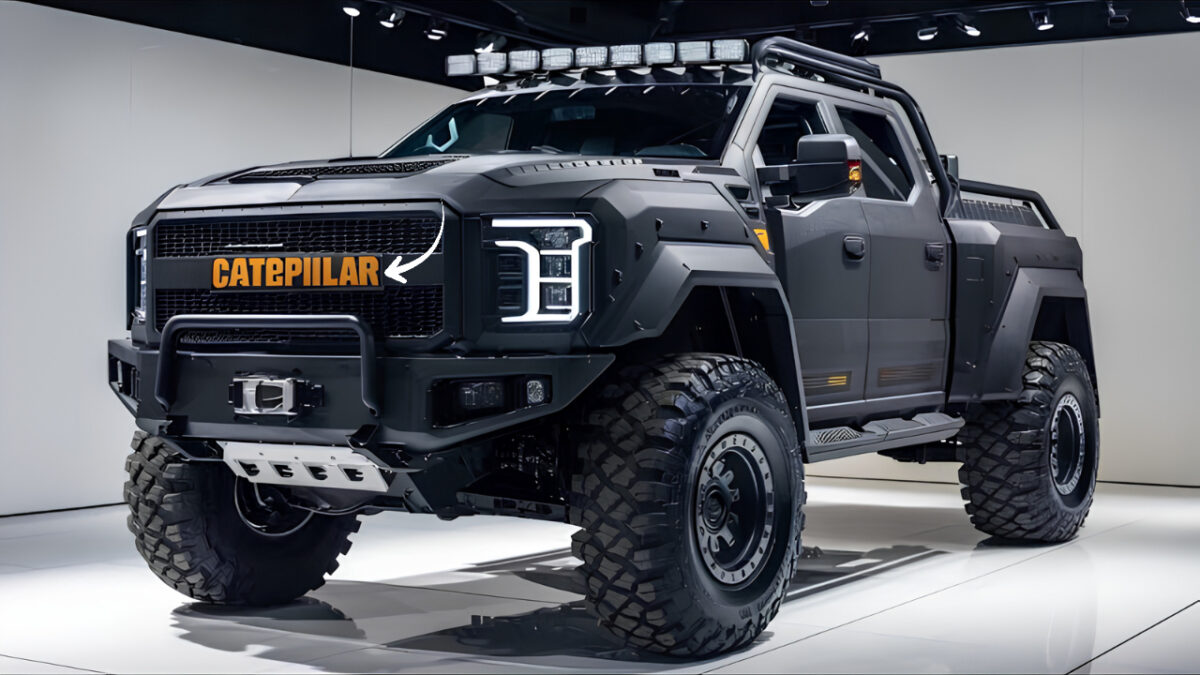
2026 Caterpillar Pickup Truck : The reveal transformed an internet talking point into a physical vehicle, although not the production pickup many fans imagined.
That distinction matters. This is not a newly announced showroom model or a confirmed challenger to established American pickups. Instead, Caterpillar used a Ford Super Duty as the foundation for a technology demonstrator aimed at construction professionals.
Its purpose reaches beyond bold styling: showing how a work truck could become a connected command center.
How an Internet Rumor Became Real
The story began in late 2024, when AI-generated pictures of a Caterpillar pickup circulated online. Their oversized proportions and industrial appearance attracted attention from people already familiar with the company’s construction equipment. What started as fictional imagery soon produced genuine questions about whether Caterpillar might build such a vehicle.
Caterpillar noticed that enthusiasm. According to reporting surrounding the reveal, the company received thousands of messages from customers and contractors interested in the idea.
Rather than simply dismiss the pictures, it explored what a useful Cat-branded pickup could offer. The resulting concept reflects that conversation, but its emphasis is practical technology rather than a completely new truck platform.
Ford Foundations Beneath Cat Branding
Underneath the Caterpillar identity sits a Ford Super Duty, not a pickup engineered entirely by Caterpillar. That makes the concept different from the clean-sheet vehicle suggested by some earlier online illustrations. It is an existing heavy-duty truck adapted to demonstrate another company’s approach to jobsite operations.
Visually, Cat branding, yellow accents, and exterior modifications give the vehicle its own character. The familiar construction-equipment identity is central to its appeal, particularly for contractors who associate the name with machines they use professionally.
Still, appearance should not obscure the engineering distinction: Caterpillar’s contribution centers on the concept’s integration and technology, rather than an independently developed production pickup.
A Mobile Office With Greater Awareness
The most interesting part of the truck is not its badge. Caterpillar has equipped the concept with an integrated display hub that brings together its AI Assistant, VisionLink productivity monitoring, and other connected systems. The intention is to make information easier to access from one location.
For an American construction supervisor, that idea has an obvious practical attraction. A pickup often serves as transportation, an office, and a meeting point throughout the working day.
Bringing equipment information into that space could help connect decisions made behind the wheel with activity elsewhere on a project. However, a demonstration of that approach is not proof of measured productivity improvements.
Safety Technology Takes Center Stage
Caterpillar also highlighted Detect camera technology designed to identify situations where personnel are too close to machinery. On a busy construction site, awareness around moving equipment is a serious concern.
The concept places that concern alongside the truck’s broader information systems rather than treating it as a separate feature.
Another component is a Driver Safety System intended to monitor fatigue. Together, these technologies show why Caterpillar presents the vehicle as more than a styling exercise.
Their significance lies in helping people recognize potential risks. They should not be interpreted as a promise that technology can eliminate accidents or replace trained operators, supervision, and established safety procedures.
A Drone Station Adds Another Dimension
A drone-launching station gives the concept one of its most distinctive features. Caterpillar described potential applications including site surveys and parts delivery, extending the truck’s role beyond ground-level transportation. It is an ambitious addition that fits the wider command-center theme.
The important word is potential. A show vehicle can illustrate how several technologies might work together without establishing that every proposed task is ready for routine use.
For readers following the story, the drone equipment is best understood as part of Caterpillar’s broader demonstration of connected operations, not evidence of a standard feature on an upcoming consumer truck.
What American Buyers Should Understand
Despite the attention, the Cat Truck remains a one-of-a-kind concept. Reporting on its introduction does not establish a production launch, an ordering process, or a nationwide retail rollout. Calling it a confirmed 2026 production pickup would therefore give readers the wrong impression.
The same caution applies to specifications circulating online. Details attached to fictional renderings should not be treated as official information about the real concept.
Buyers looking for verified towing ratings, payload figures, trim choices, or availability need a formal product announcement. Until then, the clearest description is a Ford-based Caterpillar technology demonstrator created for a major construction-industry event.
Why This Concept Still Matters 2026 Caterpillar Pickup Truck
The absence of a production announcement does not make the project meaningless. Caterpillar took a popular fantasy and redirected it toward a genuine workplace question: how can a pickup help people manage the equipment and activity surrounding it?
That is the lasting story behind the 2026 Caterpillar pickup truck. The concept offers something more grounded than the extravagant claims that helped make its name travel online.
It connects recognizable heavy-duty hardware with Caterpillar’s jobsite technology and presents a possible direction for professional work vehicles. For now, American enthusiasts have a real truck to examine, but not a new Caterpillar pickup to order.