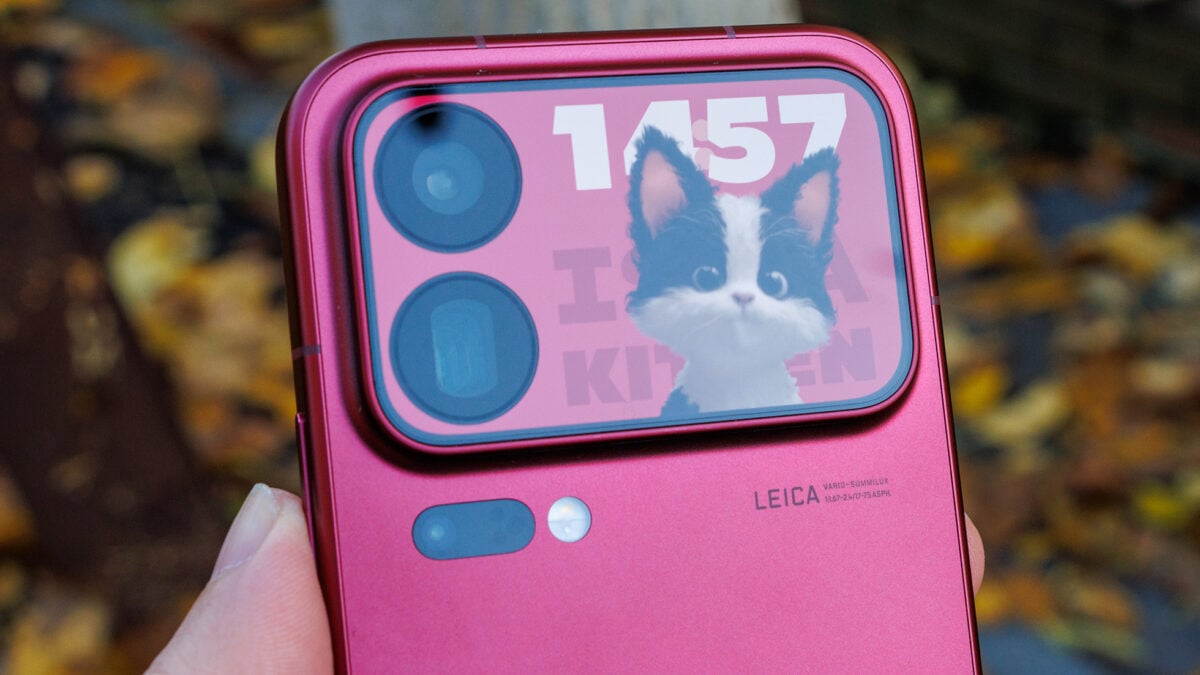
Xiaomi 18 Pro Max, Digi Mart USA News: Xiaomi is bringing its larger Pro model, the 18 Pro Max, to the global market for the first time, after the Xiaomi 17 Pro Max remained exclusive to China. According to a hands-on report from Notebookcheck, the phone keeps the distinctive secondary display on its back while improving camera hardware, performance and display technology.
Compared with the smaller Xiaomi 18 Pro, the Max model has a 6.9-inch main display instead of 6.4 inches, a 2.9-inch rear display instead of 2.7 inches, and a 7,050 mAh battery instead of 6,000 mAh. It also offers faster charging and the Snapdragon 8 Elite Extreme Gen 6. The three-speaker audio system and the LOFIC high-dynamic-range technology on the main camera are reserved for the Pro Max.
The review unit in Velvet Red measures 163.39 x 77.6 x 8.39 mm and weighs 229 grams, while the Cosmic Blue variant is slightly thicker and heavier at 8.47 mm and 234 grams. The report describes the build quality as excellent and the matte finish as premium, but notes that the phone’s considerable weight becomes noticeable when held.
The chassis is rated IP68 for dust and water resistance.
The rear display is a 2.9-inch LTPO AMOLED with a resolution of 976 x 596 pixels, an adaptive refresh rate of 1 to 120 Hz and a peak brightness of up to 4,000 cd/m², according to the manufacturer. It can show notifications, calls, music controls and selected live activities such as navigation instructions.
It can also act as a viewfinder for the rear cameras, support selfies and vlogs, and offer a teleprompter function. The phone can switch to the ultrawide camera automatically when it detects at least three people in a group selfie.
Xiaomi’s GenAI Apps let users create small applications for the secondary display from natural language prompts, and more than 50 prebuilt apps are included. The report notes that these generated apps are not full Android applications and cannot access the internet, other apps or personal data.
An AI interpreter uses both displays to show translations to conversation participants, with the international version set to support 29 languages.
The main 6.9-inch display is an M11 LTPO AMOLED with a resolution of 2,624 x 1,208 pixels and a 1 to 120 Hz refresh rate. Xiaomi claims a 20% efficiency improvement for the green emitter compared with the M10 generation.
The panel supports 12-bit color, HDR10+ and Dolby Vision.
The privacy display feature integrates two pixel types at a 1:1 ratio, with privacy pixels designed to direct light primarily forward. The report finds the effect disappointing in practice: the screen is clearer when viewed head-on, but a person sitting beside the user can still make out the content.
The reviewer judges the protection considerably less effective than that of the Samsung Galaxy S26 Ultra, which limits its usefulness on public transportation.
The camera system includes two 200 MP cameras and a 50 MP ultrawide camera. The main camera uses a 1/1.28-inch Light Fusion 960L sensor with an f/1.67 aperture and produces 12.5 MP images through 16-in-1 pixel binning.
Xiaomi claims a dynamic range of up to 16.2 stops with LOFIC technology, which cannot be combined with the 200 MP mode. The periscope camera uses a 1/1.56-inch Samsung HP5 sensor with 75 mm (3.2x) focal length, and its in-sensor zoom provides 150 and 300 mm equivalents.
The ultrawide camera has a 17 mm focal length and a 102-degree field of view.
In the sample photos, the report says natural colour reproduction and high dynamic range impress, and night photography is a particular strength, with low noise and a preserved nighttime atmosphere. Weaknesses appear when shooting toward light sources, where some ghosting and veiling glare reduce contrast.
The phone uses a 7,050 mAh dual-cell silicon-carbon battery, supports wired charging up to 100 watts and wireless charging up to 50 watts, and offers wired and wireless reverse charging.
The report concludes that the Xiaomi 18 Pro Max offers an impressive specification set and a more versatile rear display than expected, while the privacy display falls well short of the Galaxy S26 Ultra and the phone’s weight is noticeable in daily use. Notebookcheck says an in-depth review will follow to test camera hardware, the 2 nm SoC performance and battery life.