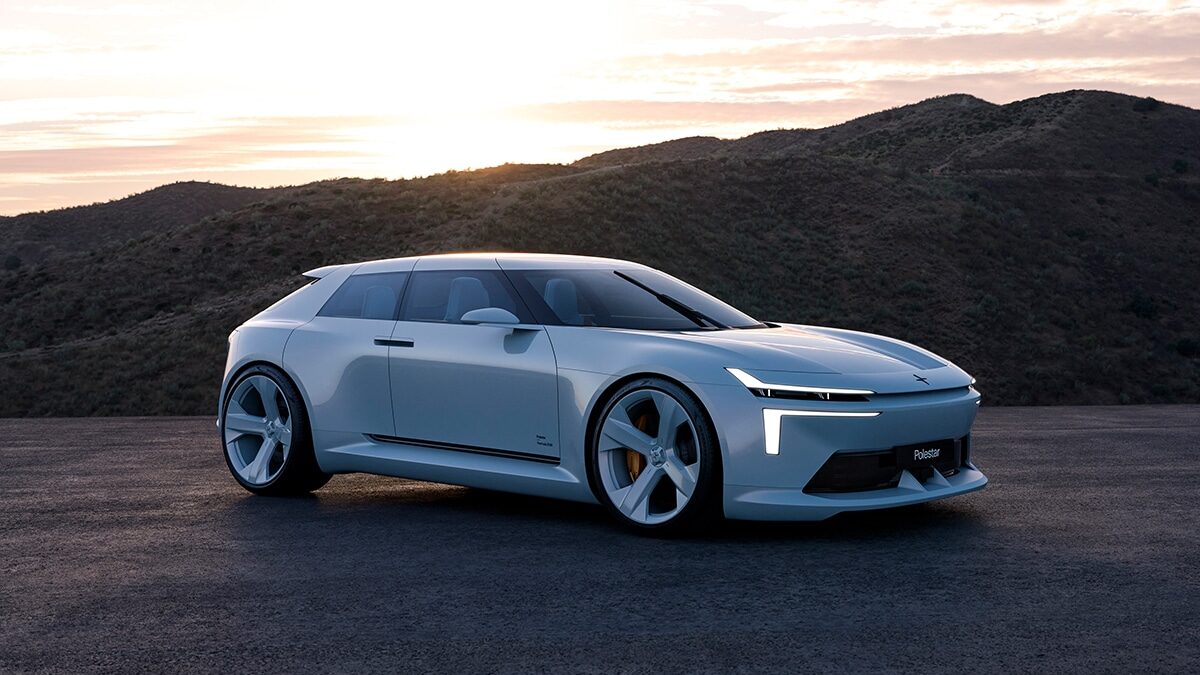
Polestar Formula 2030 concept car, Digi Mart USA News (Gothenburg, Sweden): Polestar has revealed the Formula 2030 concept car in Gothenburg, previewing a low-slung four-door electric sports car architecture developed under the direction of Head of Design Philipp Römers. The show car measures 1,350 mm in height with a wide 2,021 mm track.
The concept packages an all-electric dual-motor powertrain, exposed Öhlins suspension dampers, and Swedish Gold Brembo brake hardware within a lightweight bio-composite structure. Polestar describes the vehicle as a dedicated design study rather than a production model, created to establish future styling themes.
The concept introduces aerodynamic signatures intended for series production on the next-generation Polestar 2 in 2027 and the forthcoming Polestar 7 compact SUV in 2028. The 4,680 mm vehicle sits between those two models, adopting aero wing elements influenced by the Polestar 3 and low-slung packaging inspired by the Polestar 4.
“Design should always reflect the values and mission of a brand and that is exactly what we did with Polestar Formula 2030 concept. It is a physical embodiment of how we apply Polestar’s core values of design, performance and sustainability to the next production cars,” said Philipp Römers, Head of Design at Polestar.
The Formula 2030 uses a cab-rearward silhouette on a 2,780 mm wheelbase. Polestar’s Dual Blade headlights form a functional aero wing, previewing the front fascia planned for the next Polestar 2. Below this is a sharknose snout with a deep front splitter, and the rear replaces the brand’s continuous lightbar with thin Single Blade lighting units.
“We wanted to evolve, while respecting, the core design values we demonstrated with previous models that define the Polestar brand in such a recognisable way,” said Nahum Escobedo, Head of Exterior Design at Polestar.
Inside, the four-seat cabin uses physical mechatronic switchgear alongside a 12.2-inch Centre Screen Display. Eight customisable switches and rotary dials sit on the rising centre tunnel, and a 20-inch curved HyperDIM instrument display is mounted on the steering column.
Connected software runs Google built-in, using Google Gemini conversational AI for vehicle diagnostics and navigation commands. The four bucket seats feature air-inflatable cushions and bolsters that adjust lateral support.
“With the Formula 2030 concept, we’re reducing the unnecessary, distilling the experience to its very essence,” said Juan Pablo Bernal, Head of Interior Design at Polestar. “We introduce physical buttons and controls, and we believe we have achieved a tactile harmony suited for our premium positioning.”
The concept rolls on 22-inch four-spoke centre-lock wheels concealing Brembo calipers finished in Swedish Gold. Its structure relies on Bcomp natural flax-fibre composites and bio-based polypropylene weaves rather than virgin plastics, and a transparent boot floor displays the race-derived Öhlins dampers.
The bodywork uses a Nitrogen paint that shifts under natural light.
“With the Formula 2030 concept we knew we had to do something that stands out, but we had to do it in a true Polestar way,” said Maria Uggla, Head of Colour Material and Finishes at Polestar.
Polestar engineered the Formula 2030 strictly as a design study. The concept is not for sale and carries no price.
Elements including the Dual Blade aero-wing nose and Single Blade taillights are locked in for the next-generation Polestar 2 due in 2027, followed by the European-built Polestar 7 compact SUV in 2028. These vehicles support Polestar’s corporate targets to halve per-vehicle greenhouse gas emissions by 2030 and achieve full value-chain climate neutrality by 2040.
Polestar’s Formula 2030 concept, according to the source, previews its next production cars. Its aesthetic features are expected to reach Australian roads when the redesigned Polestar 2 launches locally next year.
Australian buyers currently considering the premium electric segment can access the recently introduced Polestar 4 SUV.