patient sees cat’s eyes in human faces after brain surgery, Digi Mart USA News: A recently published case study describes a 28-year-old man, known only as Karl, who began seeing features of his cat in human faces after brain surgery. According to the report in the journal Cortex, the eye swap also worked in reverse, with a familiar person’s eyes sometimes appearing on his cat’s face.
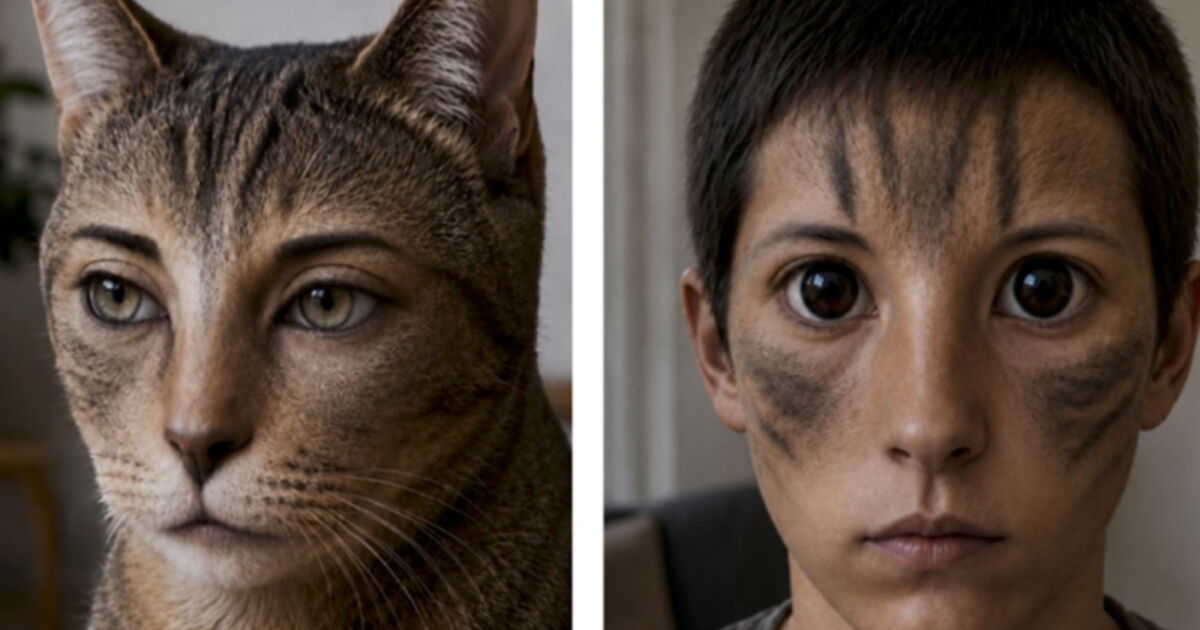
The study’s lead author, Brad Duchaine, a principal investigator of the Social Perception Lab at Dartmouth College, said the case demonstrates that individual features can be pulled from memory and influence ongoing perception. The researchers worked with Karl over months to develop AI-assisted images, refining them with his feedback until he judged them representative.
These images are reconstructions of remembered perceptions rather than direct recordings of vision.
Karl’s changes followed surgery to remove an arteriovenous malformation, an abnormal tangle of blood vessels, from his right posterior temporal region. According to a Dartmouth College press release, his gray tabby, Luna, is often the first face he sees in the morning, and on some days her almond-shaped eyes, large pupils and stripes appear on human faces, both in person and online.
The condition is described as a feature of palinopsia, in which something previously seen persists or returns to perception. Karl also appears to have prosopometamorphopsia, a rare condition that alters the appearance of faces, sometimes called “demon face syndrome.” Episodes often last hours and can continue throughout the day.
Karl recognizes the borrowed features, which the researchers say points to facial components being retrieved from his long-term visual memory of his cat or friends.
The authors note that other cases show how neurological injury can change face perception differently, including a 1986 case involving a woman who saw dog faces on bus passengers after a stroke, and a 2024 Lancet report of a man who saw distorted faces in person while photographs looked normal. The researchers say none of these cases alone explains how the brain produces such substitutions.