Hopcopter Hopping Flying Robot, Digi Mart USA News: Researchers are developing robots that can reach places difficult for humans to access, but existing designs each have limits. Wheeled and legged robots struggle on uneven ground, while flying drones cannot carry much weight.
The Hopcopter was designed to combine features of both approaches.
Developed by researchers from City University of Hong Kong and The Hong Kong University of Science and Technology, the Hopcopter is a quadcopter drone with a single spring-loaded leg. It is inspired by birds that hop between locations to save energy.
The robot can hop from spot to spot without using much battery, or stay airborne like a regular drone when no suitable landing place is available.
During a hop, the robot enters a free-fall state, and its four rotors engage briefly as it rises. According to the creators, this allows the Hopcopter to cover long distances using one-tenth the energy of a drone of the same size.
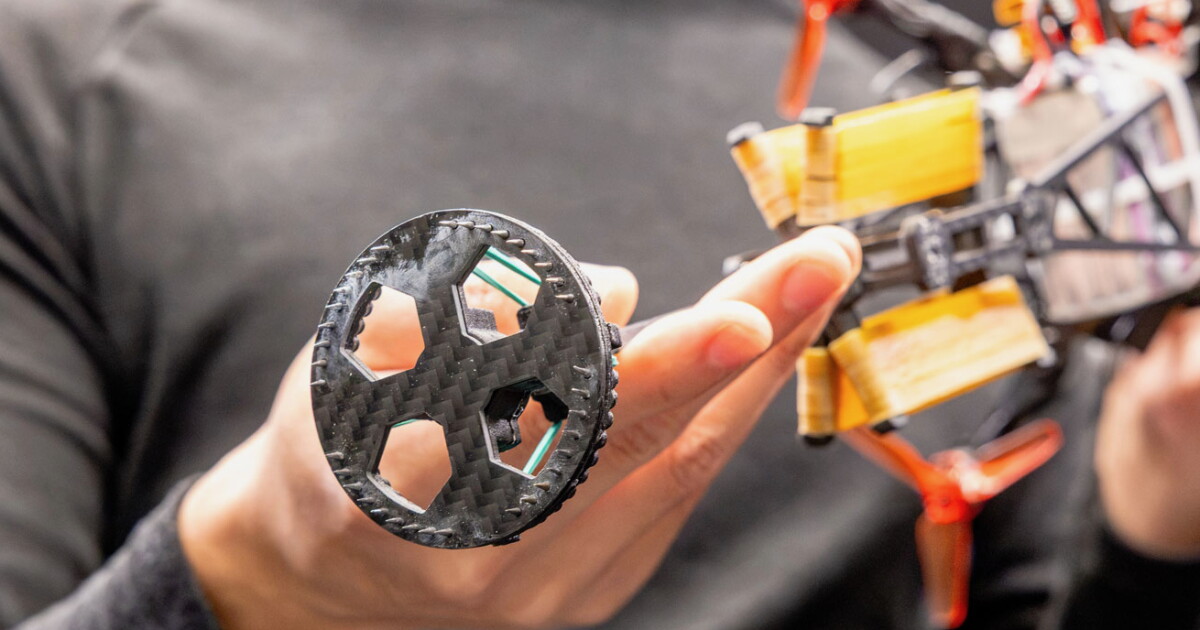
The first prototype could land on flat surfaces such as concrete or fine gravel, but it struggled on unpredictable terrain, sinking into sand, slipping on ice and often falling over on slopes. To address these problems, research partners at the University of Toronto developed a new flexible foot pad.
The wider foot pad distributes the robot’s weight more evenly to prevent sinking into soft soil or sand. Three rubber bands return the foot to position after landing to help restore balance, and short spikes on the underside help grip slippery surfaces.
According to the researchers, these changes reduced performance variation across different terrains by 84%.
Some of the creators are working on commercialising the technology, though a production version is not yet available for sale. A version with integrated AI modules for obstacle avoidance is also planned.
The research team hopes future versions could support search-and-rescue operations, inspections of remote mining sites and possibly exploration of other planets. A paper on the study was recently published in the journal Advanced Intelligent Systems.