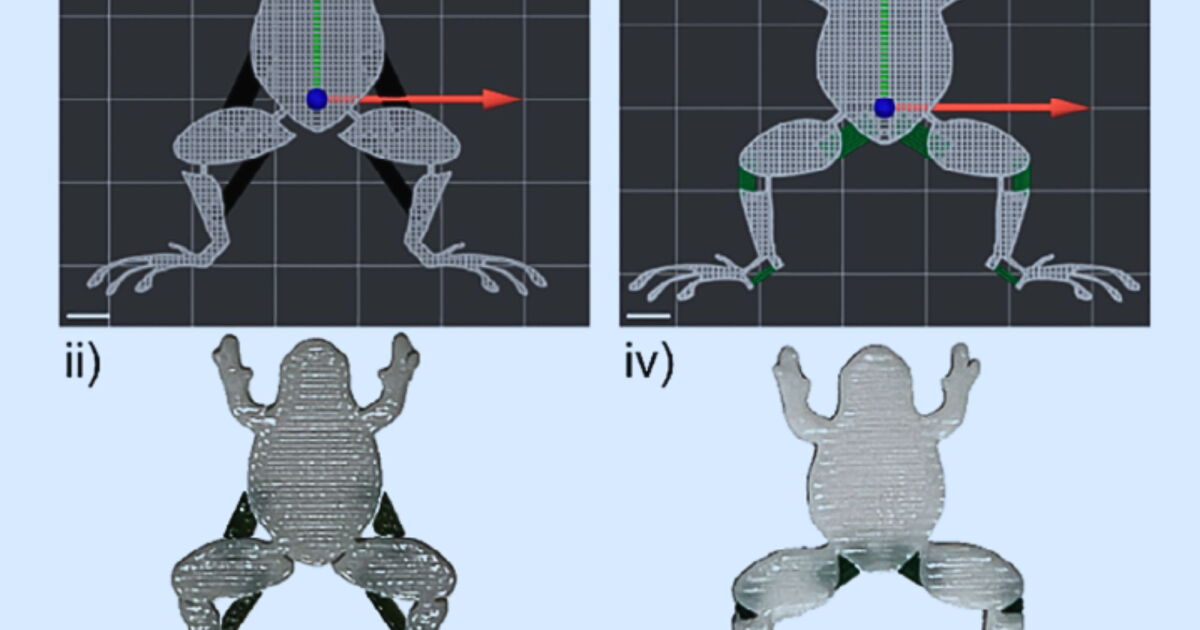
3D-printed light-powered frog robot swims using liquid crystal muscles, Digi Mart USA News (Denmark and Luxembourg research): A small frog-shaped robot, built by chemist Brigitte Städler and PhD student Cecilie Ryberg from Aarhus University in Denmark together with colleagues from the University of Luxembourg, is able to swim across water without a motor, battery or wires. The device weighs less than a gram.
According to the publisher’s report, the robot is propelled by a lamp that supplies flashes of pulsing near-infrared light onto six liquid crystal muscles attached to a pair of hind legs. Working together, the muscle strands moved the tiny swimmer about 80 millimeters (3.1 in) across the surface of a water bath, taking 1 minute 54 seconds on average, a speed of roughly 1.5 body lengths per minute.
The researchers say coordination was the main challenge. Städler said getting the six muscles to work together was difficult, noting that if they do not contract in a coordinated way, the frog will not swim forwards and may simply spin around.
The muscles and soft silicone body were printed in a single run, with the liquid-crystal elastomer ink pushed through a nozzle so its molecules aligned during printing.
Developing a printable ink that could flow through the nozzle, hold its shape and still move predictably proved difficult. Near-infrared light heats a dye in the material, which disrupts the polymer’s molecules, shortening the strips and contracting the muscle; as the strips cool, the muscle lengthens.
In an early design, the muscles pulled the legs inward and pushed water toward the head. The researchers changed muscle attachments and joint shape so the legs straightened and drove water backward.
The team notes that the frog needs light pulses evenly distributed to swim straight, and that water can draw heat away from its muscles. It suggests a steerable beam could eventually light one leg at a time to allow turning.
The publisher notes a separate MIT design earlier this year, a light-powered swimmer steered through a maze using engineered living muscle cells.
The publisher reports that the researchers see the printing method as potentially useful for small swimmers that could inspect flooded structures or carry sensors into shallow, cluttered waterways, and that the most immediate prospect is toys. The research was published in Advanced Materials Technologies.