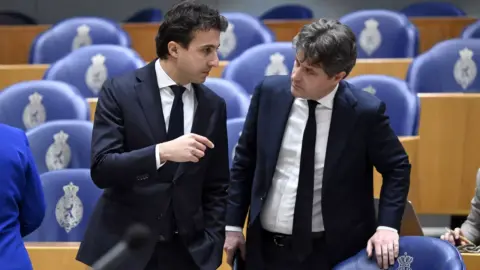
Merz links EU budget to Ukraine funding, Digi Mart USA News: Hungarian Prime Minister Peter Magyar said on Tuesday in the Chancellery in Berlin that he did not regard the move as blackmail, but made clear that he rejects what German Chancellor Friedrich Merz is attempting. Merz is seeking larger savings in the EU’s multiannual financial framework while expecting the burden of Ukraine aid to be shared more fairly among all EU member states.
Slovak Prime Minister Robert Fico was more blunt, accusing Merz of “blackmail” and saying in Bratislava that he would not give in. “We are a sovereign country,” Fico said, adding that Slovakia has its own view on the matter.
In a letter to European Council President António Costa, with European Commission President Ursula von der Leyen copied, Merz wrote that support for Ukraine is an indivisible responsibility shared by all. He argued that bilateral aid is unevenly distributed and provided largely by only a few member states, and he cited a Ukrainian financing gap of about 70 billion euros next year, of which about 45 billion euros falls to the EU.
Merz asked Costa to place the issue on the agenda of the informal EU Council meeting on Friday. He wrote that a joint commitment by all member states to make a fair contribution to closing the gap is an essential precondition for resolving the question and for discussing other issues with financial implications.
He also called for a solution covered by all member states that ensures a solid, multiyear financing outlook for Ukraine from 2028, including accrued interest obligations.
The linkage between the financial framework and Ukraine financing emerged at the European Council in mid-October. Costa has indicated he wants to handle both issues together, first at a special session at the end of November and then in mid-December, when a final agreement is to be reached.
The move is politically sensitive, since states that benefit strongly from EU cohesion funds would likely face cuts while Ukraine is set to receive additional money.
Hungary, Slovakia and the Czech Republic made clear in October that they do not want to be liable for a new loan to Kyiv, and Bulgaria is reported to have made similar demands internally. These countries benefit particularly from cohesion funds.
For the 90-billion-euro loan to Kyiv approved at the end of last year, then-Hungarian Prime Minister Viktor Orbán secured an exemption, which the Czech and Slovak leaders joined. Their countries agreed only on condition that they would not be liable for loan costs or repayment, and the loan was secured against headroom in the EU budget.
Merz’s preferred solution of using frozen Russian central bank assets had failed due to opposition from Belgium and other states. Because those reservations persist, a loan modeled on the 2025 arrangement is again under discussion.
Merz, however, now has his own leverage: no new financial framework can be adopted without Germany.