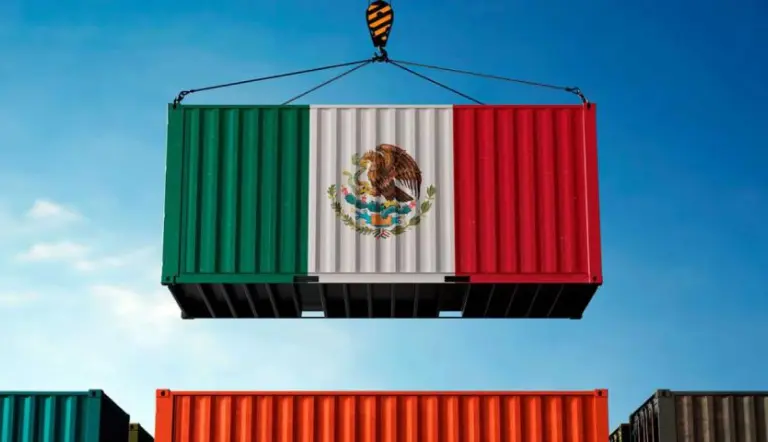
Mexico September 2026 exports, Digi Mart USA News: Mexican exports grew 37.9% year over year in September 2026, driven mainly by the manufacturing industry and demand for electronic products. The result strengthens Mexico’s presence in international trade, although it also highlights challenges in the country’s trade balance.
Mexico continues to expand its participation in international markets. In September 2026, the value of merchandise exports reached $77.797 billion, an annual increase of 37.9%, according to information from the National Institute of Statistics and Geography (INEGI).
The growth was mainly related to the strength of non-oil exports, particularly in sectors such as electronics, manufacturing and the production of industrial components. The results show Mexico’s importance as a supplier of goods to different markets, especially the United States, its main trading partner.
However, the rise in foreign sales was also accompanied by higher imports, which poses new challenges for strengthening competitiveness and the added value of domestic production.
According to the Mexico Merchandise Trade Balance report, non-oil exports grew 38.8% year over year in September, while oil exports rose 9.6%. Among the main factors explaining this trend is demand for manufactured products, which remains one of the drivers of Mexico’s foreign trade.
Manufacturing exports reached approximately $72.773 billion in September, with annual growth of 39%. This performance reflects Mexico’s integration into international production chains, where it participates in manufacturing and distributing goods used by different industries.
On a cumulative basis, Mexican exports totaled $627.194 billion between January and September 2026, an increase of approximately 30.4% compared with the same period of the previous year. The result confirms the relevance of foreign trade to national economic activity.
One of the most dynamic sectors in September was electrical and electronic equipment and apparatus. According to official figures, exports in this category grew 94.7% year over year, standing out above other manufacturing activities.
The trend was related to higher international demand for technology products, including computing equipment and components used in various industrial processes. Other sectors also reported increases.
Although the automotive industry remains relevant to Mexican exports, the growth of electronic products reflects diversification within manufacturing activity. This development opens opportunities for companies linked to technology, industrial components, logistics and specialized services.
The economic relationship between Mexico and the United States continues to play a decisive role in export performance. In September, non-oil exports to the U.S.
market rose 43.5% year over year, while those destined for the rest of the world grew 16.4%.
These figures reflect the importance of North American production integration and Mexico’s participation in supply chains that serve the U.S. market.
For Mexican companies, this relationship represents growth opportunities, particularly in industrial sectors that require specialized suppliers and production capacity.
However, the concentration of exports in a single market also implies risks related to regulatory changes, trade conditions and variations in international demand. In this context, diversifying destinations and strengthening domestic production remain relevant factors for business development.
Although foreign sales showed significant growth, imports also increased in September. According to INEGI, Mexico imported goods worth approximately $78.403 billion, an annual increase of 33.1%.
As a result, the trade balance recorded a deficit of $606 million during the month.
The increase in imports was driven mainly by purchases of intermediate goods used as inputs for industrial production. This reflects Mexico’s integration into international manufacturing chains, where many companies import components to transform, assemble or incorporate them into products destined for other markets.
Nevertheless, the report also underscores the importance of strengthening domestic supplier capacity to increase the added value of exported products.
Despite the monthly deficit, Mexico recorded a cumulative trade surplus of $9.254 billion between January and September 2026.
The increase in exports signals dynamism for businesses linked to international trade, manufacturing and logistics services. Greater demand for Mexican products may benefit suppliers, transport operators, technology companies and firms participating in supply chains.
It also presents opportunities to attract investment aimed at expanding productive capacity and developing industrial infrastructure.
However, export growth alone does not guarantee greater benefits for the entire economy. Its impact will depend on factors such as productivity, job creation, the national content of products and companies’ ability to compete internationally.
Looking toward the close of 2026, foreign trade performance will be tied to the evolution of U.S. demand, international economic conditions and the review process of the Agreement between Mexico, the United States and Canada (USMCA, known in Mexico as T-MEC).
September figures show that Mexico maintains an important position within global production chains. The next challenge will be converting this export momentum into greater investment, innovation and development opportunities for Mexican companies.