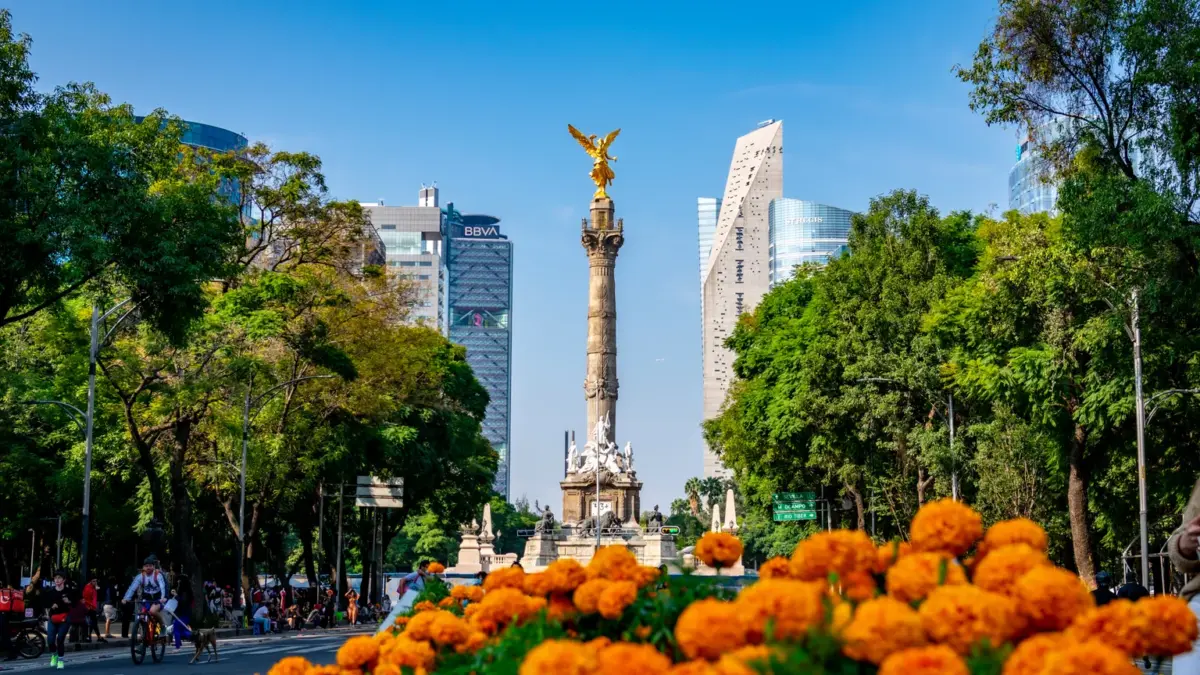
Día de Muertos, USA News (Mexico City): Long before the actual calendar date arrives, the celebrations in Mexico City are already underway. Beginning with a zombie march followed by a catrinas procession and a massive parade along Paseo de la Reforma—the capital’s most important avenue—the event witnesses the ongoing metamorphosis of a deeply popular tradition into a global cultural and tourist attraction.
Early cempasúchil marigolds, foreign visitors with painted catrín faces, and giant decorative skulls transform the illuminated avenue. The capital embraces surrounding changes, from the reclaiming of indigenous customs and the boom of catrinas to the influence of Halloween and films like James Bond’s Spectre and Disney’s Coco. Today, Día de Muertos stretches across a full month, encompassing roughly 5,000 activities that inject up to 12 billion pesos into the city.
The Growth of Processions and International Visitors
The catrina procession running from the Ángel de la Independencia to the Zócalo marked its thirteenth edition this past Sunday. Established by a collective of makeup artists alongside the city government, the project was designed to strengthen and preserve Día de Muertos at a time when Halloween was gaining ground in Mexico. Among the 20,000 attendees, American tourists Bob and Curtis made their way through the crowd, speaking in spanglish about their month-long journey across several states, driven primarily by their excitement for the holiday while repeating references to the movie Coco.
Floats and dancers from various states paraded in makeup, crowns, masks, and feathered headdresses, surrounded by hundreds of food stalls, coats, headbands, and makeup artists. While most faces emulated the traditional catrinas of José Guadalupe Posada, witches, clowns, and animated characters also appeared alongside fake blood-splattered zombies wielding toy saws. Local vendors, such as Esmeralda who travels from the State of Mexico to sell corn snacks in the capital, noted the growing influx of international visitors over the years.
Tourism Packages and Cinematic Influence
Experiencing the holiday weekend in the capital can cost foreign tourists up to 10,000 pesos through specialized operators like Journey Mexico, which offers private museum tours, visits to artistic altars in Coyoacán and San Ángel, and a candlelit cemetery trip in Mixquic, with optional beach extensions available for an additional 14,000 pesos. Airbnb experiences such as baking pan de muerto or riding a trajinera boat in Xochimilco also draw substantial interest.
A major catalyst for the modern spectacle was the 2015 James Bond film Spectre, which featured a fictionalized parade that the government subsequently turned into an annual reality. Veka Duncan, author of a recently published book on the history of Día de Muertos, explains that current festivities combine colonial Catholicism with pre-Hispanic cosmovision, noting that much of what is considered traditional is a relatively recent invention shaped by political and social shifts, including nineteenth-century civil cemeteries and revolutionary nationalism.
Reflections on Tradition and Commercialization
Dr. María Angélica Galicia Gordillo of UNAM’s Anthropological Research Institute highlights that how Mexicans understand death unifies them, adapting to religious, cultural, and economic contexts. However, she laments the decline of essential community practices like large-scale food preparation, criticizing foreign romanticization in media while acknowledging that the popularization of the Catrina has helped push back against foreign Halloween tropes. At the same time, she warns that mass tourism primarily enriches businesses rather than local communities.
Despite debates over neutral-colored altars, pet remembrance days on October 27, and overlap with the Formula 1 Grand Prix weekend—which draws additional global visitors and generates up to 21 billion pesos—scholars emphasize that traditions must evolve. As Galicia Gordillo notes, a tradition that undergoes no changes ultimately dies, provided people remember that celebrating death in Mexico remains fundamentally about honoring the connection with ancestors.